• Fri frakt över 249 kr
  • •
  • Snabba leveranser
  • •
  • Billiga böcker
Kundservice

Du är på sajten för privatpersoner.

Företag, bibliotek eller offentlig verksamhet?

Du handlar på classic.bokus.com, där alla dina funktioner finns intakta.
Till classic.bokus.com
Bokus logotyp. Gå till startsidan.
  • Erbjudanden
  • Nyheter
  • Student
  • Topplistor
  • Barn & ungdom
  • Bokus Play
  • E-böcker
  • Pocketböcker
  • Spel & pussel

10% rabatt på allt med kod: NYSTART10 →

Sidfot

Mina sidor

    Hjälp

    • Kundservice
    • Vanliga frågor och svar
    • Frakt och leverans
    • Retur vid ångerrätt
    • Reklamera vara
    • Betalning
    • Köpvillkor
    • Allmänna villkor
    • Information om webbplatsens tillgänglighet

    Om Bokus

    • Om oss
    • Pressrum
    • För studenter
    • För företag
    • För bibliotek och offentlig verksamhet
    • För leverantörer
    • Hållbarhet

    Populärt

    • Aktuella erbjudanden
    • Presentkort
    • Studentlitteratur
    • Nya böcker
    • Topplistor
    • Signerade böcker
    • Engelska böcker

    Inspiration

    • Boktips
    • BookTok
    • Populära bokserier
    • Barnbokskaraktärer
    • Populära författare
    Logotyp för Bokus
    Följ oss på Facebook (extern länk)Följ oss på Instagram (extern länk)Följ oss på YouTube (extern länk)Följ oss på TikTok (extern länk)
    bokus @ CookiesAnpassa cookiesIntegritetspolicyKöpvillkor
    Till Citymail hemsida (extern länk)Till Budbee hemsida (extern länk)Till Postnord hemsida (extern länk)Till Schenker hemsida (extern länk)Till Early Bird hemsida (extern länk)Till Walleys hemsida (extern länk)
    1. Data och IT
    2. Systemvetenskap och AI

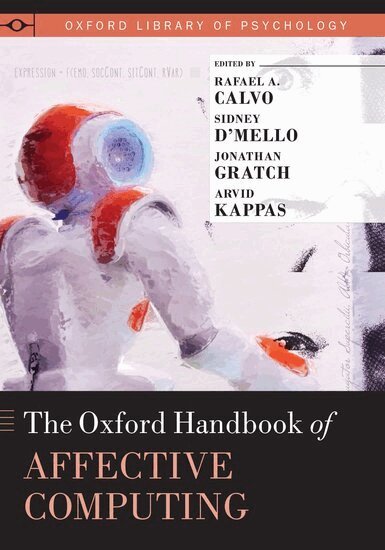
    The Oxford Handbook of Affective Computing

    AvCALVO,Rafael A. Calvo

    Inbunden, Engelska, 2015

    Del i serien Oxford Library of Psychology

    3 005 kr

    Beställningsvara. Skickas inom 5-8 vardagar. Fri frakt över 249 kr.

    Beskrivning

    Affective Computing is a growing multidisciplinary field encompassing computer science, engineering, psychology, education, neuroscience, and many other disciplines. It explores how affective factors influence interactions between humans and technology, how affect sensing and affect generation techniques can inform our understanding of human affect, and on the design, implementation, and evaluation of systems that intricately involve affect at their core. The Oxford Handbook of Affective Computing will help both new and experienced researchers identify trends, concepts, methodologies, and applications in this burgeouning field. The volume features 41 chapters divided into five main sections: history and theory, detection, generation, methodologies, and applications. Section One begins with a look at the makings of AC and a historical review of the science of emotion. Chapters discuss the theoretical underpinnings of AC from an interdisciplinary perspective involving the affective, cognitive, social, media, and brain sciences. Section Two focuses on affect detection or affect recognition, which is one of the most commonly investigated areas in AC. Section Three examines aspects of affect generation including the synthesis of emotion and its expression via facial features, speech, postures and gestures. Cultural issues in affect generation are also discussed. Section Four features chapters on methodological issues in AC research, including data collection techniques, multimodal affect databases, emotion representation formats, crowdsourcing techniques, machine learning approaches, affect elicitation techniques, useful AC tools, and ethical issues in AC. Finally, Section Five highlights existing and future applications of AC in domains such as formal and informal learning, games, robotics, virtual reality, autism research, healthcare, cyberpsychology, music, deception, reflective writing, and cyberpsychology.With chapters authored by world leaders in each area, The Oxford Handbook of Affective Computing is suitable for use as a textbook in undergraduate or graduate courses in AC, and will serve as a valuable resource for students, researchers, and practitioners across the globe.

    Produktinformation

    • Utgivningsdatum:2015-01-15
    • Mått:254 x 183 x 35 mm
    • Vikt:1 297 g
    • Format:Inbunden
    • Språk:Engelska
    • Serie:Oxford Library of Psychology
    • Antal sidor:624
    • Förlag:OUP USA
    • ISBN:9780199942237

    Utforska kategorier

    • Systemvetenskap och AI inom Data och IT
    • Naturvetenskap:allmänt inom Naturvetenskap och teknik
    • Kognitiv psykologi inom Psykologi och pedagogik

    Mer om författaren

    Rafael A. Calvo, Associate Professor of Software Engineering, University of Sydney; Sidney D'Mello, Assistant Professor of Computer Science and Psychology, University of Notre Dame; Jonathan Gratch, Research Associate Professor of Computer Science, University of Southern California; Arvid Kappas, Professor of Psychology, Jacobs University, Bremen, Germany.

    Recensioner i media

    This excellent book covers the topic of affective computing well. Weighted Numerical Score: 98 - 5 Stars!

    Innehållsförteckning

    • 1. Introduction to Affective Computing ; Rafael A. Calvo, Sidney K. D'Mello, Jonathan Gratch, and Arvid Kappas ; Section One: Theories and Models ; 2. The Promise of Affective Computing ; Rosalind W. Picard ; 3. A Short History of Psychological Perspectives of Emotion ; Rainer Reisenzein ; 4. Neuroscientific Perspectives of Emotion ; Andrew H. Kemp, Jonathan Krygier, and Eddie Harmon-Jones ; 5. Appraisal Models ; Jonathan Gratch and Stacy Marsella ; 6. Emotions in Interpersonal Life: Computer Mediation, Modeling, and Simulation ; Brian Parkinson ; 7. Social Signal Processing ; Maja Pantic and Alessandro Vinciarelli ; 8. Why and How to Build Emotion-Based Agent Architectures ; Christine Lisetti and Eva Hudlicka ; 9. Affect and Machines in the Media ; Despina Kakoudaki ; Section Two: Affect Detection ; 10. Automated Face Analysis for Affective Computing ; Jeff Cohn and Fernando De la Torre ; 11. Automatic Recognition of Affective Body Expressions ; Nadia Bianchi-Berthouze and Andrea Kleinsmith ; 12. Speech in Affective Computing ; Chi-Chun Lee, Jangwon Kim, Angeliki Metallinou, Carlos Busso, Sungbok Lee, and Shrikanth S. Narayanan ; 13. Affect Detection in Texts ; Carlo Strapparava and Rada Mihalcea ; 14. Physiological Sensing of Affect ; Jennifer Healey ; 15. Affective Brain-Computer Interfaces: Neuroscientific Approaches to Affect Detection ; Christian Muhl, Dirk Heylen, and Anton Nijholt ; 16. Interaction-Based Affect Detection in Educational Software ; Ryan Baker and Jaclyn Ocumpaugh ; 17. Multimodal Affect Detection for Naturalistic Human-Computer and Human-Robot Interactions ; Ginevra Castellano, Hatice Gunes, Christopher Peters, and Bjorn Schuller ; Section Three: Affect Generation ; 18. Facial Expressions of Emotions for Virtual Characters ; Magalie Ochs, Radoslaw Niewiadomski, and Catherine Pelachaud ; 19. Emotion Postures and Gestures ; Stacy Marsella ; 20. Emotional Speech Synthesis ; Felix Burkhardt and Nick Campbell ; 21. Emotion Modeling for Social Robots ; Ana Paiva, Iolanda Leite, and Tiago Ribeiro ; 22. Preparing Emotional Agents for Intercultural Communication ; Elisabeth Andre ; Section Four: Methodologies and Databases ; 23. Multimodal Databases: Collection, Challenges, and Chances ; Bjorn Schuller ; 24. Ethical Issues in Affective Computing (Research Studies and Outcomes) ; Roddy Cowie ; 25. Research and Development Tools in Affective Computing ; M. Sazzad Hussain, Sidney K. D'Mello, and Rafael A. Calvo ; 26. Emotion Data Collection and Its Implications for Affective Computing ; Shazia Afzal and Peter Robinson ; 27. Emotion Elicitation ; Jacqueline M. Kory and Sidney K. D'Mello ; 28. Crowdsourcing Techniques for Affective Computing ; Robert R. Morris and Daniel McDuff ; 29. Emotion Mark-Up Language ; Marc Schroder, Paolo Baggia, Felix Burkhardt, Catherine Pelachaud, Christian Peter, and Enrico Zovato ; 30. Machine Learning Techniques in Affective Computing ; Ashish Kapoor ; Section Five: Applications of Affective Computing ; 31. Feeling, Thinking, and Computing with Affect-Aware Learning Technologies ; Sidney K. D'Mello and Art C. Graesser ; 32. Enhancing Informal Learning Experiences with Affect-Aware Technology ; Chad Lane ; 33. Affect-Aware Reflective Writing Studios ; Rafael A. Calvo ; 34. Emotions and Games ; Georgios N. Yannakakis and Ana Paiva ; 35. Autonomous Closed-Loop Biofeedback: An Introduction and a Melodious Application ; Egon L. van den Broek, Joris H. Janssen, and Joyce Westerink ; 36. Affect in Human-Robot Interaction ; Ronald Arkin and Lilia Moshkina ; 37. Virtual Reality and Collaboration ; Jakki Bailey and Jeremy Bailenson ; 38. Unobtrusive Deception Detection ; Aaron Elkins, Stefanos Zafeiriou, Judee Burgoon, and Maja Pantic ; 39. Affective Computing, Emotional Development, and Autism ; Daniel Messinger, Leticia Lobo Duvivier, Zachary Warren, Mohammad Mahoor, Jason Baker, Anne Warlaumont, and Paul Ruvolo ; 40. Relational Agents in Health Applications: Leveraging Affective Computing to Promote Healing and Wellness ; Timothy Bickmore ; 41. Cyberpsychology and Affective Computing ; Giuseppe Riva, Rafael A. Calvo, and Christine Lisetti ; Glossary ; Index