• Fri frakt över 249 kr
  • •
  • Snabba leveranser
  • •
  • Billiga böcker
Kundservice

Du är på sajten för privatpersoner.

Företag, bibliotek eller offentlig verksamhet?

Du handlar på classic.bokus.com, där alla dina funktioner finns intakta.
Till classic.bokus.com
Bokus logotyp. Gå till startsidan.
  • Erbjudanden
  • Nyheter
  • Student
  • Topplistor
  • Barn & ungdom
  • Bokus Play
  • E-böcker
  • Pocketböcker
  • Spel & pussel

10% rabatt på allt med kod: NYSTART10 →

Sidfot

Mina sidor

    Hjälp

    • Kundservice
    • Vanliga frågor och svar
    • Frakt och leverans
    • Retur vid ångerrätt
    • Reklamera vara
    • Betalning
    • Köpvillkor
    • Allmänna villkor
    • Information om webbplatsens tillgänglighet

    Om Bokus

    • Om oss
    • Pressrum
    • För studenter
    • För företag
    • För bibliotek och offentlig verksamhet
    • För leverantörer
    • Hållbarhet

    Populärt

    • Aktuella erbjudanden
    • Presentkort
    • Studentlitteratur
    • Nya böcker
    • Topplistor
    • Signerade böcker
    • Engelska böcker

    Inspiration

    • Boktips
    • BookTok
    • Populära bokserier
    • Barnbokskaraktärer
    • Populära författare
    Logotyp för Bokus
    Följ oss på Facebook (extern länk)Följ oss på Instagram (extern länk)Följ oss på YouTube (extern länk)Följ oss på TikTok (extern länk)
    bokus @ CookiesAnpassa cookiesIntegritetspolicyKöpvillkor
    Till Citymail hemsida (extern länk)Till Budbee hemsida (extern länk)Till Postnord hemsida (extern länk)Till Schenker hemsida (extern länk)Till Early Bird hemsida (extern länk)Till Walleys hemsida (extern länk)
    1. Filosofi och religion
    2. Filosofi
    3. Filosofiska discipliner

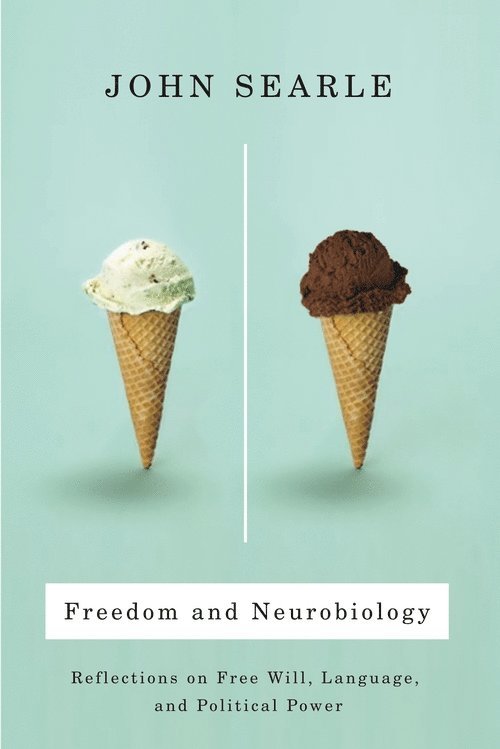
    Freedom and Neurobiology

    Reflections on Free Will, Language, and Political Power

    AvJohn Searle

    Inbunden, Engelska, 2006

    Del i serien Columbia Themes in Philosophy

    572 kr

    Tillfälligt slut

    Fler format och utgåvor

    Häftad

    170 kr

    E-bok

    244 kr

    Beskrivning

    Our self-conception derives mostly from our own experience. We believe ourselves to be conscious, rational, social, ethical, language-using, political agents who possess free will. Yet we know we exist in a universe that consists of mindless, meaningless, unfree, nonrational, brute physical particles. How can we resolve the conflict between these two visions? In Freedom and Neurobiology, the philosopher John Searle discusses the possibility of free will within the context of contemporary neurobiology. He begins by explaining the relationship between human reality and the more fundamental reality as described by physics and chemistry. Then he proposes a neurobiological resolution to the problem by demonstrating how various conceptions of free will have different consequences for the neurobiology of consciousness. In the second half of the book, Searle applies his theory of social reality to the problem of political power, explaining the role of language in the formation of our political reality.The institutional structures that organize, empower, and regulate our lives-money, property, marriage, government-consist in the assignment and collective acceptance of certain statuses to objects and people. Whether it is the president of the United States, a twenty-dollar bill, or private property, these entities perform functions as determined by their status in our institutional reality. Searle focuses on the political powers that exist within these systems of status functions and the way in which language constitutes them. Searle argues that consciousness and rationality are crucial to our existence and that they are the result of the biological evolution of our species. He addresses the problem of free will within the context of a neurobiological conception of consciousness and rationality, and he addresses the problem of political power within the context of this analysis. A clear and concise contribution to the free-will debate and the study of cognition, Freedom and Neurobiology is essential reading for students and scholars of the philosophy of mind.

    Produktinformation

    • Utgivningsdatum:2006-11-07
    • Mått:140 x 210 x 18 mm
    • Vikt:298 g
    • Format:Inbunden
    • Språk:Engelska
    • Serie:Columbia Themes in Philosophy
    • Antal sidor:128
    • Förlag:Columbia University Press
    • ISBN:9780231137522

    Utforska kategorier

    • Filosofiska discipliner inom Filosofi och religion
    • Kognitiv psykologi inom Psykologi och pedagogik

    Mer om författaren

    John Searle is Slusser Professor of Philosophy at the University of California, Berkeley. He is the author of sixteen books, including Speech Acts; Expression and Meaning; Intentionality; Minds, Brains, and Science; The Rediscovery of the Mind; The Construction of Social Reality; Rationality in Action; and Mind: An Introduction. His works have been translated into twenty-one languages, and in 2004, he was awarded the National Humanities Medal.

    Recensioner i media

    This book is a short but powerful presentation of views of the author... [it] includes interesting new arguments and is very useful... as an excellent and exceptionally clear summary of the free-will debate. -- Joelle Proust, director of research, Institut Jean-Nicod, Paris This small book speaks volumes. It shows why John Searle is the most widely read of philosophers of mind today and why he has a particularly large following among brain scientists. Searle here illustrates that he owes his success to two fundamental talents rare among philosophers. First, he is eminently readable. He is not simply interested in exposing his vast erudition but in explaining in straightforward entertaining prose what the issues of free will, language, and brain sciences are about. Second, Searle is eminently empirical. He does not see philosophy of mind as a rarefied discipline but one that is continuous with physics, biology, and brain science. Searle sees the task of philosophy as posing problems in precise enough terms to permit of an empirical, scientific solution. These two features are brilliantly in evidence in this marvelous book. But what makes these lectures particularly inviting for readers not yet addicted to Searle is that he provides here--for the first time--a broad introduction to the complete Searle. He combines in a thin volume the two major interests of his career: his early focus on language and his current focus on consciousness and free will. This is an irresistible treat for both the uninitiated and the cognoscenti. -- Eric Kandel, Nobel Laureate, Columbia University This engaging small volume serves as a token reminder of how masterfully Searle manages to combine philosophical innovation with clarity of prose. -- Constantine Sandis Metapsychology Clear and engaging. -- Randall J. Russac Science Books and Films Searle is a beacon of accessible expertise, a throwback to a time when philosophy was part of the public debate. -- David Papineau Times Literary Supplement [A] slim, elegantly written and intellectually rigorous volume. British Journal of Psychiatry A brief clearly articulated account by one the world's foremost philosophers. -- Henry Stapp Journal of Consciousness Studies Perhaps most importantly, it sets forth a suggestive vision of the systematic connections across various philosophical fields and avenues for their further exploration. -- Daniel K. Silber Philosophy in Review

    Innehållsförteckning

    • Introduction. Philosophy and the Basic Facts 1. Free Will as a Problem in Neurobiology 2. Social Ontology and Political Power Index