• Fri frakt över 249 kr
  • •
  • Snabba leveranser
  • •
  • Billiga böcker
Kundservice

Du är på sajten för privatpersoner.

Företag, bibliotek eller offentlig verksamhet?

Du handlar på classic.bokus.com, där alla dina funktioner finns intakta.
Till classic.bokus.com
Bokus logotyp. Gå till startsidan.
  • Erbjudanden
  • Nyheter
  • Student
  • Topplistor
  • Barn & ungdom
  • Bokus Play
  • E-böcker
  • Pocketböcker
  • Spel & pussel

10% rabatt på allt med kod: NYSTART10 →

Sidfot

Mina sidor

    Hjälp

    • Kundservice
    • Vanliga frågor och svar
    • Frakt och leverans
    • Retur vid ångerrätt
    • Reklamera vara
    • Betalning
    • Köpvillkor
    • Allmänna villkor
    • Information om webbplatsens tillgänglighet

    Om Bokus

    • Om oss
    • Pressrum
    • För studenter
    • För företag
    • För bibliotek och offentlig verksamhet
    • För leverantörer
    • Hållbarhet

    Populärt

    • Aktuella erbjudanden
    • Presentkort
    • Studentlitteratur
    • Nya böcker
    • Topplistor
    • Signerade böcker
    • Engelska böcker

    Inspiration

    • Boktips
    • BookTok
    • Populära bokserier
    • Barnbokskaraktärer
    • Populära författare
    Logotyp för Bokus
    Följ oss på Facebook (extern länk)Följ oss på Instagram (extern länk)Följ oss på YouTube (extern länk)Följ oss på TikTok (extern länk)
    bokus @ CookiesAnpassa cookiesIntegritetspolicyKöpvillkor
    Till Citymail hemsida (extern länk)Till Budbee hemsida (extern länk)Till Postnord hemsida (extern länk)Till Schenker hemsida (extern länk)Till Early Bird hemsida (extern länk)Till Walleys hemsida (extern länk)
    1. Samhälle och politik
    2. Politik och statsskick
    3. Centralt styre och förvaltning

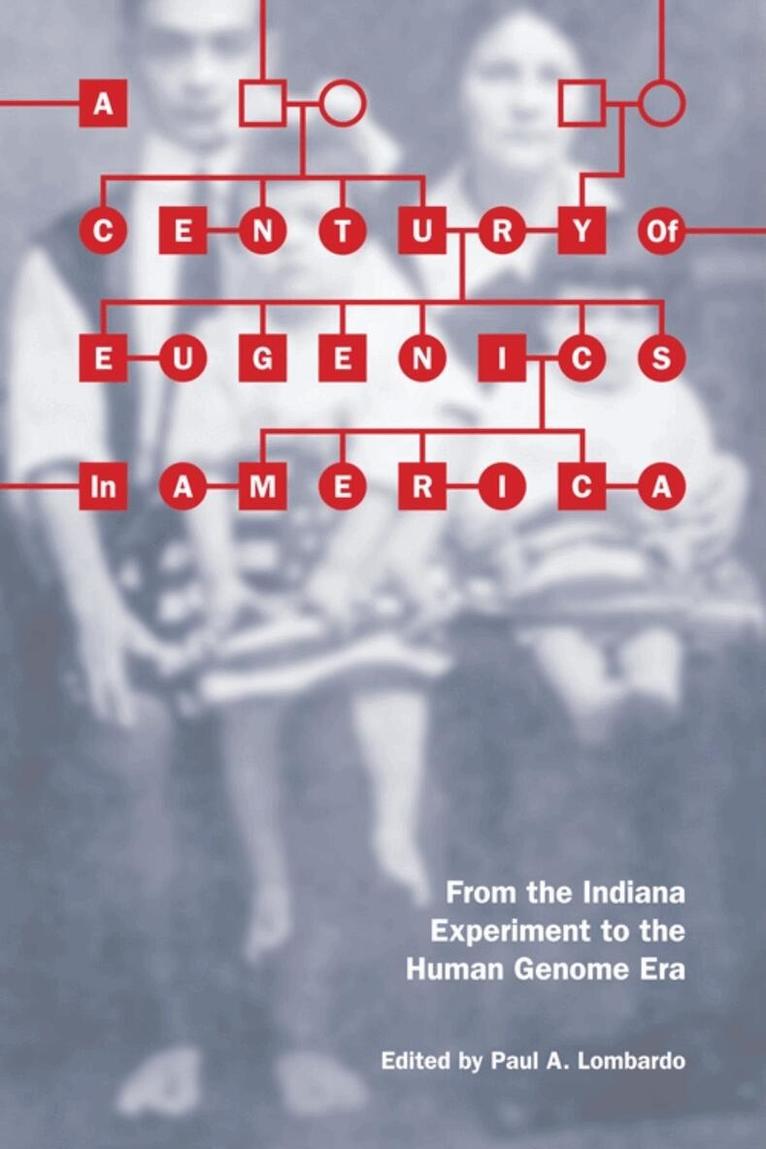
    Century of Eugenics in America

    From the Indiana Experiment to the Human Genome Era

    AvPaul A. Lombardo

    Häftad, Engelska, 2011

    Del i serien Bioethics and the Humanities

    281 kr

    Beställningsvara. Skickas inom 5-8 vardagar. Fri frakt över 249 kr.

    Beskrivning

    In 1907, Indiana passed the world's first involuntary sterilization law based on the theory of eugenics. In time, more than 30 states and a dozen foreign countries followed suit. Although the Indiana statute was later declared unconstitutional, other laws restricting immigration and regulating marriage on "eugenic" grounds were still in effect in the U.S. as late as the 1970s. A Century of Eugenics in America assesses the history of eugenics in the United States and its status in the age of the Human Genome Project. The essays explore the early support of compulsory sterilization by doctors and legislators; the implementation of eugenic schemes in Indiana, Georgia, California, Minnesota, North Carolina, and Alabama; the legal and social challenges to sterilization; and the prospects for a eugenics movement basing its claims on modern genetic science.

    Produktinformation

    • Utgivningsdatum:2011-01-06
    • Mått:150 x 226 x 23 mm
    • Vikt:400 g
    • Format:Häftad
    • Språk:Engelska
    • Serie:Bioethics and the Humanities
    • Antal sidor:268
    • Förlag:Indiana University Press
    • ISBN:9780253222695

    Utforska kategorier

    • Centralt styre och förvaltning inom Samhälle och politik
    • Sociologi inom Samhälle och politik
    • Etiska frågor och debatter inom Samhälle och politik

    Mer om författaren

    Paul A. Lombardo is Professor of Law at Georgia State University College of Law. He is author of Three Generations, No Imbeciles: Eugenics, the Supreme Court, and Buck v. Bell.

    Recensioner i media

    "As a nation with lofty ambitions, the United States has had a mixed relationship with eugenics. The first country to prohibit procreation by criminals and 'idiots' — in the state of Indiana in 1907 — today it embraces the Human Genome Project and the possibility of genetic enhancement. Law professor Paul Lombardo examines US legislation and attitudes to human selection in the past century, and the likelihood of such pressures arising again in modern genetics."—Nature, Vol. 469, January 12 2011"In 1907, Indiana became the first state to pass a sterilization law. The last sterilization of an Indiana resident took place in 1971. Thus, the state has the dubious honor of being the first and one of the last states to sterilize a US citizen forcibly in hopes of protecting the fit from the unfit. The subjects of this essay collection include the definitions of those two terms, the legality of the process, the culture that would rationalize such a procedure, and the uneasiness engendered in many persons by the neo-eugenic language used by supporters of the Human Genome Project. A noted historian of the eugenics movement, editor Lombardo (Georgia State Univ.) has divided this book into essays that focus upon the history of sterilization in Indiana; additional state studies, including California, which sterilized more persons than any other state; and two chapters that examine sterilization as portrayed in popular culture. The final two essays are perhaps the most important, as they look at the implications for contemporary medicine and law regarding the renewed interest in 'better breeding' as a result of the Human Genome Project. Summing Up: Recommended. All academic levels/libraries. —Choice"—D. O. Cullen, Collin College, October 2011"Valuable and welcome . . ."—BULLETIN HISTORY OF MEDICINE"[T]here are indeed valuable lessons to be learnt from . . . this book; the editor was probably wise to confine its scope to the narrower brief of American compulsory sterilisation . . . .Nov. 2011"—Human Genetics"Valuable and welcome . . .Vol. 85.4 Winter 2011"—BULLETIN HISTORY OF MEDICINE"A noted historian of the eugenics movement, editor Lombardo has divided this book into essays . . . The final two essays are perhaps the most important, as they look at the implications for contemporary medicine and law regarding the renewed interest in 'better breeding' as a result of the Human Genome Project. . . . Recommended.October 2011"—Choice"Paul Lombardo has assembled a compelling argument for close monitoring of modern genetic policies in the Human Genome Era . . . It is essential reading. April 20, 2011"—The Internet Review of Books"A groundbreaking achievement in the historiography of American eugenics."—Joanne Woiak, University of Washington"A most important volume and a significant contribution to the field, [the book] will serve both experts and the general public in parsing the difficult issues raised by a transformed eugenics in the 21st century."—Steven Selden, University of Maryland

    Innehållsförteckning

    • ContentsPreface and AcknowledgmentsIntroduction: Looking Back at Eugenics / Paul A. LombardoPart 1. The Indiana Origins of Eugenic Sterilization1. The Hoosier Connection: Compulsory Sterilization as Moral Hygiene / Elof Axel Carlson2. The Indiana Way of Eugenics: Sterilization Laws, 1907–74 / Jason S. LantzerPart 2. Eugenics and Popular Culture3. From Better Babies to the Bunglers: Eugenics on Tobacco Road / Paul A. Lombardo4. "Quality, Not Mere Quantity, Counts": Black Eugenics and the NAACP Baby Contests / Gregory Michael Dorr and Angela LoganPart 3. State Studies of Eugenic Sterilization5. From Legislation to Lived Experience: Eugenic Sterilization in California and Indiana, 1907–79 / Alexandra Minna Stern6. Eugenics and Social Welfare in New Deal Minnesota / Molly Ladd-Taylor7. Reassessing Eugenic Sterilization: The Case of North Carolina / Johanna Schoen8. Protection or Control? Women's Health, Sterilization Abuse, and Relf v. Weinberger / Gregory Michael DorrPart 4. Eugenics in the Human Genome Era9. Are We Entering a "Perfect Storm" for a Resurgence of Eugenics? Science, Medicine, and Their Social Context / Linda L. McCabe and Edward R. B. McCabe10. Modern Eugenics and the Law / Maxwell J. MehlmanList of ContributorsIndex