• Fri frakt över 249 kr
  • •
  • Snabba leveranser
  • •
  • Billiga böcker
Kundservice

Du är på sajten för privatpersoner.

Företag, bibliotek eller offentlig verksamhet?

Du handlar på classic.bokus.com, där alla dina funktioner finns intakta.
Till classic.bokus.com
Bokus logotyp. Gå till startsidan.
  • Erbjudanden
  • Nyheter
  • Student
  • Topplistor
  • Barn & ungdom
  • Bokus Play
  • E-böcker
  • Pocketböcker
  • Spel & pussel

10% rabatt på allt med kod: NYSTART10 →

Sidfot

Mina sidor

    Hjälp

    • Kundservice
    • Vanliga frågor och svar
    • Frakt och leverans
    • Retur vid ångerrätt
    • Reklamera vara
    • Betalning
    • Köpvillkor
    • Allmänna villkor
    • Information om webbplatsens tillgänglighet

    Om Bokus

    • Om oss
    • Pressrum
    • För studenter
    • För företag
    • För bibliotek och offentlig verksamhet
    • För leverantörer
    • Hållbarhet

    Populärt

    • Aktuella erbjudanden
    • Presentkort
    • Studentlitteratur
    • Nya böcker
    • Topplistor
    • Signerade böcker
    • Engelska böcker

    Inspiration

    • Boktips
    • BookTok
    • Populära bokserier
    • Barnbokskaraktärer
    • Populära författare
    Logotyp för Bokus
    Följ oss på Facebook (extern länk)Följ oss på Instagram (extern länk)Följ oss på YouTube (extern länk)Följ oss på TikTok (extern länk)
    bokus @ CookiesAnpassa cookiesIntegritetspolicyKöpvillkor
    Till Citymail hemsida (extern länk)Till Budbee hemsida (extern länk)Till Postnord hemsida (extern länk)Till Schenker hemsida (extern länk)Till Early Bird hemsida (extern länk)Till Walleys hemsida (extern länk)
    1. Samhälle och politik
    2. Samhälle och kultur
    3. Kultur och medier
    4. Kulturvetenskap

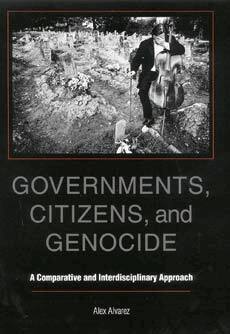
    Governments, Citizens, and Genocide

    A Comparative and Interdisciplinary Approach

    AvAlex Alvarez

    Inbunden, Engelska, 2001

    345 kr

    Beställningsvara. Skickas inom 5-8 vardagar. Fri frakt över 249 kr.

    Beskrivning

    Governments, Citizens, and GenocideA Comparative and Interdisciplinary ApproachAlex AlvarezA comprehensive analysis demonstrating how whole societies come to support the practice of genocide."Alex Alvarez has produced an exceptionally comprehensive and useful analysis of modern genocide . . . [It] is perhaps the most important interdisciplinary account to appear since Zygmunt Bauman's classic work, Modernity and the Holocaust."—Stephen Feinstein, Director, Center for Holocaust and Genocide Studies"Alex Alvarez has written a first-rate propaedeutic on the running sore of genocide. The singular merit of the work is its capacity to integrate a diverse literature in a fair-minded way and to take account of genocides in the post-Holocaust environment ranging from Cambodia to Serbia. The work reveals patterns of authoritarian continuities of repression and rule across cultures that merit serious and widespread public concern." —Irving Louis Horowitz, Rutgers UniversityMore people have been killed in 20th-century genocides than in all wars and revolutions in the same period. Recent events in countries such as Rwanda and the former Yugoslavia have drawn attention to the fact that genocide is a pressing contemporary problem, one that has involved the United States in varying negotiating and peace-keeping roles. Genocide is increasingly recognized as a threat to national and international security, as well as a source of tremendous human suffering and social devastation.Governments, Citizens, and Genocide views the crime of genocide through the lens of social science. It discusses the problem of defining genocide and then examines it from the levels of the state, the organization, and the individual. Alex Alvarez offers both a skillful synthesis of the existing literature on genocide and important new insights developed from the study of criminal behavior. He shows that governmental policies and institutions in genocidal states are designed to suppress the moral inhibitions of ordinary individuals.By linking different levels of analysis, and comparing a variety of cases, the study provides a much more complex understanding of genocide than have prior studies. Based on lessons drawn from his analysis, Alvarez offers an important discussion of the ways in which genocide might be anticipated and prevented.Alex Alvarez is Associate Professor in the Department of Criminal Justice at Northern Arizona University. His primary research interests are minorities, crime, and criminal justice, as well as collective and interpersonal violence. He is author of articles in Journal of Criminal Justice, Social Science History, and Sociological Imagination and is currently writing a book on patterns of American murder.April 2001240 pages, 6 1/8 x 9 1/4, bibl., indexcloth0-253-33849-2$29.95 s / £22.95ContentsThe Age of GenocideA Crime By Any Other NameDeadly RegimesLethal CogsAccommodating GenocideConfronting Genocide=

    Produktinformation

    • Utgivningsdatum:2001-02-22
    • Mått:156 x 235 x undefined mm
    • Vikt:522 g
    • Format:Inbunden
    • Språk:Engelska
    • Antal sidor:240
    • Förlag:Indiana University Press
    • ISBN:9780253338495

    Utforska kategorier

    • Kulturvetenskap inom Samhälle och politik
    • Folkmord och etnisk rensning inom Historia och arkeologi
    • Statsvetenskap och politisk teori inom Samhälle och politik

    Mer om författaren

    Alex Alvarez earned his Ph.D. in Sociology from the University of New Hampshire in 1991 and is currently an Associate Professor in the Department of Criminal Justice at Northern Arizona University. His primary areas of study have focused on minorities, crime, and criminal justice, as well as on collective and interpersonal violence. He has published on Native Americans, Latinos, and African Americans, fear of crime, sentencing, justifiable and criminal homicide, and genocide. He is currently writing a book on patterns of American murder.

    Recensioner i media

    "This is a disturbing account of a crime that has plagued humankind throughout recorded history. As Alvarez (criminal justice, Northern Arizona Univ.) notes, Genocides do not suddenly happen, nor are they precipitated by age-old animosity between groups. Rather, they are the result of conscious choices made by political and military leaders. The author then takes the reader on an excursion into the political, social, legal, and military justifications employed by governments in the 20th century to justify mass killings of essentially innocent human beings. He begins his investigation with the massacre of the Armenians in Turkey after WW I and ends with a discussion of the Balkan genocides in the 1990s. The author goes into meticulous detail about the Nazi and Imperial Japanese mass killings in WW II, Stalin's great purges of the Russian peasantry in the 1930s, and the Cambodian genocide by the Pol Pot regime in the 1970s. Alvarez maintains that nationalism and the concept of sovereignty are driving forces behind most acts of genocide. Academic collections.November 2001"—J. C. Watkins, Jr., University of Alabama

    Innehållsförteckning

    • Preliminary Table of Contents:IntroductionChapter 1. The Age of GenocideChapter 2. A Crime By Any Other NameChapter 3. Deadly RegimesChapter 4. Lethal CogsChapter 5. Accommodating GenocideChapter 6. Confronting Genocide