• Fri frakt över 249 kr
  • •
  • Snabba leveranser
  • •
  • Billiga böcker
Kundservice

Du är på sajten för privatpersoner.

Företag, bibliotek eller offentlig verksamhet?

Du handlar på classic.bokus.com, där alla dina funktioner finns intakta.
Till classic.bokus.com
Bokus logotyp. Gå till startsidan.
  • Erbjudanden
  • Nyheter
  • Student
  • Topplistor
  • Barn & ungdom
  • Bokus Play
  • E-böcker
  • Pocketböcker
  • Spel & pussel

10% rabatt på allt med kod NYSTART10 →

Sidfot

Mina sidor

    Hjälp

    • Kundservice
    • Vanliga frågor och svar
    • Frakt och leverans
    • Retur vid ångerrätt
    • Reklamera vara
    • Betalning
    • Köpvillkor
    • Allmänna villkor
    • Information om webbplatsens tillgänglighet

    Om Bokus

    • Om oss
    • Pressrum
    • För studenter
    • För företag
    • För bibliotek och offentlig verksamhet
    • För leverantörer
    • Hållbarhet

    Populärt

    • Aktuella erbjudanden
    • Presentkort
    • Studentlitteratur
    • Nya böcker
    • Topplistor
    • Signerade böcker
    • Engelska böcker

    Inspiration

    • Boktips
    • BookTok
    • Populära bokserier
    • Barnbokskaraktärer
    • Populära författare
    Logotyp för Bokus
    Följ oss på Facebook (extern länk)Följ oss på Instagram (extern länk)Följ oss på YouTube (extern länk)Följ oss på TikTok (extern länk)
    bokus @ CookiesAnpassa cookiesIntegritetspolicyKöpvillkor
    Till Citymail hemsida (extern länk)Till Budbee hemsida (extern länk)Till Postnord hemsida (extern länk)Till Schenker hemsida (extern länk)Till Early Bird hemsida (extern länk)Till Walleys hemsida (extern länk)
    1. Samhälle och politik
    2. Politik och statsskick
    3. Centralt styre och förvaltning

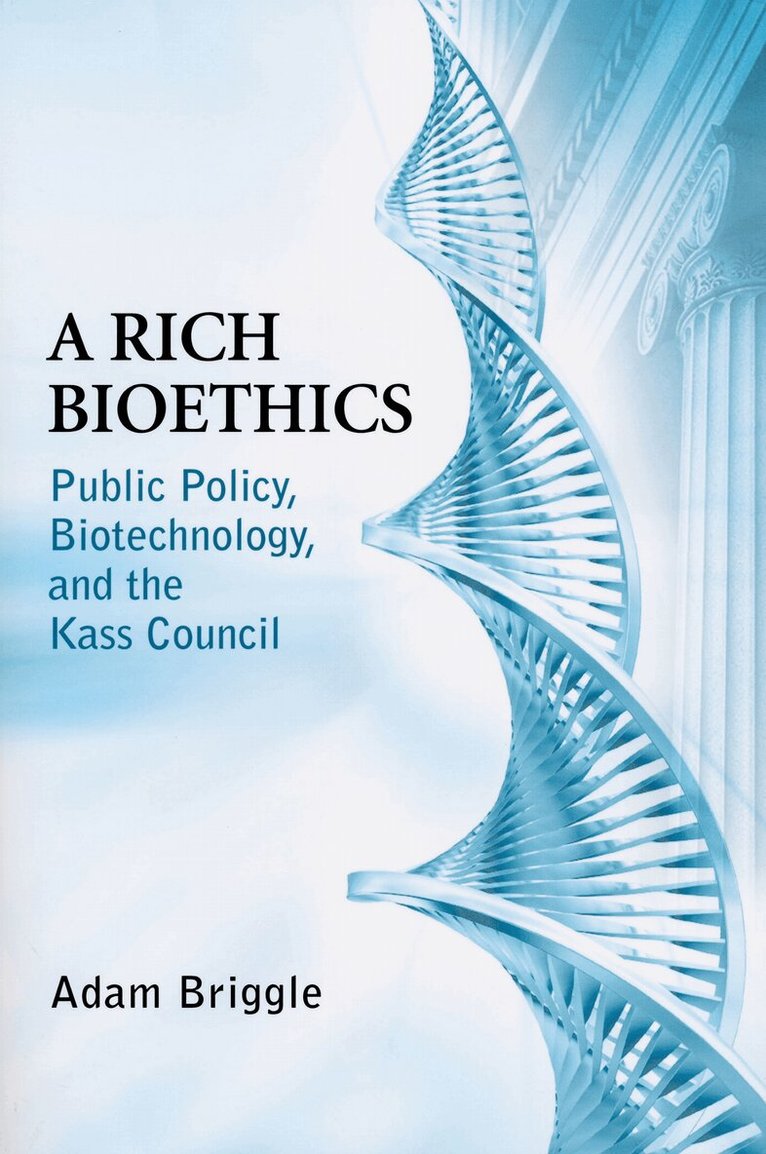
    Rich Bioethics

    Public Policy, Biotechnology, and the Kass Council

    AvAdam Briggle

    Häftad, Engelska, 2010

    318 kr

    Beställningsvara. Skickas inom 5-8 vardagar. Fri frakt över 249 kr.

    Fler format och utgåvor

    Inbunden

    858 kr

    Beskrivning

    Several presidents have created bioethics councils to advise their administrations on the importance, meaning and possible implementation or regulation of rapidly developing biomedical technologies. From 2001 to 2005, the President's Council on Bioethics, created by President George W. Bush, was under the leadership of Leon Kass. The Kass Council, as it was known, undertook what Adam Briggle describes as a more rich understanding of its task than that of previous councils. The council sought to understand what it means to advance human flourishing at the intersection of philosophy, politics, science, and technology within a democratic society. Briggle's survey of the history of U.S. public bioethics and advisory bioethics commissions, followed by an analysis of what constitutes a "rich" bioethics, forms the first part of the book. The second part treats the Kass Council as a case study of a federal institution that offered public, ethical advice within a highly polarized context, with the attendant charges of inappropriate politicization and policy irrelevance. The conclusion synthesizes the author's findings into a story about the possible relationships between philosophy and policy making. A Rich Bioethics: Public Policy, Biotechnology, and the Kass Council will attract students and scholars in bioethics and the fields of science, technology, and society, as well as those interested in the ethical and political dilemmas raised by modern science.

    Produktinformation

    • Utgivningsdatum:2010-06-15
    • Mått:152 x 229 x 12 mm
    • Vikt:319 g
    • Format:Häftad
    • Språk:Engelska
    • Antal sidor:230
    • Förlag:University of Notre Dame Press
    • ISBN:9780268022211

    Utforska kategorier

    • Centralt styre och förvaltning inom Samhälle och politik
    • Medicinsk etik och läkaretik inom Medicin
    • Filosofiska discipliner inom Filosofi och religion

    Mer om författaren

    Adam Briggle is assistant professor of philosophy at the University of North Texas.

    Recensioner i media

    "Adam Briggle has written a fine book on a complex, controversial topic. He shows the wisdom of the approach to bioethics taken by the Kass Council, sets right the unfair and often nasty attacks on the council and Kass himself, and offers a perceptive and wide-ranging look at the terrain of ethics." —Daniel Callahan, The Hastings Center"Briggle had an inspired idea to make the controversies surrounding Leon Kass's chairmanship of the President's Council on Bioethics (2001-5) his point of departure to argue the need for bioethics based in humanistic questioning rather than accepting the more restricted task of what he calls instrumental bioethics, which exists to offer specific policy guidelines. The issues are clear throughout but perhaps best crystallized near the end of the book, when Briggle presents criticisms that the Kass Council failed to be sufficiently policy oriented." —Science and Public Policy"In this book Dr. Briggle provides a sympathetic account of the President's Council on Bioethics led by Dr. Leon Kass. He shows the wisdom of the approach to bioethics taken by the Kass Council and corrects the unfair and often nasty attacks on the Council and Dr. Kass himself. It is a persuasive and thoughtful reconstruction of the Council's goals and rationale." —Law & Medicine"The Kass council's reports, even more than Kass's own work, became, in Adam Briggle's words, 'a lightning rod for political controversy.' In particular, the council attracted criticism from many that its membership had been stacked to reflect Bush's own conservative views and that it was insufficiently attentive to the existence of disagreement among its own members. In his brief and breezy A Rich Bioethics, Briggle (a philosopher at the University of North Texas) sets out to give an account of the council's fundamental conception of bioethics and to evaluate its performance against that conception." —Science"Anyone familiar with MacIntyre's narrative of decline and hoped-for renewal is likely to be struck by the similarities with this account of Adam Briggle's depiction of contemporary bioethics in A Rich Bioethics. In Briggle's view, bioethics is in disarray largely because it has succumbed to what he calls 'instrumentalism.' . . . there is much of value in Briggle's book. . . . it offers a model for public ethics committees that merits serious consideration." —Commonweal"Briggle offers the first book-length analysis of the council's work, setting it in a wider philosophical, historical, and political context. The book also discusses how the procedure for selecting council members led to accusations that it was ideologically narrow. The book's well-balanced analysis and close but fair readings of the council's documents show how the Kass Council dealt with differences and was far more tolerant of varying opinions than many think. This book would be a useful supplementary text in classes on bioethics and public policy." —Choice"A Rich Bioethics: Public Policy, Biotechnology, and the Kass Council . . . gives an account of the President's Council of Bioethics, led by Leon Kass from 2001-05, during President George W. Bush's administration." —Denton Record-Chronicle"This is the most persuasive and thoughtful reconstruction of the Kass Council's goals and rationale that I have seen. Adam Briggle's account of the notion of a 'richer' bioethics is comprehensive and well-reasoned." —Jonathan D. Moreno, University of Pennsylvania"What an eloquent, humane, and wise book. Briggle discovers an imperfect yet fascinating effort to bring the world of biomedical research into the domain of public philosophy. His scholarship and generosity make clear that a democratic society need not be morally shackled to the realm of the possible that science is constantly expanding." —Daniel Sarewitz, Consortium for Science, Policy, and Outcomes, Arizona State University"Adam Briggle has written a rich and sympathetic account of the President's Council on Bioethics led by Leon Kass. It puts in historical context the efforts of this council to move beyond the limited 'instrumentalist' approaches to bioethics taken by earlier commissions, toward a more philosophically serious effort to deliberate on the human goods put in play by modern biomedicine. In the process it answers many of the charges of politicization and corrects the record concerning the council's work." —Francis Fukuyama, The Johns Hopkins School of Advanced International Studies