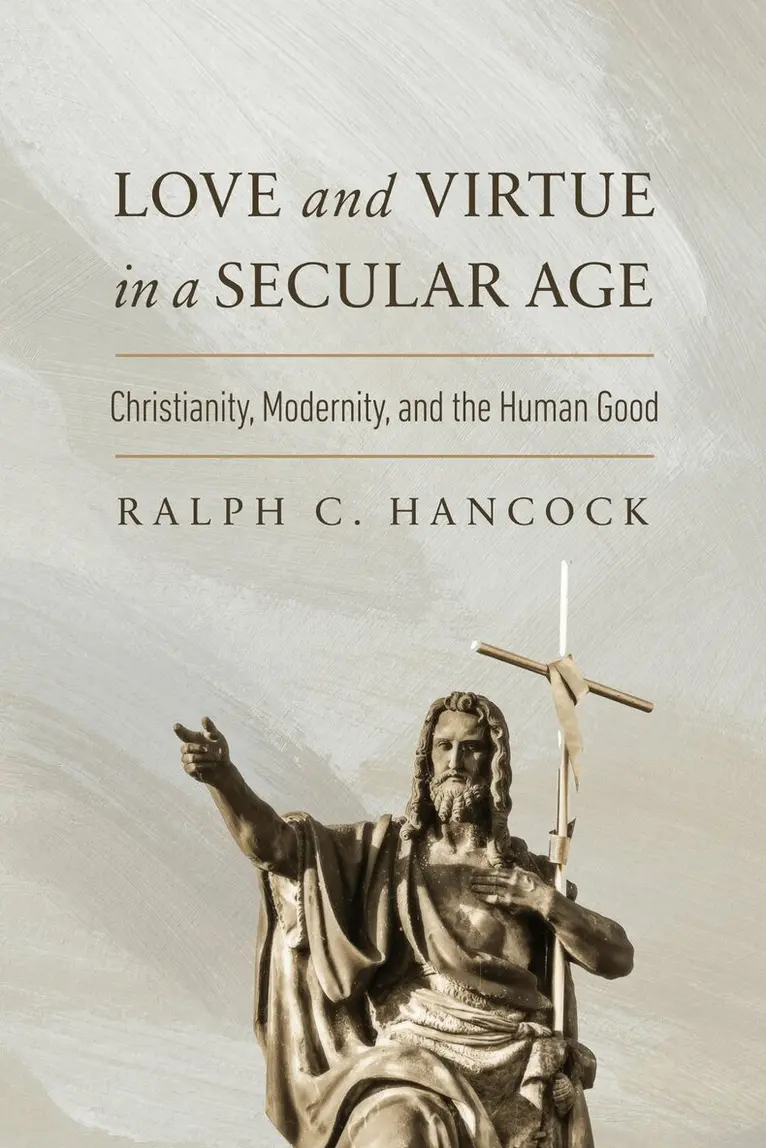
Inbunden, Engelska, 2026
Love and Virtue in a Secular Age
Christianity, Modernity, and the Human Good
Del i serien Beginning and the Beyond of Politics
1901 kr
Beställningsvara. Skickas inom 3-6 vardagar. Fri frakt över 249 kr.
Beskrivning
Produktinformation
- Utgivningsdatum: 2026-03-15
- Mått: 152 x 229 x 21 mm
- Vikt: 594 g
- Format: Inbunden
- Språk: Engelska
- Serie: Beginning and the Beyond of Politics
- Antal sidor: 338
- Förlag: University of Notre Dame Press
- ISBN: 9780268210861
Utforska kategorier
Mer om författaren
Ralph C. Hancock is a professor of political science at Brigham Young University, where he teaches political philosophy. He has authored, edited, or translated many books and articles on the interrelation of religion, morality, and politics, including authoring The Responsibility of Reason and translating Pierre Manent's Natural Law and Human Rights.
Recensioner i media
"Ralph Hancock has given himself a most intimidating task: to recover human agency, with its accompanying confidence in the primacy of the Good. He convincingly shows why our post-Christian souls, in order to understand themselves, need a full and accurate engagement with the Christian proposition. This book is a major achievement." —Pierre Manent, author of Natural Law and Human Rights and Challenging Modern Atheism and Indifference"Drawing on the best classical, Christian, and contemporary wisdom, Hancock brilliantly rescues Christian love from its thoughtless identification with mere sentimentality and shows that authentic virtue is inseparable from the proud cultivation of moral and political responsibility." —Daniel J. Mahoney, author of Recovering Politics, Civilization, and the Soul"Is pride the root of sin or a spur to virtue? With careful attention to Christian theology as well as political philosophy, Ralph Hancock guides the reader through this question and offers a bracing defense of political liberty against progressive humanitarianism." —James R. Stoner, author of Common-Law Liberty"It would be one thing for Hancock merely to anatomize the secular cult of victimhood. . . . But here Hancock goes further, engaging with thinkers from Aquinas and Tocqueville to Leo Strauss and Pierre Manent to point toward a 'practical ethics' for the postmodern age—one that prizes man's yearning for transcendence while respecting the quotidian, necessarily imperfect means of his getting there." —The New Criterion
Betyg & recensioner
0 recensioner
Inga recensioner tillgängliga.