• Fri frakt över 249 kr
  • •
  • Snabba leveranser
  • •
  • Billiga böcker
Kundservice

Du är på sajten för privatpersoner.

Företag, bibliotek eller offentlig verksamhet?

Du handlar på classic.bokus.com, där alla dina funktioner finns intakta.
Till classic.bokus.com
Bokus logotyp. Gå till startsidan.
  • Erbjudanden
  • Nyheter
  • Student
  • Topplistor
  • Barn & ungdom
  • Bokus Play
  • E-böcker
  • Pocketböcker
  • Spel & pussel

10% rabatt på allt med kod NYSTART10 →

Sidfot

Mina sidor

    Hjälp

    • Kundservice
    • Vanliga frågor och svar
    • Frakt och leverans
    • Retur vid ångerrätt
    • Reklamera vara
    • Betalning
    • Köpvillkor
    • Allmänna villkor
    • Information om webbplatsens tillgänglighet

    Om Bokus

    • Om oss
    • Pressrum
    • För studenter
    • För företag
    • För bibliotek och offentlig verksamhet
    • För leverantörer
    • Hållbarhet

    Populärt

    • Aktuella erbjudanden
    • Presentkort
    • Studentlitteratur
    • Nya böcker
    • Topplistor
    • Signerade böcker
    • Engelska böcker

    Inspiration

    • Boktips
    • BookTok
    • Populära bokserier
    • Barnbokskaraktärer
    • Populära författare
    Logotyp för Bokus
    Följ oss på Facebook (extern länk)Följ oss på Instagram (extern länk)Följ oss på YouTube (extern länk)Följ oss på TikTok (extern länk)
    bokus @ CookiesAnpassa cookiesIntegritetspolicyKöpvillkor
    Till Citymail hemsida (extern länk)Till Budbee hemsida (extern länk)Till Postnord hemsida (extern länk)Till Schenker hemsida (extern länk)Till Early Bird hemsida (extern länk)Till Walleys hemsida (extern länk)
    1. Samhälle och politik
    2. Samhälle och kultur
    3. Sociala och etiska frågor

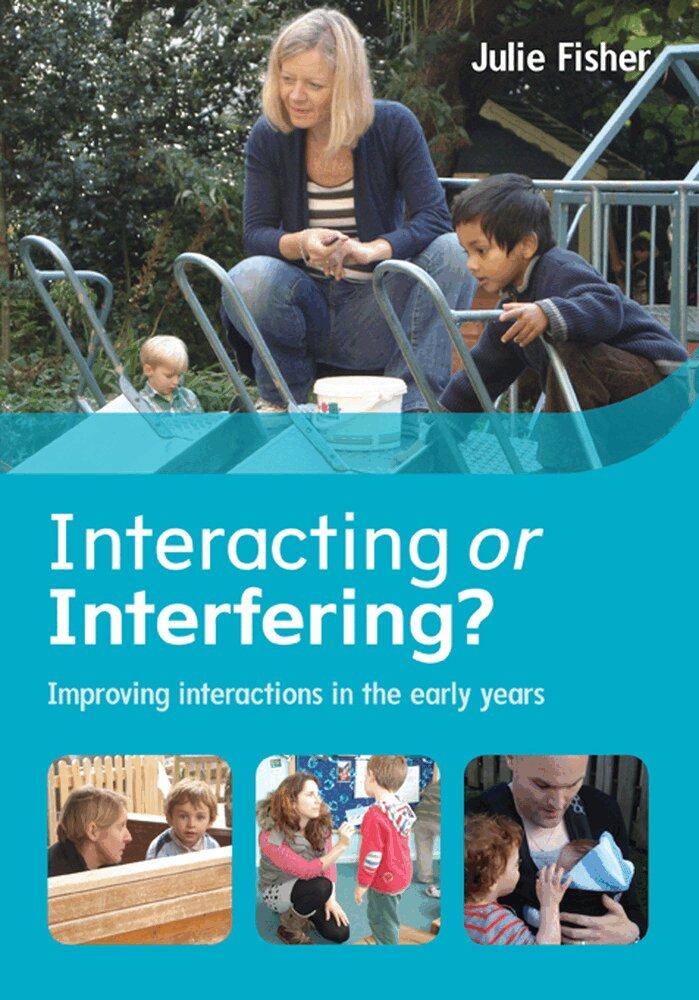
    Interacting or Interfering? Improving Interactions in the Early Years

    AvJulie Fisher

    Häftad, Engelska, 2016

    331 kr

    Beställningsvara. Skickas inom 3-6 vardagar. Fri frakt över 249 kr.

    Fler format och utgåvor

    E-bok

    319 kr

    Beskrivning

    High quality interactions are recognised as fundamental to the achievement of outstanding teaching and learning in the early years.  If you are working with children from six months to six years this authoritative new book from leading author Julie Fisher encourages you to reflect deeply on the quality and impact of interactions in your setting.

    Drawing on research undertaken in baby rooms, nurseries and classrooms over four years the book challenges prevailing orthodoxies and offers specific practical guidance on how to improve the quality of interactions on a day-to-day basis. With its illuminating examples, the book shows how you can best tune into and respond effectively to young children’s conversations.  It exemplifies how interactions are most effectively sustained and how developing high quality interactions can better scaffold and support children’s learning and development.

    'Interacting or Interfering?'

    • Identifies the key components of effective interactions and how implementing these can improve the quality of children’s learning
    • Contains transcripts of interactions from baby rooms through to Year 2 classes which exemplify key messages
    • Provides prompts you can use to analyse and improve your own practice

    Written in the author’s exceptionally clear and accessible style, this book is indispensable reading for all students and practitioners working and studying in the early years.

    "There is a tendency for adult talk to dominate nurseries and schools in an attempt to manage, organise and interrogate children’s learning; this closes down children’s own investigation and capacity for thought. Fisher points out how ‘the very act of “being an educator” can sometimes distort the nature of an interaction so much that it inhibits the very learning it is trying to promote’. In this timely, thought-provoking and very readable book she prompts us to think more deeply about interactions and adapt new strategies to encourage all young children to engage in meaningful and enriching talk."
    TACTYC, March, 2016

    "The prompts and points for reflection encourage practitioners to critically consider their role and function, noting where their work is affirmed and where there is scope for further development ... This book is both relevant, though provoking and extremely useful for all involved in early childhood - an excellent tool for professional development."
    Marion Dowling, Early Education Journal, No 79/ Summer 2016
     

    Produktinformation

    • Utgivningsdatum:2016-01-16
    • Mått:173 x 240 x 11 mm
    • Vikt:398 g
    • Format:Häftad
    • Språk:Engelska
    • Antal sidor:248
    • Förlag:McGraw-Hill Education
    • ISBN:9780335262564

    Utforska kategorier

    • Sociala och etiska frågor inom Samhälle och politik
    • Skolan och förskolan inom Psykologi och pedagogik
    • Barnpsykologi och utvecklingspsykologi inom Psykologi och pedagogik

    Mer om författaren

    Julie Fisher is an independent Early Years Adviser and visiting Professor of early childhood education at Oxford Brookes University. Prior to this she held the post of Early Years Adviser in Oxfordshire for 11 years. Before moving to Oxfordshire, Julie was lecturer in early childhood education at the University of Reading. She has taught children from 3 to 12 years and has been headteacher of two urban, multi-cultural schools. Julie has been chair of the Early Years Curriculum Group and the National Association of Inspectors, Advisers and Consultants Early Childhood Group. She was the first elected chair of the national Early Childhood Forum. She is now national vice-chair of the British Association for Early Childhood Education. Julie is author of a number of articles on early childhood education as well as her books ‘Starting from the Child’ and ‘The Foundations of Learning’ (Open University Press).

    Innehållsförteckning

    • 1 The importance of interactions for young children’s learning Introduction Different definitions of ‘effectiveness’ Interactions in the home Why interaction matters Why interactions matter to children entering school Why interactions matter to practitioners Summary 2 Interacting with babies and toddlers Introduction The foundations of interactionThe development of interactions Summary 3 Knowing the child well Introduction Focus on babies and toddlers What practitioners need to learn about children The importance of the Key Persons Approach The impact of knowing children well Talking to someone and not everyone Analysing your own practice Transcripts: knowing the child well Transcripts 3:1; 3:2 Summary 4 Environments conducive to conversation Introduction Focus on babies and toddlersEmotional space Physical space Analysing your own practiceTranscripts 4:1; 4:2 Summary 5 Tuning in to the child Introduction Focus on babies and toddlers The child as a learner Strategies for tuning in to children Working out what a child is thinking is more valuable than looking at what they are doing Deciding when and whether to interact can be the difference between interacting and interfering Analysing your own practice Transcripts 5:1; 5:2 Summary 6 Who leads the learning? Introduction Focus on babies and toddlersThe benefits of learning alongside an adult and learning independently Independent learning is not abandoned learning Interactions in adult-led, adult-initiated and child-led contexts The purpose of an interaction The balance between adult-led and child-led learning Who leads the learning? Analysing your own practice Transcripts 6:1 to 6:4 Summary 7 Sustaining effective interactions Introduction Focus on babies and toddlersInitiating conversations Sustaining interactions Consolidating, extending and provoking thinking Analysing your own practice Body language Analysing your own practiceTone of voice Transcripts 7:1 to 7:7Analysing your own practice  Summary 8 Interacting with children who might not want to interact Introduction Focus on babies and toddlers Reluctant talkers Children with autism Children with English as an additional language (Eal) Signing as a form of communication Analysing your own practice Transcripts 8:1; 8:2 Summary 9 Questions that work and questions that don’tIntroduction Focus on babies and toddlersWhy do we ask questions? Who asks the questions? Transcripts 9:1 to 9:6 Different types of questions Using questioning as control Children’s answers Questions that work and questions that don’t Alternatives to questioning Analysing my own practiceTranscripts 9:5 to 9:6 Summary 10 The attributes of effective practitioners Introduction Focus on babies and toddlers The attributes of effectiveness The importance of reciprocity Interacting not interfering Analysing your own practice Transcript 10:1 Summary