• Fri frakt över 249 kr
  • •
  • Snabba leveranser
  • •
  • Billiga böcker
Kundservice

Du är på sajten för privatpersoner.

Företag, bibliotek eller offentlig verksamhet?

Du handlar på classic.bokus.com, där alla dina funktioner finns intakta.
Till classic.bokus.com
Bokus logotyp. Gå till startsidan.
  • Erbjudanden
  • Nyheter
  • Student
  • Topplistor
  • Barn & ungdom
  • Bokus Play
  • E-böcker
  • Pocketböcker
  • Spel & pussel

10% studentrabatt med kod TERM26

Sidfot

Mina sidor

    Hjälp

    • Kundservice
    • Vanliga frågor och svar
    • Frakt och leverans
    • Retur vid ångerrätt
    • Reklamera vara
    • Betalning
    • Köpvillkor
    • Allmänna villkor
    • Information om webbplatsens tillgänglighet

    Om Bokus

    • Om oss
    • Pressrum
    • För studenter
    • För företag
    • För bibliotek och offentlig verksamhet
    • För leverantörer
    • Hållbarhet

    Populärt

    • Aktuella erbjudanden
    • Presentkort
    • Studentlitteratur
    • Nya böcker
    • Topplistor
    • Signerade böcker
    • Engelska böcker

    Inspiration

    • Boktips
    • BookTok
    • Populära bokserier
    • Barnbokskaraktärer
    • Populära författare
    Logotyp för Bokus
    Följ oss på Facebook (extern länk)Följ oss på Instagram (extern länk)Följ oss på YouTube (extern länk)Följ oss på TikTok (extern länk)
    bokus @ CookiesAnpassa cookiesIntegritetspolicyKöpvillkor
    Till Citymail hemsida (extern länk)Till Budbee hemsida (extern länk)Till Postnord hemsida (extern länk)Till Schenker hemsida (extern länk)Till Early Bird hemsida (extern länk)Till Walleys hemsida (extern länk)
    1. Samhälle och politik
    2. Samhälle och kultur
    3. Kultur och medier
    4. Kulturvetenskap

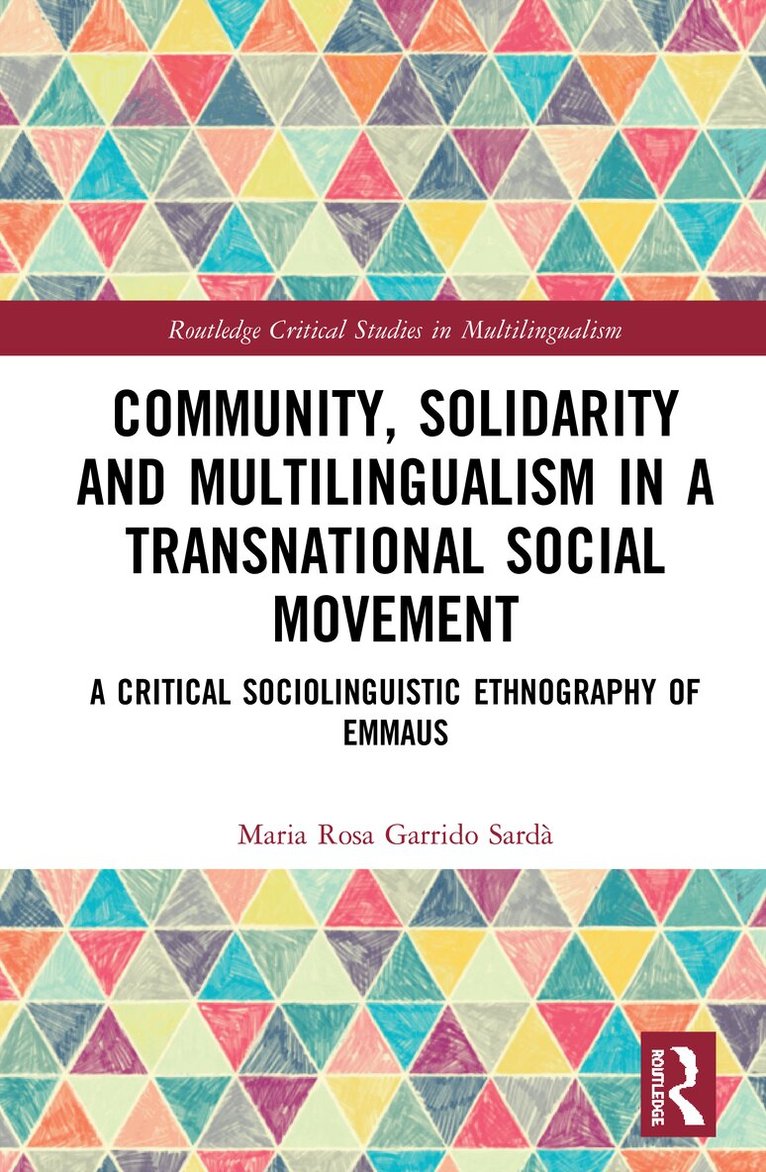
    Community, Solidarity and Multilingualism in a Transnational Social Movement

    A Critical Sociolinguistic Ethnography of Emmaus

    AvMaria Rosa Garrido Sardà

    Inbunden, Engelska, 2020

    Del i serien Routledge Critical Studies in Multilingualism

    2 506 kr

    Beställningsvara. Skickas inom 10-15 vardagar. Fri frakt över 249 kr.

    Fler format och utgåvor

    Häftad

    684 kr

    E-bok

    805 kr

    E-bok

    805 kr

    Beskrivning

    *RUNNER UP FOR 2022 BAAL BOOK PRIZE*Community, solidarity and multilingualism in a transnational social movement presents a critical sociolinguistic ethnography of the Emmaus movement that analyses linguistic and discursive practices in two local communities in order to provide insight into solidarity discourses and transnational communication more broadly. Integrating perspectives from a range of disciplines, the monograph seeks to understand the ways in which social movements are maintained across disparate communities grounded in shared cultural referents and communicative practices but not necessarily a shared language. The book focuses on Emmaus, the solidarity movement that emerged in post-war France which brings formerly marginalised people together with others looking for an alternative lifestyle into live-in communities dedicated to recycling work and social projects.The book first offers a historical overview of the Emmaus movement more generally, moving into an account of its development and spread across national and linguistic borders. The volume draws on data from two Emmaus communities in Barcelona and London to analyse the everyday communicative and discursive practices that appropriate and resignify the shared transnational movement ideas in different socio-political, economic, historical and linguistic contexts.Community, solidarity and multilingualism in a transnational social movement considers the social implications of local practices on the situated (re)production and evolution of transnational social movements more generally and will be of particular interest to students and researchers in sociolinguistics, linguistic anthropology, discourse studies, cultural studies, and sociology.

    Produktinformation

    • Utgivningsdatum:2020-09-02
    • Mått:152 x 229 x 20 mm
    • Vikt:453 g
    • Format:Inbunden
    • Språk:Engelska
    • Serie:Routledge Critical Studies in Multilingualism
    • Antal sidor:220
    • Förlag:Taylor & Francis Ltd
    • ISBN:9780367143527

    Utforska kategorier

    • Kulturvetenskap inom Samhälle och politik
    • Europas historia inom Historia och arkeologi
    • Språkvetenskap och lingvistik inom Språk och ordböcker

    Mer om författaren

    Maria Rosa Garrido Sardà is Lecturer in English Linguistics at the University of Lausanne, Switzerland

    Innehållsförteckning

    • ContentsList of Figures AcknowledgementsChapter 1: Language, discourse and transnationalism in a social movement xxEmmaus as a holistic social movement xxInvestigating sociolinguistic articulation across borders xxTheoretical approaches xxCritical ethnographic sociolinguistics xxTransnational social movements xxCommunity as a nexus xxAn ethnographic journey into a transnational field xxAccess, collaboration and positioning xxAn ethnographic toolbox xxStructure of the book xxChapter 2: Historicising the transnational expansion of a social movement through key events and texts xxIntroduction xxTransnational and multilingual expansion of a French movement xxFoundation and "Catacombs period" (1949-1954) xx"Insurrection of Goodness" in France (1954) and early expansion (1955-1969) xxFrom the First World Assembly (1969) to the politicisation of the movement (1988) xxHistoricising religion and politics in two different Emmaus communities xxFaith traditions and socio-political activism xxEmmaus Barcelona: Progressive Catholicism and post-‘68 activism xxEmmaus London: Charity and social enterprise xxConcluding remarks: A solidarity mission over time xxChapter 3: Transnational articulation and socialisation through the Emmaus founding story xxIntroduction: A social movement tells a "new story" xxConceptual framework: Collective identity through narrative chronotopes xx"A story of us": A chronotopic analysis of the Emmaus origin story xxAn ethnographic analysis of the movement’s founding story in situated interactions xxSocialisation into "stories of us": Oral storytelling and semiotic artefacts xx"Stories of self": Personal narratives of transformation xxConcluding remarks: Creating sameness in the Emmaus social movement xxChapter 4: Discursive localisations of solidarity in two socio-political contexts xxIntroduction xx"Towards other reasons to live": Alter-globalisation discourses in Emmaus Barcelona xxSnapshot: "Stories of now" in socio-political activism xxZooming in: A residential project for migrants xx"Emmaus, the homeless charity that works": Discourses of reciprocity and skilling in the UK xxSnapshot: "Stories of now" in homeless activation xxZooming in: Voluntary work schemes for the homeless xxConcluding remarks: Solidarity at the intersection of transnational trends, nation-state regimes and individual trajectories xxChapter 5: Language ideologies for negotiating positioning in the Emmaus social movement xxIntroduction xxTwo distinct visions of Emmaus as a movement xxEmmaus as a "multi-national of the heart" xxEmmaus as a rhizomatic network xxConstructing positioning in Emmaus through language ideologies of lingua francas xxDeproblematising language: French and Spanish as lingua francas in a Catalan community xxProblematising language: Tensions between English and French in a recent English community xxConcluding remarks: Ideologies of multilingualism and positioning in themovement xxChapter 6: Linguistic nationalism and the erasure of multilingualism in local Emmaus communities xxConstructing language: Between fixity and fluidity in localities xxFitting into (linguistic) nationalism xxEmmaus London: Constructing a monolingual space in an English charity xxEmmaus Barcelona: Tensions between monolingual and bilingual norms xxBackgrounding multilingualism in everyday practices xxEmmaus London: Institutional erasure of multilingual biographies xxEmmaus Barcelona: Multilingualism and new migrants xxConcluding remarks: Nationalist ideologies in a transnational social movement xxChapter 7: Language, transnational solidarity and utopia in an imagined community xxEmmaus as a utopia made of "walking words" xxWhat’s the (hi)story? Key findings about Emmaus as a social movement xxTowards a sociolinguistics of transnationalism xxWhat now? The story continues xxAppendix 1: Universal Manifesto of the Emmaus movement (1969)Appendix 2: Abbé Pierre’s Radio Appeal on 1st February 1954 (short version)Appendix 3: Orientations – Propositions – Questions adopted at the 6th Emmaus International General Assembly in Verona (1988)Appendix 4: Transcription conventionsReferencesIndex