• Fri frakt över 249 kr
  • •
  • Snabba leveranser
  • •
  • Billiga böcker
Kundservice

Du är på sajten för privatpersoner.

Företag, bibliotek eller offentlig verksamhet?

Du handlar på classic.bokus.com, där alla dina funktioner finns intakta.
Till classic.bokus.com
Bokus logotyp. Gå till startsidan.
  • Erbjudanden
  • Nyheter
  • Student
  • Topplistor
  • Barn & ungdom
  • Bokus Play
  • E-böcker
  • Pocketböcker
  • Spel & pussel

Må bättre, för mindre! Upp till 50% rabatt på hälsoböcker

Sidfot

Mina sidor

    Hjälp

    • Kundservice
    • Vanliga frågor och svar
    • Frakt och leverans
    • Retur vid ångerrätt
    • Reklamera vara
    • Betalning
    • Köpvillkor
    • Allmänna villkor
    • Information om webbplatsens tillgänglighet

    Om Bokus

    • Om oss
    • Pressrum
    • För studenter
    • För företag
    • För bibliotek och offentlig verksamhet
    • För leverantörer
    • Hållbarhet

    Populärt

    • Aktuella erbjudanden
    • Presentkort
    • Studentlitteratur
    • Nya böcker
    • Topplistor
    • Signerade böcker
    • Engelska böcker

    Inspiration

    • Boktips
    • BookTok
    • Populära bokserier
    • Barnbokskaraktärer
    • Populära författare
    Logotyp för Bokus
    Följ oss på Facebook (extern länk)Följ oss på Instagram (extern länk)Följ oss på YouTube (extern länk)Följ oss på TikTok (extern länk)
    bokus @ CookiesAnpassa cookiesIntegritetspolicyKöpvillkor
    Till Citymail hemsida (extern länk)Till Budbee hemsida (extern länk)Till Postnord hemsida (extern länk)Till Schenker hemsida (extern länk)Till Early Bird hemsida (extern länk)Till Walleys hemsida (extern länk)
    1. Samhälle och politik
    2. Samhälle och kultur
    3. Kultur och medier
    4. Kulturvetenskap

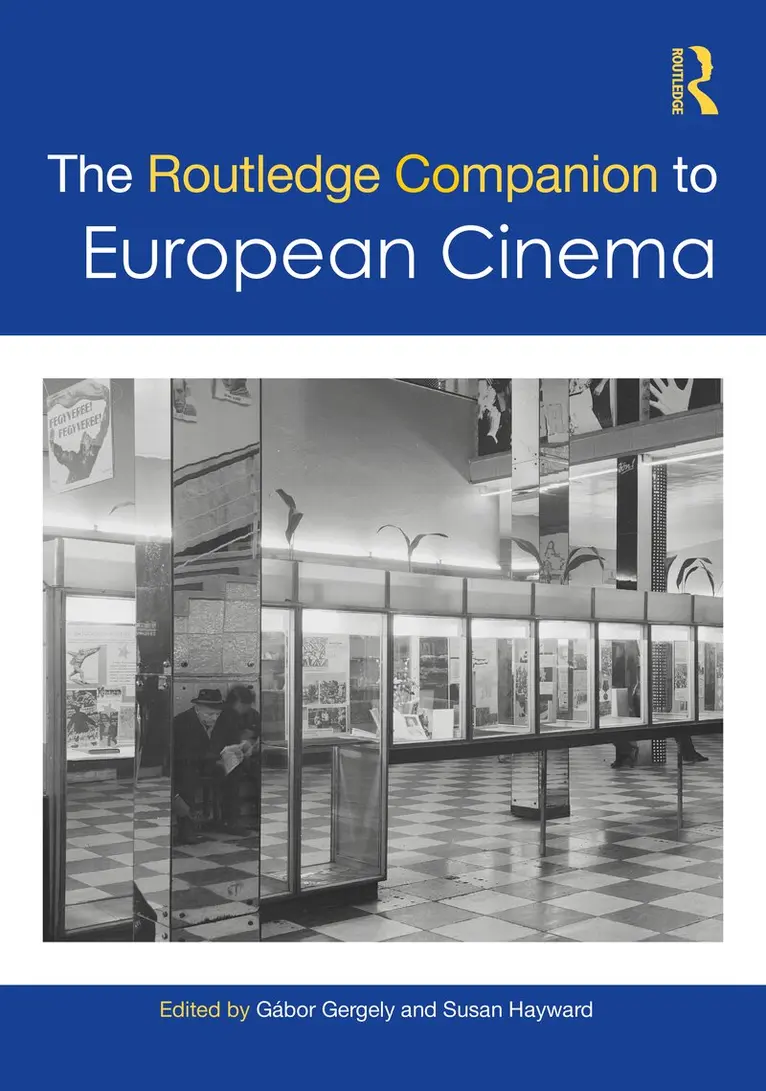
    Routledge Companion to European Cinema

    AvGábor Gergely,Susan Hayward

    Inbunden, Engelska, 2021

    Del i serien Routledge Media and Cultural Studies Companions

    3 656 kr

    Beställningsvara. Skickas inom 10-15 vardagar. Fri frakt över 249 kr.

    Beskrivning

    Presenting new and diverse scholarship, this wide-ranging collection of 43 original chapters asks what European cinema tells us about Europe. The book engages with European cinema that attends to questions of European colonial, racialized and gendered power; seeks to decentre Europe itself (not merely its putative centres); and interrogate Europe’s various conceptualizations from a variety of viewpoints. It explores the broad, complex and heterogeneous community/ies produced in and by European films, taking in Kurdish, Hollywood and Singapore cinema as comfortably as the cinema of Poland, Spanish colonial films or the European gangster genre. Chapters cover numerous topics, including individual films, film movements, filmmakers, stars, scholarship, representations and identities, audiences, production practices, genres and more, all analysed in their context(s) so as to construct an image of Europe as it emerges from Europe’s film corpus.The Companion opens the study of European cinema to a broad readership and is ideal for students and scholars in film, European studies, queer studies and cultural studies, as well as historians with an interest in audio-visual culture, nationalism and transnationalism, and those working in language-based area studies.

    Produktinformation

    • Utgivningsdatum:2021-12-30
    • Mått:174 x 246 x 32 mm
    • Vikt:1 109 g
    • Format:Inbunden
    • Språk:Engelska
    • Serie:Routledge Media and Cultural Studies Companions
    • Antal sidor:466
    • Förlag:Taylor & Francis Ltd
    • ISBN:9780367461850

    Utforska kategorier

    • Kulturvetenskap inom Samhälle och politik
    • Medievetenskap inom Samhälle och politik
    • Film inom Kultur

    Mer om författaren

    Gábor Gergely is Senior Lecturer in Film Studies at the University of Lincoln, UK. He has published on Hungarian, French and Italian cinema, on European actors in Hollywood and he is the editor of the Stardom special issue of Studies in Eastern European Cinema.Susan Hayward is Emerita Professor of Cinema Studies at Exeter University, UK. She is the author of several books on French cinema and Cinema Studies: The Key Concepts (now in its sixth edition).

    Innehållsförteckning

    • Introduction Part I: A first dialogical cluster: European cinema speaking about Europe: Through explorations of sexualities, identities, migration and the crisis of modernity 1. Post-communist nostalgia in new Bulgarian cinema as a social critique: Mediated post-communist nostalgia 2. Slow Slippy: Still shite being Scottish? T2: Trainspotting and the ‘Scottish European’ 3. Beauty and historical understanding in Suspiria and Cold War 4. ‘Europe was built on blood’: Christian Petzold as a European filmmaker 5. Europe wounded? Politics of hope and resistance in Vincent Dieutre’s Orlando Ferito (2013) 6. Lilting and the entangled temporalities of Europe(an cinema) 7. New ways of looking: The case of Maren Ade, Valeska Grisebach and Małgorzata Szumowska 8. The ebbs and flows of girlhood experience across European cinema 9. ‘Dream on princess’: Cultural value, gender politics and the Hungarian film canon through the documentary Pretty Girls 10. European ecology-documentaries as performative exchange 11. Following the flâneur Hulot in Playtime: Soundscape of the new Paris 12. Ágata’s (filmmaking) girlfriends: The new wave of women directors in Catalonia 13. The Bourne multiplicity: Quantum Europeanness in the Bourne films (2002-2016) 14. Noisy presences in contemporary European Cinema: Paris est une fête: un film en 18 vagues 15. Gay male sex, carnal knowledge and realism in contemporary French cinema 16. Eden is West, Europe as a magic trick Part II: A second dialogical cluster: Cinema and its industry, national transnationalisms: Actors, studios and cross-overs 17. Omar Sharif: A European Middle Eastern star 18. Weakened nationalism and thickened time: Interrogating the position of Kurdish cinema within European cinema discussions 19. Why small European film industries remake each other’s successes: The case of the Low Countries 20. European collaboration after World War Two: A Tale of Five Cities (M. Tully, R. Marcellini, W. Staudte, G. von Cziffra, E. E. Reinert, 1948—1951) 21. A film ‘highly offensive to our nation’: Stanley Kubrick’s Paths of Glory (1957), censorship, and militaristic representations of post-war Europe 22. Europe comes to Hollywood: The silent era, 1912—1927 23. The non-professional actor in European cinema 24. The (cultural) politics of international co-production: Morocco and Europe 25. British comedy in a foreign light: Looking at the trope of British comedy through the lens of émigré filmmakers 26. Corporate consolidation, artistic conservatism and the persistence of Hollywood: The European film industry, 2006—2020 27. ‘Boyish’ women and female soldiers: British gender disguise comedies between the world wars 28. Fred Zinnemann: A Hollywood director who never leaves Europe Part III: A third dialogical cluster: European cinema and the myth of a unifying and pluralist Europe: Through explorations of borders, genres and histories 29. Framing fundamentalism in contemporary European film 30. Gangster films reloaded: European values and the criminal spectre of late modernity 31. Films at the intersection of Europe, the Balkans and transgender visibility: A sketch map 32. Two-speed economic systems and bipolarity in the European Union: Frontier spaces in Valeska Grisebach’s Western 33. Film topography and national belonging: Hungarian Jewishness and the high mountains 34. Identity and belonging in the bordered spaces of Gatlif’s Indignados (2012) and Geronimo (2014) 35. Accented silences: The aesthetics of displacement in diasporic post-Yugoslav cinema 36. Resisting the traps of hegemony: Variation in contemporary German queer of color cinema 37. Lisbon on film 1980-2020: Locating Europe 38. ‘We live like swine and die like swine, because we mean nothing to each other’: The little person, the state and nationhood in contemporary Russian film 39. Family, memories and borders: Europe in the films of Stephan Komandarev 40. Neoliberal authorship: Auteur theory and European art cinema in 2021 — The example of Paweł Pawlikowski 41. Queer bodies and the death drive: Gender and sexuality in Italian giallo 42. Political discourse and rhetoric: Challenging twenty-first century populism in Chez nous/This Is Our Land 43. Recovering memory, reasserting Europeanness. Modern Convivencia and Hispanotropicalism in Palm Trees in the Snow (2015) and Neckan (2014)