• Fri frakt över 249 kr
  • •
  • Snabba leveranser
  • •
  • Billiga böcker
Kundservice

Du är på sajten för privatpersoner.

Företag, bibliotek eller offentlig verksamhet?

Du handlar på classic.bokus.com, där alla dina funktioner finns intakta.
Till classic.bokus.com
Bokus logotyp. Gå till startsidan.
  • Erbjudanden
  • Nyheter
  • Student
  • Topplistor
  • Barn & ungdom
  • Bokus Play
  • E-böcker
  • Pocketböcker
  • Spel & pussel

10% studentrabatt med kod TERM26

Sidfot

Mina sidor

    Hjälp

    • Kundservice
    • Vanliga frågor och svar
    • Frakt och leverans
    • Retur vid ångerrätt
    • Reklamera vara
    • Betalning
    • Köpvillkor
    • Allmänna villkor
    • Information om webbplatsens tillgänglighet

    Om Bokus

    • Om oss
    • Pressrum
    • För studenter
    • För företag
    • För bibliotek och offentlig verksamhet
    • För leverantörer
    • Hållbarhet

    Populärt

    • Aktuella erbjudanden
    • Presentkort
    • Studentlitteratur
    • Nya böcker
    • Topplistor
    • Signerade böcker
    • Engelska böcker

    Inspiration

    • Boktips
    • BookTok
    • Populära bokserier
    • Barnbokskaraktärer
    • Populära författare
    Logotyp för Bokus
    Följ oss på Facebook (extern länk)Följ oss på Instagram (extern länk)Följ oss på YouTube (extern länk)Följ oss på TikTok (extern länk)
    bokus @ CookiesAnpassa cookiesIntegritetspolicyKöpvillkor
    Till Citymail hemsida (extern länk)Till Budbee hemsida (extern länk)Till Postnord hemsida (extern länk)Till Schenker hemsida (extern länk)Till Early Bird hemsida (extern länk)Till Walleys hemsida (extern länk)
    1. Naturvetenskap och teknik
    2. Geovetenskap
    3. Miljövetenskap och miljöpolitik

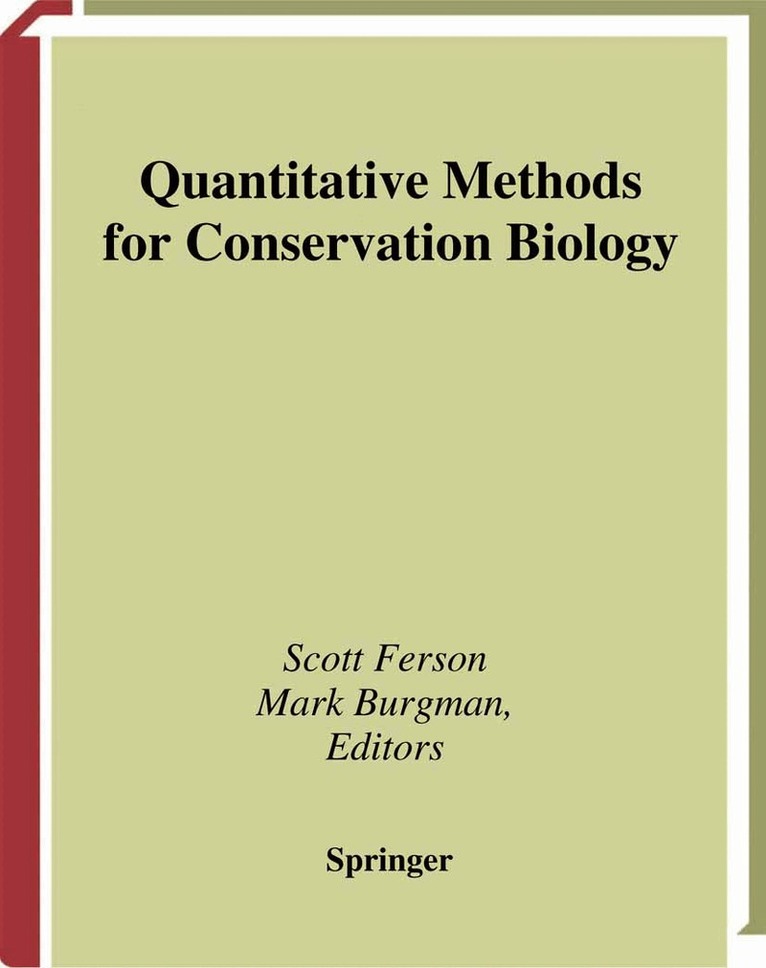
    Quantitative Methods for Conservation Biology

    AvScott Ferson,S. Ferson

    Häftad, Engelska, 2002

    1 092 kr

    Beställningsvara. Skickas inom 10-15 vardagar. Fri frakt över 249 kr.

    Beskrivning

    Quantitative methods are needed in conservation biology more than ever as an increasing number of threatened species find their way onto international and national “red lists. ” Objective evaluation of population decline and extinction probability are required for sound decision making. Yet, as our colleague Selina Heppell points out, population viability analysis and other forms of formal risk assessment are underused in policy formation because of data uncertainty and a lack of standardized methodologies and unambiguous criteria (i. e. , “rules of thumb”). Models used in conservation biology range from those that are purely heuristic to some that are highly predictive. Model selection should be dependent on the questions being asked and the data that are available. We need to develop a toolbox of quantitative methods that can help scientists and managers with a wide range of systems and that are subject to varying levels of data uncertainty and environmental variability. The methods outlined in the following chapters represent many of the tools needed to fill that toolbox. When used in conjunction with adaptive management, they should provide information for improved monitoring, risk assessment, and evaluation of management alternatives. The first two chapters describe the application of methods for detecting trends and extinctions from sighting data. Presence/absence data are used in general linear and additive models in Chapters 3 and 4 to predict the extinction proneness of birds and to build habitat models for plants.

    Produktinformation

    • Utgivningsdatum:2002-06-13
    • Mått:155 x 235 x 19 mm
    • Vikt:511 g
    • Format:Häftad
    • Språk:Engelska
    • Antal sidor:322
    • Förlag:Springer-Verlag New York Inc.
    • ISBN:9780387954868

    Utforska kategorier

    • Miljövetenskap och miljöpolitik inom Naturvetenskap och teknik
    • Biovetenskap inom Naturvetenskap och teknik

    Recensioner i media

    From the reviews: "Population decline and extinction of many species is a worldwide phenomenon. Because quantitative methods are either lacking or not applied population declines are often poorly understood ... . The present book aims to contribute to close this gap by introducing several different quantitative methods that are useful to conservationists. ... The book has been written for graduate students and working conservation biologists. ... The authors succeeded ... in presenting the different methods in an understandable and simple way. ... I would recommend the book." (Michael Schaub, Basic and Applied Ecology, Issue 5, 2004)

    Innehållsförteckning

    • Detecting Extinction in Sighting Data.- Inferring Threat from Scientific Collections: Power Tests and an Application to Western Australian Acacia Species.- Identifying the Ecological Correlates of Extinction-Prone Species: A Case Study of New Zealand Birds.- Quantitative Methods for Modeling Species Habitat: Comparative Performance and an Application to Australian Plants.- Risk Assessment of a Proposed Introduction of Pacific Salmon in the Delaware River Basin.- Likelihood of Introducing Nonindigenous Organisms with Agricultural Commodities: Probabilistic Estimation.- “Best” Abundance Estimates and Best Management: Why They Are Not the Same.- Whaling Models for Cetacean Conservation.- Assessing Land-Use Impacts on Bull Trout Using Bayesian Belief Networks.- Using Matrix Models to Focus Research and Management Efforts in Conservation.- Variability and Measurement Error in Extinction Risk Analysis: The Northern Spotted Owl on the Olympic Peninsula.- Can Individual-Based Models Yield a Better Assessment of Population Variability?.- Potential of Branching Processes as a Modeling Tool for Conservation Biology.- Role of Genetics in Conservation Biology.- Modeling Problems in Conservation Genetics Using Laboratory Animals Richard Frankham.- Theoretical Properties of Extinction by Inbreeding Depression Under Stochastic Environments.- Mathematical Methods for Identifying Representative Reserve Networks.