• Fri frakt över 249 kr
  • •
  • Snabba leveranser
  • •
  • Billiga böcker
Kundservice

Du är på sajten för privatpersoner.

Företag, bibliotek eller offentlig verksamhet?

Du handlar på classic.bokus.com, där alla dina funktioner finns intakta.
Till classic.bokus.com
Bokus logotyp. Gå till startsidan.
  • Erbjudanden
  • Nyheter
  • Student
  • Topplistor
  • Barn & ungdom
  • Bokus Play
  • E-böcker
  • Pocketböcker
  • Spel & pussel

10% rabatt på allt med kod: NYSTART10 →

Sidfot

Mina sidor

    Hjälp

    • Kundservice
    • Vanliga frågor och svar
    • Frakt och leverans
    • Retur vid ångerrätt
    • Reklamera vara
    • Betalning
    • Köpvillkor
    • Allmänna villkor
    • Information om webbplatsens tillgänglighet

    Om Bokus

    • Om oss
    • Pressrum
    • För studenter
    • För företag
    • För bibliotek och offentlig verksamhet
    • För leverantörer
    • Hållbarhet

    Populärt

    • Aktuella erbjudanden
    • Presentkort
    • Studentlitteratur
    • Nya böcker
    • Topplistor
    • Signerade böcker
    • Engelska böcker

    Inspiration

    • Boktips
    • BookTok
    • Populära bokserier
    • Barnbokskaraktärer
    • Populära författare
    Logotyp för Bokus
    Följ oss på Facebook (extern länk)Följ oss på Instagram (extern länk)Följ oss på YouTube (extern länk)Följ oss på TikTok (extern länk)
    bokus @ CookiesAnpassa cookiesIntegritetspolicyKöpvillkor
    Till Citymail hemsida (extern länk)Till Budbee hemsida (extern länk)Till Postnord hemsida (extern länk)Till Schenker hemsida (extern länk)Till Early Bird hemsida (extern länk)Till Walleys hemsida (extern länk)
    1. Samhälle och politik
    2. Social välfärd och brottslighet
    3. Socialt arbete och välfärd

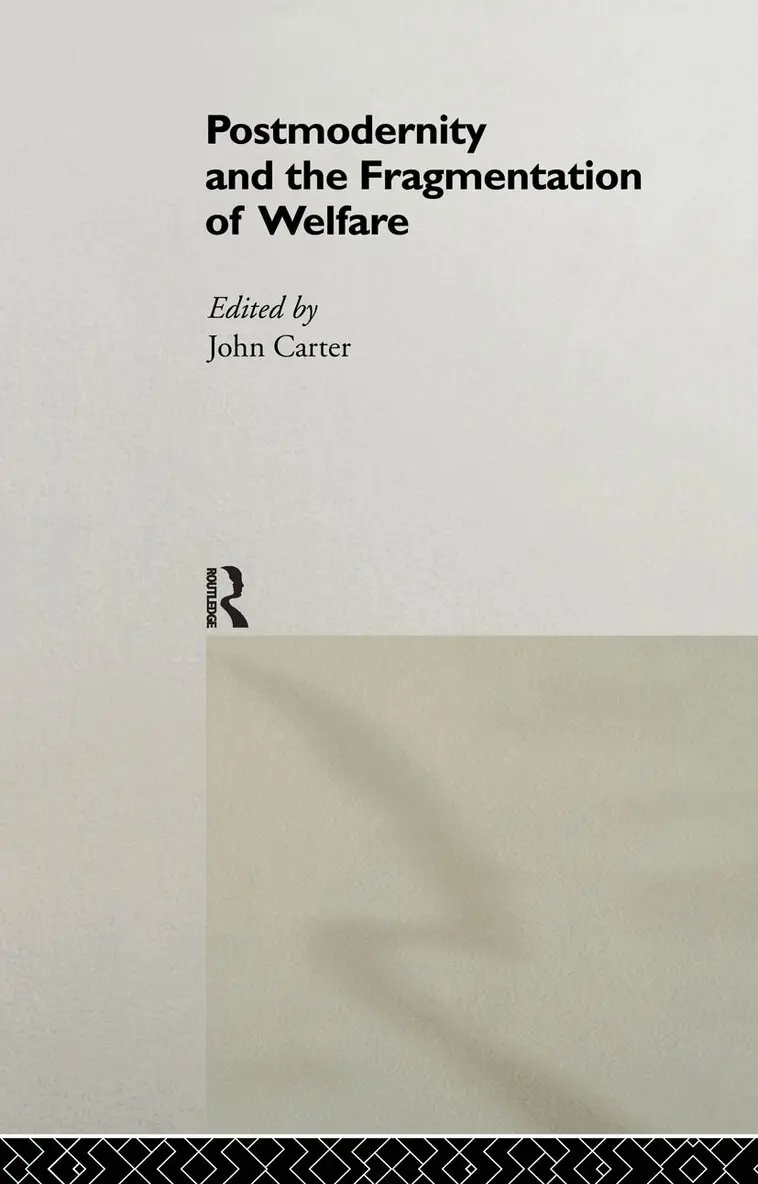
    Postmodernity and the Fragmentation of Welfare

    AvJohn Carter

    Inbunden, Engelska, 1998

    2 954 kr

    Beställningsvara. Skickas inom 10-15 vardagar. Fri frakt över 249 kr.

    Beskrivning

    Postmodern ideas have been vastly influential in the social sciences and beyond. However, their impact on the study of social policy has been minimal. Postmodernity and the Fragmentation of Welfare analyses the potential for a postmodern or cultural turn in welfare as it treats postmodernity as an evolving canon -from the seminal works of Baudrillard, Foucault and Lyotard, through to recent theories of the 'risk society'.Already disorientated by globalisation, new technologies and the years of new right ascendancy, welfare faces a significant challenge in the postmodern. It suggests that, rather than universality and state provision, the new social policy will be consumerised and fragmented -a welfare state of ambivalence.With contributions from authors coming from a variety of fields offering very different perspectives on postmodernity and welfare Postmodernity and the Fragmentation of Welfare also keeps social policy's intellectual inheritance in view. By exploring ways in which theorisations of postmodernity might improve understanding of welfare issues in the 1990s and assessing the relevance of theories of diversity and difference to mainstream and critical social policy traditions, this book will be and essential text for all students of social policy, social administration, social work and sociology.

    Produktinformation

    • Utgivningsdatum:1998-03-19
    • Mått:156 x 234 x 21 mm
    • Vikt:566 g
    • Format:Inbunden
    • Språk:Engelska
    • Antal sidor:304
    • Förlag:Taylor & Francis Ltd
    • ISBN:9780415163910

    Utforska kategorier

    • Socialt arbete och välfärd inom Samhälle och politik
    • Kulturvetenskap inom Samhälle och politik
    • Filosofiska discipliner inom Filosofi och religion

    Mer om författaren

    John Carter is a Senior Lecturer in the School of Social Sciences, University of Teesside.

    Innehållsförteckning

    • Chapter 1 Preludes, Introductions and Meanings, John Carter; Part 1 Postmodern Frameworks and Social Policy; Chapter 2 Studying Social Policy After Modernity, John Carter; Chapter 3 Postmodernism, Poststructuralism and Social Policy, John R. Gibbins; Chapter 4 Oppositional Postmodern Theory and Welfare Analysis, Martin O’Brien, Sue Penna; Chapter 5 Quality Assurance and Evaluation in Social Work in a Postmodern Era, Barbara Fawcett, Brid Featherstone; Part 2 Critical Social Policy and Postmodernity; Chapter 6 ‘One Step Beyond’, Kirk Mann; Chapter 7 Postmodernity and the Future of Welfare, Suzy Croft, Peter Beresford; Part 3 Social Divisions and Social Exclusion; Chapter 8 New Horizons? New Insights?, Jean Carabine; Chapter 9 Reopening the Gift, Chris Smaje; Chapter 10 Individualisation Processes and Social Policy, Sarah Nettleton, Roger Burrows; Part 4 Governance and New Technologies of Control in the New Social Policy; Chapter 11 Thriving on Chaos?, John Clarke; Chapter 12 Performativity and Fragmentation in ‘Postmodern Schooling’, Stephen J. Ball; Chapter 13 Post-Betty Fordism and Neo-Liberal Drug Policies, Robin Bunton; Chapter 14 Welfare Direct, Brian D. Loader; Part 5 Citizenship Amid the Fragmented Nation State; Chapter 15 The Delivery of Welfare, Paul Hoggett, Simon Thompson; Chapter 16 Globalisation, Fragmentation and Local Welfare Citizenship, Allan Cochrane; Chapter 17 Postmodernity and Social Europe, Norman Ginsburg;