• Fri frakt över 249 kr
  • •
  • Snabba leveranser
  • •
  • Billiga böcker
Kundservice

Du är på sajten för privatpersoner.

Företag, bibliotek eller offentlig verksamhet?

Du handlar på classic.bokus.com, där alla dina funktioner finns intakta.
Till classic.bokus.com
Bokus logotyp. Gå till startsidan.
  • Erbjudanden
  • Nyheter
  • Student
  • Topplistor
  • Barn & ungdom
  • Bokus Play
  • E-böcker
  • Pocketböcker
  • Spel & pussel

10% studentrabatt med kod TERM26

Sidfot

Mina sidor

    Hjälp

    • Kundservice
    • Vanliga frågor och svar
    • Frakt och leverans
    • Retur vid ångerrätt
    • Reklamera vara
    • Betalning
    • Köpvillkor
    • Allmänna villkor
    • Information om webbplatsens tillgänglighet

    Om Bokus

    • Om oss
    • Pressrum
    • För studenter
    • För företag
    • För bibliotek och offentlig verksamhet
    • För leverantörer
    • Hållbarhet

    Populärt

    • Aktuella erbjudanden
    • Presentkort
    • Studentlitteratur
    • Nya böcker
    • Topplistor
    • Signerade böcker
    • Engelska böcker

    Inspiration

    • Boktips
    • BookTok
    • Populära bokserier
    • Barnbokskaraktärer
    • Populära författare
    Logotyp för Bokus
    Följ oss på Facebook (extern länk)Följ oss på Instagram (extern länk)Följ oss på YouTube (extern länk)Följ oss på TikTok (extern länk)
    bokus @ CookiesAnpassa cookiesIntegritetspolicyKöpvillkor
    Till Citymail hemsida (extern länk)Till Budbee hemsida (extern länk)Till Postnord hemsida (extern länk)Till Schenker hemsida (extern länk)Till Early Bird hemsida (extern länk)Till Walleys hemsida (extern länk)
    1. Samhälle och politik
    2. Politik och statsskick
    3. Statsvetenskap och politisk teori

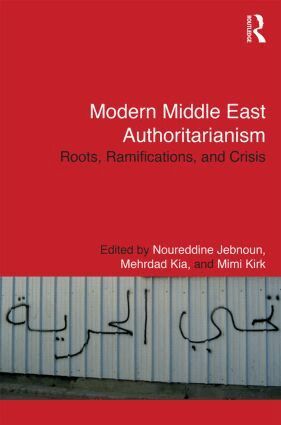
    Modern Middle East Authoritarianism

    Roots, Ramifications, and Crisis

    AvNoureddine Jebnoun,Mehrdad Kia

    Inbunden, Engelska, 2013

    Del i serien Routledge Studies in Middle Eastern Politics

    2 434 kr

    Beställningsvara. Skickas inom 10-15 vardagar. Fri frakt över 249 kr.

    Beskrivning

    While the Arab uprisings have overturned the idea of Arab "exceptionalism," or the acceptance of authoritarianism, better analysis of authoritarianism’s resilience in pre- and post-uprising scenarios is still needed. Modern Middle East Authoritarianism: Roots, Ramifications, and Crisis undertakes this task by addressing not only the mechanisms that allowed Middle Eastern regimes to survive and adapt for decades, but also the obstacles that certain countries face in their current transition to democracy.This volume analyzes the role of ruling elites, Islamists, and others, as well as variables such as bureaucracy, patronage, the strength of security apparatuses, and ideological legitimacy to ascertain regimes’ life expectancies and these factors’ post-uprisings repercussions. Discussing not only the paradigms through which the region has been analyzed, but also providing in-depth case studies of Tunisia, Egypt, Libya, Algeria, Saudi Arabia, Iraq, and Iran, the authors arrive at critical conclusions about dictatorship and possibilities for its transformation. Employing diverse research methods, including interviews, participant observation, and theoretical discussions of authoritarianism and political transition, this book is essential reading for scholars of Middle East Studies, Islamic Studies and those with an interest in the governance and politics of the Middle East.

    Produktinformation

    • Utgivningsdatum:2013-07-26
    • Mått:156 x 234 x 27 mm
    • Vikt:740 g
    • Format:Inbunden
    • Språk:Engelska
    • Serie:Routledge Studies in Middle Eastern Politics
    • Antal sidor:304
    • Förlag:Taylor & Francis Ltd
    • ISBN:9780415845007

    Utforska kategorier

    • Statsvetenskap och politisk teori inom Samhälle och politik
    • Religiösa och teokratiska ideologier inom Samhälle och politik
    • Statsskick: diktatur inom Samhälle och politik

    Mer om författaren

    Noureddine Jebnoun is a faculty member at Georgetown University’s Center for Contemporary Arab Studies where his teaching interests focus on governance and security challenges of the Arab Middle East and North Africa. He is the author of L’espace méditerranéen: les enjeux de la coopération et de la sécurité entre les rives nord et sud à l’aube du XXIème siècle (2003), as well as many book chapters and articles.Mehrdad Kia is Director of the Central and Southwest Asian Studies Center and a professor of Middle Eastern and North African history at the University of Montana. Kia has published extensively on the intellectual and cultural history of nineteenth century Iran, as well as the history of the Ottoman Empire. His most recent books are TheOttoman Empire (2008), and Daily Life in the Ottoman Empire (2011) both published by Greenwood.Mimi Kirk is Research Director at the Middle East Institute in Washington, D.C. Her other co-edited volumes include Palestine and the Palestinians in the Twenty-first Century (forthcoming, 2013); Uncovering Iraq: Trajectories of Disintegration and Transformation (2011); and Industrialization in the Gulf: A Socioeconomic Revolution (2009). Her writing has appeared in Middle East Report, Jadaliyya, and the Atlantic.

    Recensioner i media

    "The Arab uprisings of 2011 have forced scholars of the region to rethink arguments about the durability of authoritarianism and the prospects for democratic change in the Middle East. This volume is an important contribution to this necessary rethinking. Its chapters offer valuable insight into the complex and evolving political landscape that is taking shape in the Middle East today following the mass protests that forced four Arab autocrats from power, and left their counterparts elsewhere in region uneasy about their own survival."Steven Heydemann, Special Adviser for Middle East Initiatives, United States Institute of Peace"This fine collection, nicely introduced by Noureddine Jebnoun, features timely analyses by seasoned scholars, including several with a wealth of recent field experience in the Middle East. Particularly impressive are sage assessments by Clement M. Henry, Michael C. Hudson and Eric Davis, but case studies by a number of the authors are also of high quality. This is an indispensable volume for understanding the authoritarian political context in which the Arab Awakening began in late 2010. In addition, three noteworthy contributions on Iran expand the substantive canvas. At a time when on-the-fly books on the "Arab Spring" vie for attention, this volume offers more durable scholarship."Professor Augustus Richard Norton, Boston University, USA"Modern Middle East Authoritarianism: Roots, Ramifications, and Crisis is an exceptional addition to the existing body of scholarship on authoritarianism in the Middle East, and in general. It accurately reflects the various dynamics that animate authoritarian governments in the region and offers an astute set of observations about the origins and persistence of this phenomenon. Its relevance and rigor make it a useful tool for students of Middle Eastern politics and history, while its clear assessments of policy render it a necessary resource for policy makers. Many have come close to producing a book of this caliber, but few have patiently labored through analyses of a region swirling in change and delivered a product that may well become a staple of its discipline. The editors and contributors of this volume have done just that." Nathan Lean, writer and scholar on the Middle EastAs the Arab revolts in Egypt, Syria, and Libya face serious hurdles, and pessimism about the state of affairs in the region (with some optimism about Tunisia) is rising, this new edited volume comes as a welcome addition to the study of authoritarianism. So much has been written on the uprisings in the last three years that one would imagine that authoritarianism, as a system, no longer exists or that it has largely dissolved. Nothing could be further from reality; more studying and probing of these systems is needed, together with a deep analysis of the roots and ramifications of authoritarianism. […] Indeed, more research has to follow this important and timely book to explore these institutions, the survival of the old networks, the implications of repression of many decades on the population, and last but not least the hard journey of transition from authoritarianism to postauthoritarianism.Joseph SassoonCenter for Contemporary Arab Studies, Georgetown University, Washington, DC, USA

    Innehållsförteckning

    • Introduction: Rethinking the Paradigm of "Durable" and "Stable" Authoritarianism in the Middle East -Noureddine Jebnoun Part I: Entrenched Authoritarianism: An Historical Snapshot 1 Bumpy Democratic Routes to Dictatorial Ends? – Nathan J. Brown 2 The Longevity of Arab Regimes: Causes of Oppression – As’ad AbuKhalil 3 The Making of Modern Authoritarianism in Contemporary Iran-Mehrdad Kia Part II: Authoritarianism’s Coercive Mechanisms 4 The Vanishing Intermediary Bodies of "Authoritarian" Regimes: Legacies of Algerian Student Revolutionaries – Clement M. Henry 5 Ben Ali’s Tunisia: the Authoritarian Path of a Dystopian State – Noureddine Jebnoun 6 Libya’s Authoritarian Tradition – Ronald Bruce St John 7 Political Control in Saudi Arabia: the Avoidance of Democratization– Jean-Francois Seznec 8 Constitutional and Ideological Barriers to Reform in Iran: Is Change Possible Within the Existing System?-Shireen Hunter Part III: Islamism in an Age of Authoritarian Crisis 9 Conditioned Participation: The Mubarak State and Egypt's Muslim Brothers-Joshua Stacher 10 Islamism, Authoritarianism and Democracy: A Comparative Study of Egypt and Iraq- Eric Davis 11 The "Islamic Republic of Iran" and the Crisis of Legitimacy – Ali M.Ansari Conclusion 12 After the "Arab Spring": Emergent Democracy vs. Resurgent Authoritarianism – Michael C. Hudson