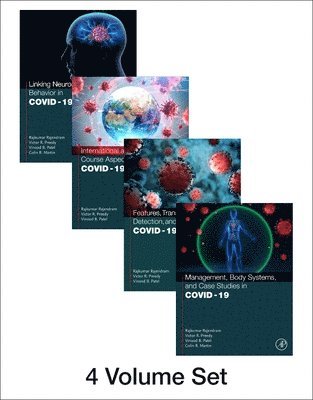
Inbunden, Engelska, 2024
Thematic Approaches to COVID-19
Av Rajkumar Rajendram, Victor R. Preedy, Vinood Patel, Colin R. Martin
8078 kr
Beställningsvara. Skickas inom 11-20 vardagar. Fri frakt över 249 kr.
Beskrivning
Produktinformation
- Utgivningsdatum: 2024-06-01
- Mått: 216 x 276 x undefined mm
- Vikt: 8 660 g
- Format: Inbunden
- Språk: Engelska
- Antal sidor: 600
- Förlag: Elsevier Science
- ISBN: 9780443188312
Utforska kategorier
Mer om författaren
Dr Rajkumar Rajendram is a clinician-scientist with expertise in internal medicine, anaesthesia, intensive care and peri-operative medicine. He graduated with distinctions from Guy’s, King’s and St Thomas’ Medical School, King’s College London, in 2001, where he received several prizes, merits and distinctions in pre-clinical and clinical subjects.Dr Rajendram completed specialist training in acute and general medicine in Oxford and subsequently held a Consultant appointment in Acute General Medicine at the John Radcliffe Hospital, Oxford. He also trained in anaesthesia and intensive care in London, including advanced training in regional anaesthesia and intensive care, and subsequently held a Consultant appointment in Intensive Care, Anaesthesia and Peri-operative Medicine at the Royal Free London Hospitals.His postgraduate training has spanned internal medicine, anaesthesia, intensive care and point-of-care ultrasound (POCUS). He was awarded Fellowship of the Royal College of Anaesthetists in 2009, Fellowship of the Faculty of Intensive Care Medicine in 2013, and the European Diploma in Intensive Care Medicine in 2014. He is a Fellow of both the Royal College of Physicians of Edinburgh and the Royal College of Physicians of London.Dr Rajendram is currently a Consultant at King Abdulaziz Medical City, Ministry of National Guard Health Affairs, Riyadh, Saudi Arabia, and holds a joint appointment as Associate Professor in the Research Unit, Department of Medical Education, at King Saud bin Abdulaziz University for Health Sciences.His multidisciplinary clinical background has informed his research interests in nutrition, fluid management and fluid balance in health and disease, particularly in acutely and critically ill patients. His research has also addressed POCUS, COVID-19 phenotypes and nutritional support in illness. Dr Rajendram has contributed extensively to medical research and education and has authored more than 400 textbook chapters, review articles, peer-reviewed papers and conference abstracts. Victor R. Preedy, BSc, PhD, DSc, FRSB, FRSPH, FRCPath, FRSC, FRSM, is Professor of Clinical Biochemistry (Hon) at King’s College Hospital and Emeritus Professor of Nutritional Biochemistry at King’s College London. He also holds an Honorary Professorship at the University of Suffolk and served as the long‑term Director of the Genomics Centre at King’s College London from 2006 to 2020. Professor Preedy graduated with an Honours Degree in Biology and Physiology with Pharmacology and later obtained his PhD from the University of London. He subsequently received Membership of the Royal College of Pathologists and later earned his second doctorate (DSc) in recognition of his contributions to protein metabolism. He is a Fellow of the Royal Society of Medicine, the Royal Society of Biology, the Royal College of Pathologists, the Royal Society for the Promotion of Health, the Royal Institute of Public Health and Hygiene, the Royal Society for Public Health, and the Royal Society of Chemistry. Professor Preedy has conducted research while affiliated with Imperial College London, the School of Pharmacy (now part of University College London), and the MRC Centre at Northwick Park Hospital. He has collaborated widely with international research groups in Finland, Japan, Australia, the USA, and Germany. His longstanding academic interests include health and well‑being. He has published more than 750 works, including peer‑reviewed research articles, abstracts, symposium presentations, reviews, and edited books.Vinood B. Patel, BSc, PhD, FRSC, is currently Professor in Clinical Biochemistry at the University of Westminster. In 2014 Dr Patel was elected as a Fellow to The Royal Society of Chemistry. Dr Patel graduated from the University of Portsmouth with a degree in Pharmacology and completed his PhD in protein metabolism from King’s College London in 1997. His postdoctoral work was carried out at Wake Forest University Baptist Medical School, NC, USA studying structural-functional alterations to mitochondrial ribosomes, where he developed novel techniques to characterize their biophysical properties. Research is being undertaken to study the role of nutrients, antioxidants, phytochemicals, iron, alcohol and fatty acids in the pathophysiology of liver disease. Other areas of interest are identifying new biomarkers that can be used for the diagnosis and prognosis of disease and understanding mitochondrial oxidative stress in neurological disorders and iron dysregulation in diabetes. Dr Patel is a nationally and internationally recognized researcher and has several edited biomedical books related to the use or investigation of active agents or components. These books include The Handbook of Nutrition, Diet, and Epigenetics, Branched Chain Amino Acids in Clinical Nutrition, Cancer: Oxidative Stress and Dietary Antioxidants, Toxicology: Oxidative Stress and Dietary Antioxidants, Molecular Nutrition: Vitamins, The Neuroscience of Pain, Cognitive Behavioural Therapy. He is Editor of the ten-volume series Biomarkers in Disease: Methods, Discoveries and Applications Colin R. Martin RN, BSc, MSc, PhD, MBA, YCAP, FHEA, C.Psychol, AFBPsS, C.Sci is Professor of Clinical Psychobiology and Applied Psychoneuroimmunology and Clinical Director of the Institute of Health and Wellbeing at the University of Suffolk, UK. He is a Chartered Health Psychologist and a Chartered Scientist. He also trained in analytical biochemistry, this aspect reflecting the psychobiological focus of much of his research within mental health. He has published or has in press well over 300 research papers and book chapters. He is a keen book author and editor having written and/or edited more than 50 books. These outputs include the prophetic insight into the treatment of neurological disease, Handbook of Behavior, Food and Nutrition (2011), Nanomedicine and the Nervous System (2012), Oxidative Stress and Dietary Antioxidants in Neurological Disease (2020), Zika Virus Impact, Diagnosis, Control and Models (2021), Factors Affecting Neurodevelopment: Genetics, Neurology, Behavior and Diet (2021), Diagnosis and Treatment of Spinal Cord Injury (2022), The Neurobiology, Physiology, and Psychology of Pain (2022) and The Handbook of Lifespan Cognitive Behavioral Therapy: Childhood, Adolescence, Pregnancy, Adulthood, and Aging (2023). Professor Martin is particularly interested in all aspects of the relationship between underlying physiological substrates and behavior, particularly in how these relationships manifest in both acute and chronic psychiatric disorder. He has published original research germane to significant mental health disorders including the areas of schizophrenia, anxiety, depression, self-esteem, alcohol and drug dependency, high secure forensic mental health and personality disorder. He has a keen interest in the impact of postviral illness and is actively involved in clinical research post-Covid pandemic and in particular, the impact of Long Covid on psychological, neurological, physiological and social functioning. He is involved in collaborative International research with many European and Non-European countries.
Betyg & recensioner
0 recensioner
Inga recensioner tillgängliga.