• Fri frakt över 249 kr
  • •
  • Snabba leveranser
  • •
  • Billiga böcker
Kundservice

Du är på sajten för privatpersoner.

Företag, bibliotek eller offentlig verksamhet?

Du handlar på classic.bokus.com, där alla dina funktioner finns intakta.
Till classic.bokus.com
Bokus logotyp. Gå till startsidan.
  • Erbjudanden
  • Nyheter
  • Student
  • Topplistor
  • Barn & ungdom
  • Bokus Play
  • E-böcker
  • Pocketböcker
  • Spel & pussel

10% rabatt på allt med kod: NYSTART10 →

Sidfot

Mina sidor

    Hjälp

    • Kundservice
    • Vanliga frågor och svar
    • Frakt och leverans
    • Retur vid ångerrätt
    • Reklamera vara
    • Betalning
    • Köpvillkor
    • Allmänna villkor
    • Information om webbplatsens tillgänglighet

    Om Bokus

    • Om oss
    • Pressrum
    • För studenter
    • För företag
    • För bibliotek och offentlig verksamhet
    • För leverantörer
    • Hållbarhet

    Populärt

    • Aktuella erbjudanden
    • Presentkort
    • Studentlitteratur
    • Nya böcker
    • Topplistor
    • Signerade böcker
    • Engelska böcker

    Inspiration

    • Boktips
    • BookTok
    • Populära bokserier
    • Barnbokskaraktärer
    • Populära författare
    Logotyp för Bokus
    Följ oss på Facebook (extern länk)Följ oss på Instagram (extern länk)Följ oss på YouTube (extern länk)Följ oss på TikTok (extern länk)
    bokus @ CookiesAnpassa cookiesIntegritetspolicyKöpvillkor
    Till Citymail hemsida (extern länk)Till Budbee hemsida (extern länk)Till Postnord hemsida (extern länk)Till Schenker hemsida (extern länk)Till Early Bird hemsida (extern länk)Till Walleys hemsida (extern länk)
    1. Medicin
    2. Medicin: allmänt

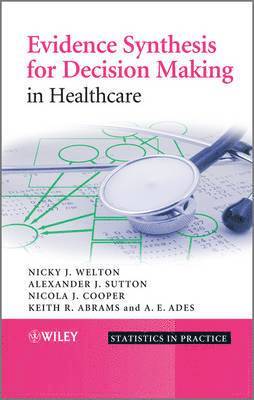
    Evidence Synthesis for Decision Making in Healthcare

    AvNicky J. Welton,Alexander J. Sutton

    Inbunden, Engelska, 2012

    Del 132 i serien Statistics in Practice

    811 kr

    Beställningsvara. Skickas inom 5-8 vardagar. Fri frakt över 249 kr.

    Beskrivning

    In the evaluation of healthcare, rigorous methods of quantitative assessment are necessary to establish interventions that are both effective and cost-effective. Usually a single study will not fully address these issues and it is desirable to synthesize evidence from multiple sources. This book aims to provide a practical guide to evidence synthesis for the purpose of decision making, starting with a simple single parameter model, where all studies estimate the same quantity (pairwise meta-analysis) and progressing to more complex multi-parameter structures (including meta-regression, mixed treatment comparisons, Markov models of disease progression, and epidemiology models). A comprehensive, coherent framework is adopted and estimated using Bayesian methods. Key features: A coherent approach to evidence synthesis from multiple sources.Focus is given to Bayesian methods for evidence synthesis that can be integrated within cost-effectiveness analyses in a probabilistic framework using Markov Chain Monte Carlo simulation.Provides methods to statistically combine evidence from a range of evidence structures.Emphasizes the importance of model critique and checking for evidence consistency.Presents numerous worked examples, exercises and solutions drawn from a variety of medical disciplines throughout the book.WinBUGS code is provided for all examples.Evidence Synthesis for Decision Making in Healthcare is intended for health economists, decision modelers, statisticians and others involved in evidence synthesis, health technology assessment, and economic evaluation of health technologies.

    Produktinformation

    • Utgivningsdatum:2012-05-11
    • Mått:158 x 236 x 18 mm
    • Vikt:504 g
    • Format:Inbunden
    • Språk:Engelska
    • Serie:Statistics in Practice
    • Antal sidor:294
    • Förlag:John Wiley & Sons Inc
    • ISBN:9780470061091

    Utforska kategorier

    • Medicin: allmänt inom Medicin
    • Matematisk statistik inom Naturvetenskap och teknik
    • Klinisk medicin och internmedicin inom Medicin

    Mer om författaren

    Nicky Welton, Department of Social Medicine, University of BristolDr Welton's research includes Bayesian statistical modeling in epidemiology and evidence synthesis and evidence consistency.Alex Sutton, Department of Health Sciences, University of LeicesterDr Sutton, senior lecture in medical statistics, has a primary research interest in meta-analysis. This specifically includes methods to combine evidence from disparate sources, and methods to deal with the problem of publication bias. With numerous published papers in a variety of journals he has also collaborated on over 15 substantive evidence synthesis projects. He is lead author on one of the first textbooks on meta-analysis in medicine and is co-editor on a recently published Wiley book on publication bias.Nicola Cooper, Department of Health Sciences, University of LeicesterDr Cooper’s primary research interest is in the interface and integration of medical statistics and health economics. This specifically includes methods for statistical modelling of cost data, integration of evidence synthesis within a decision-modelling context, handling of missing data in economic evaluations conducted alongside clinical trials, and the application of Bayesian statistical methods to all of the above.Keith Abrams, Department of Health Sciences, University of LeicesterProfessor Abrams' research interests include the development and application of Bayesian methods in healthcare evaluation, systematic reviews and meta-analysis, and the joint modeling of longitudinal and time-to-event data. He has published dozens of articles in numerous international journals and is the co-author of two Wiley books in this area.Anthony E Ades, Department of Social Medicine, University of Bristol with over 30 published articles in the last three years, Professor Ades' research interests include statistical methods for multi-parameter evidence synthesis in epidemiology, disease mapping and economic evaluation; Bayesian decision theory and the expected value of information; statistical and epidemiological methods in infectious disease surveillance.

    Innehållsförteckning

    • Preface xi1 Introduction 11.1 The rise of health economics 11.2 Decision making under uncertainty 41.2.1 Deterministic models 41.2.2 Probabilistic decision modelling 61.3 Evidence-based medicine 91.4 Bayesian statistics 101.5 NICE 111.6 Structure of the book 121.7 Summary key points 131.8 Further reading 13References 142 Bayesian methods and WinBUGS 172.1 Introduction to Bayesian methods 172.1.1 What is a Bayesian approach? 172.1.2 Likelihood 182.1.3 Bayes’ theorem and Bayesian updating 192.1.4 Prior distributions 222.1.5 Summarising the posterior distribution 232.1.6 Prediction 242.1.7 More realistic and complex models 242.1.8 MCMC and Gibbs sampling 252.2 Introduction to WinBUGS 262.2.1 The BUGS language 262.2.2 Graphical representation 312.2.3 Running WinBUGS 322.2.4 Assessing convergence in WinBUGS 332.2.5 Statistical inference in WinBUGS 362.2.6 Practical aspects of using WinBUGS 392.3 Advantages and disadvantages of a Bayesian approach 392.4 Summary key points 402.5 Further reading 412.6 Exercises 41References 423 Introduction to decision models 433.1 Introduction 433.2 Decision tree models 443.3 Model parameters 453.3.1 Effects of interventions 453.3.2 Quantities relating to the clinical epidemiology of the clinical condition being treated 503.3.3 Utilities 523.3.4 Resource use and costs 523.4 Deterministic decision tree 523.5 Stochastic decision tree 563.5.1 Presenting the results of stochastic economic decision models 603.6 Sources of evidence 663.7 Principles of synthesis for decision models (motivation for the rest of the book) 703.8 Summary key points 703.9 Further reading 713.10 Exercises 71References 724 Meta-analysis using Bayesian methods 764.1 Introduction 764.2 Fixed Effect model 784.3 Random Effects model 814.3.1 The predictive distribution 834.3.2 Prior specification for τ 844.3.3 ‘Exact’ Random Effects model for Odds Ratios based on a Binomial likelihood 844.3.4 Shrunken study level estimates 864.4 Publication bias 874.5 Study validity 884.6 Summary key points 884.7 Further reading 884.8 Exercises 89References 925 Exploring between study heterogeneity 945.1 Introduction 945.2 Random effects meta-regression models 955.2.1 Generic random effect meta-regression model 955.2.2 Random effects meta-regression model for Odds Ratio (OR) outcomes using a Binomial likelihood 985.2.3 Autocorrelation and centring covariates 1005.3 Limitations of meta-regression 1045.4 Baseline risk 1055.4.1 Model for including baseline risk in a meta-regression on the (log) OR scale 1075.4.2 Final comments on including baseline risk as a covariate 1095.5 Summary key points 1105.6 Further reading 1105.7 Exercises 110References 1136 Model critique and evidence consistency in random effects meta-analysis 1156.1 Introduction 1156.2 The Random Effects model revisited 1176.3 Assessing model fit 1216.3.1 Deviance 1216.3.2 Residual deviance 1226.4 Model comparison 1246.4.1 Effective number of parameters, pD 1256.4.2 Deviance Information Criteria 1266.5 Exploring inconsistency 1276.5.1 Cross-validation 1286.5.2 Mixed predictive checks 1316.6 Summary key points 1346.7 Further reading 1346.8 Exercises 134References 1377 Evidence synthesis in a decision modelling framework 1387.1 Introduction 1387.2 Evaluation of decision models: One-stage vs two-stage approach 1397.3 Sensitivity analyses (of model inputs and model specifications) 1477.4 Summary key points 1477.5 Further reading 1477.6 Exercises 147References 1498 Multi-parameter evidence synthesis 1518.1 Introduction 1518.2 Prior and posterior simulation in a probabilistic model: Maple Syrup Urine Disease (MSUD) 1528.3 A model for prenatal HIV testing 1558.4 Model criticism in multi-parameter models 1618.5 Evidence-based policy 1638.6 Summary key points 1648.7 Further reading 1658.8 Exercises 166References 1679 Mixed and indirect treatment comparisons 1699.1 Why go beyond ‘direct’ head-to-head trials? 1699.2 A fixed treatment effects model for MTC 1729.2.1 Absolute treatment effects 1769.2.2 Relative treatment efficacy and ranking 1769.3 Random Effects MTC models 1789.4 Model choice and consistency of MTC evidence 1799.4.1 Techniques for presenting and understanding the results of MTC 1809.5 Multi-arm trials 1819.6 Assumptions made in mixed treatment comparisons 1829.7 Embedding an MTC within a cost-effectiveness analysis 1839.8 Extension to continuous, rate and other outcomes 1859.9 Summary key points 1879.10 Further reading 1879.11 Exercises 189References 19010 Markov models 19310.1 Introduction 19310.2 Continuous and discrete time Markov models 19510.3 Decision analysis with Markov models 19610.3.1 Evaluating Markov models 19710.4 Estimating transition parameters from a single study 19910.4.1 Likelihood 20210.4.2 Priors and posteriors for multinomial probabilities 20210.5 Propagating uncertainty in Markov parameters into a decision model 20610.6 Estimating transition parameters from a synthesis of several studies 20910.6.1 Challenges for meta-analysis of evidence on Markov transition parameters 20910.6.2 The relationship between probabilities and rates 21110.6.3 Modelling study effects 21310.6.4 Synthesis of studies reporting aggregate data 21510.6.5 Incorporating studies that provide event history data 21710.6.6 Reporting results from a Random Effects model 21910.6.7 Incorporating treatment effects 22010.7 Summary key points 22410.8 Further reading 22410.9 Exercises 224References 22511 Generalised evidence synthesis 22711.1 Introduction 22711.2 Deriving a prior distribution from observational evidence 23011.3 Bias allowance model for the observational data 23311.4 Hierarchical models for evidence from different study designs 23811.5 Discussion 24411.6 Summary key points 24411.7 Further reading 24511.8 Exercises 246References 24812 Expected value of information for research prioritisation and study design 25112.1 Introduction 25112.2 Expected value of perfect information 25612.3 Expected value of partial perfect information 25912.3.1 Computation 26112.3.2 Notes on EVPPI 26412.4 Expected value of sample information 26412.4.1 Computation 26512.5 Expected net benefit of sampling 26612.6 Summary key points 26712.7 Further reading 26812.8 Exercises 268References 268Appendix 1 Abbreviations 270Appendix 2 Common distributions 272A2.1 The Normal distribution 272A2.2 The Binomial distribution 273A2.3 The Multinomial distribution 273A2.4 The Uniform distribution 274A2.5 The Exponential distribution 274A2.6 The Gamma distribution 275A2.7 The Beta distribution 276A2.8 The Dirichlet distribution 277Index 278