• Fri frakt över 249 kr
  • •
  • Snabba leveranser
  • •
  • Billiga böcker
Kundservice

Du är på sajten för privatpersoner.

Företag, bibliotek eller offentlig verksamhet?

Du handlar på classic.bokus.com, där alla dina funktioner finns intakta.
Till classic.bokus.com
Bokus logotyp. Gå till startsidan.
  • Erbjudanden
  • Nyheter
  • Student
  • Topplistor
  • Barn & ungdom
  • Bokus Play
  • E-böcker
  • Pocketböcker
  • Spel & pussel

10% rabatt på allt med kod NYSTART10 →

Sidfot

Mina sidor

    Hjälp

    • Kundservice
    • Vanliga frågor och svar
    • Frakt och leverans
    • Retur vid ångerrätt
    • Reklamera vara
    • Betalning
    • Köpvillkor
    • Allmänna villkor
    • Information om webbplatsens tillgänglighet

    Om Bokus

    • Om oss
    • Pressrum
    • För studenter
    • För företag
    • För bibliotek och offentlig verksamhet
    • För leverantörer
    • Hållbarhet

    Populärt

    • Aktuella erbjudanden
    • Presentkort
    • Studentlitteratur
    • Nya böcker
    • Topplistor
    • Signerade böcker
    • Engelska böcker

    Inspiration

    • Boktips
    • BookTok
    • Populära bokserier
    • Barnbokskaraktärer
    • Populära författare
    Logotyp för Bokus
    Följ oss på Facebook (extern länk)Följ oss på Instagram (extern länk)Följ oss på YouTube (extern länk)Följ oss på TikTok (extern länk)
    bokus @ CookiesAnpassa cookiesIntegritetspolicyKöpvillkor
    Till Citymail hemsida (extern länk)Till Budbee hemsida (extern länk)Till Postnord hemsida (extern länk)Till Schenker hemsida (extern länk)Till Early Bird hemsida (extern länk)Till Walleys hemsida (extern länk)
    1. Naturvetenskap och teknik
    2. Teknik och industri
    3. Transportteknik
    4. Flyg- och rymdteknik

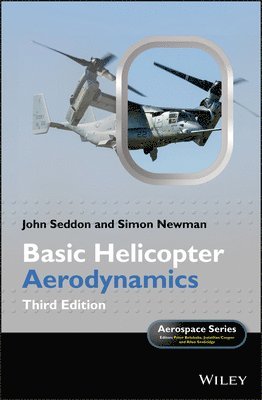
    Basic Helicopter Aerodynamics

    AvJohn M. Seddon,Simon Newman

    Inbunden, Engelska, 2011

    Del 35 i serien Aerospace Series

    939 kr

    Beställningsvara. Skickas inom 5-8 vardagar. Fri frakt över 249 kr.

    Beskrivning

    Basic Helicopter Aerodynamics is widely appreciated as an easily accessible, rounded introduction to the first principles of the aerodynamics of helicopter flight. Simon Newman has brought this third edition completely up to date with a full new set of illustrations and imagery. An accompanying website www.wiley.com/go/seddon contains all the calculation files used in the book, problems, solutions, PPT slides and supporting MATLAB® code. Simon Newman addresses the unique considerations applicable to rotor UAVs and MAVs, and coverage of blade dynamics is expanded to include both flapping, lagging and ground resonance. New material is included on blade tip design, flow characteristics surrounding the rotor in forward flight, tail rotors, brown-out, blade sailing and shipborne operations.Concentrating on the well-known Sikorsky configuration of single main rotor with tail rotor, early chapters deal with the aerodynamics of the rotor in hover, vertical flight, forward flight and climb. Analysis of these motions is developed to the stage of obtaining the principal results for thrust, power and associated quantities. Later chapters turn to the characteristics of the overall helicopter, its performance, stability and control, and the important field of aerodynamic research is discussed, with some reference also to aerodynamic design practice.This introductory level treatment to the aerodynamics of helicopter flight will appeal to aircraft design engineers and undergraduate and graduate students in aircraft design, as well as practising engineers looking for an introduction to or refresher course on the subject.

    Produktinformation

    • Utgivningsdatum:2011-07-28
    • Mått:173 x 252 x 19 mm
    • Vikt:576 g
    • Format:Inbunden
    • Språk:Engelska
    • Serie:Aerospace Series
    • Antal sidor:288
    • Upplaga:3
    • Förlag:John Wiley & Sons Inc
    • ISBN:9780470665015

    Utforska kategorier

    • Flyg- och rymdteknik inom Naturvetenskap och teknik
    • Maskinteknik och material inom Naturvetenskap och teknik

    Mer om författaren

    John Seddon, Formerly of the Ministry of Defence, UK Simon Newman, University of Southampton, UK

    Recensioner i media

    “In summary, this greatly improved edition is going to be of interest to all those young people wishing to embark on the understanding of the helicopter, without the fuss of too much detail and too much theory.”  (Aeronautical Journal, 1 August 2013)

    Innehållsförteckning

    • About the Authors xiSeries Preface xiiiPreface to First Edition xvPreface to Second Edition xviiPreface to Third Edition xixNotation xxiiiUnits xxviiAbbreviations xxix1 Introduction 11.1 Looking Back 11.1.1 Early Years 11.1.2 First World War Era 31.1.3 Inter-war Years 31.1.4 Second World War Era 61.1.5 Post-war Years 71.1.6 The Helicopter from an Engineering Viewpoint 131.2 Book Presentation 22Reference 222 Rotor in Vertical Flight: Momentum Theory and Wake Analysis 232.1 Momentum Theory for Hover 232.2 Non-dimensionalization 252.3 Figure of Merit 262.4 Axial Flight 292.5 Momentum Theory for Vertical Climb 292.6 Modelling the Streamtube 342.7 Descent 372.8 Wind Tunnel Test Results 452.9 Complete Induced-Velocity Curve 492.9.1 Basic Envelope 492.9.2 Autorotation 512.9.3 Ideal Autorotation 522.10 Summary Remarks on Momentum Theory 522.11 Complexity of Real Wake 532.12 Wake Analysis Methods 552.13 Ground Effect 582.14 Brownout 60References 613 Rotor in Vertical Flight: Blade Element Theory 633.1 Basic Method 633.2 Thrust Approximations 683.3 Non-uniform Inflow 703.3.1 Constant Downwash 713.4 Ideal Twist 713.5 Blade Mean Lift Coefficient 733.6 Power Approximations 743.7 Tip Loss 763.8 Example of Hover Characteristics 78Reference 784 Rotor Mechanisms for Forward Flight 794.1 The Edgewise Rotor 794.2 Flapping Motion 854.3 Rotor Control 884.4 Equivalence of Flapping and Feathering 944.4.1 Blade Sailing 954.4.2 Lagging Motion 954.4.3 Coriolis Acceleration 954.4.4 Lag Frequency 984.4.5 Blade Flexibility 994.4.6 Ground Resonance 99References 1095 Rotor Aerodynamics in Forward Flight 1115.1 Momentum Theory 1115.2 Descending Forward Flight 1155.3 Wake Analysis 1205.3.1 Geometry of the Rotor Flow 1205.4 Blade Element Theory 1255.4.1 Factors Involved 1255.4.2 Thrust 1285.4.3 In-Plane H-force 1305.4.4 Torque and Power 1315.4.5 Flapping Coefficients 1335.4.6 Typical Numerical Values 136References 1386 Aerodynamic Design 1396.1 Introductory 1396.2 Blade Section Design 1396.3 Blade Tip Shapes 1446.3.1 Rectangular 1446.3.2 Swept 1446.3.3 Advanced Planforms 1466.4 Tail Rotors 1486.4.1 Propeller Moment 1516.4.2 Precession – Yaw Agility 1556.4.3 Calculation of Downwash 1606.4.4 Yaw Acceleration 1626.4.5 Example – Sea King 1646.5 Parasite Drag 1656.6 Rear Fuselage Upsweep 1686.7 Higher Harmonic Control 1726.8 Aerodynamic Design Process 173References 1777 Performance 1797.1 Introduction 1797.2 Hover and Vertical Flight 1807.3 Forward Level Flight 1837.4 Climb in Forward Flight 1847.4.1 Optimum Speeds 1867.5 Maximum Level Speed 1877.6 Rotor Limits Envelope 1877.7 Accurate Performance Prediction 1887.8 AWorld Speed Record 1897.9 Speculation on the Really Low-Drag Helicopter 1917.10 An Exercise in High-Altitude Operation 1937.11 Shipborne Operation 195References 2008 Trim, Stability and Control 2018.1 Trim 2018.2 Treatment of Stability and Control 2048.3 Static Stability 2058.3.1 Incidence Disturbance 2068.3.2 Forward Speed Disturbance 2078.3.3 Angular Velocity (Pitch or Roll Rate) Disturbance 2078.3.4 Sideslip Disturbance 2078.3.5 Yawing Disturbance 2078.3.6 General Conclusion 2078.4 Dynamic Stability 2088.4.1 Analytical Process 2088.4.2 Special Case of Hover 2088.5 Hingeless Rotor 2098.6 Control 2098.7 Autostabilization 211References 2139 A Personal Look at the Future 215References 222Appendix: Performance and Mission Calculation 223A.1 Introduction 223A.2 Glossary of Terms 224A.3 Overall Aircraft 224A.3.1 Main Rotor 225A.3.2 Tail Rotor 227A.3.3 Complete Aircraft 228A.3.4 Example of Parameter Values 228A.4 Calculation of Engine Fuel Consumption 229A.5 Engine Limits 230A.5.1 Maximum Continuous Power Rating 231A.5.2 Take-Off or 1 Hour Power Rating 231A.5.3 Maximum Contingency or 21/2 Minute Power Rating 231A.5.4 Emergency or 1/2 Minute Power Rating 231A.6 Calculation of the Performance of a Helicopter 231A.6.1 Influence of Wind 236A.7 Mission Analysis 237A.7.1 Calculation Method 238A.7.2 Atmospheric Parameters 238A.7.3 Downwash Calculation 239A.8 Helicopter Power 240A.9 Fuel Flow 242A.10 Mission Leg 242A.11 Examples of Mission Calculations 244A.12 Westland Lynx – Search and Rescue 245A.12.1 Description of the Mission 245A.12.2 Fuel Consumption 246Index 249