• Fri frakt över 249 kr
  • •
  • Snabba leveranser
  • •
  • Billiga böcker
Kundservice

Du är på sajten för privatpersoner.

Företag, bibliotek eller offentlig verksamhet?

Du handlar på classic.bokus.com, där alla dina funktioner finns intakta.
Till classic.bokus.com
Bokus logotyp. Gå till startsidan.
  • Erbjudanden
  • Nyheter
  • Student
  • Topplistor
  • Barn & ungdom
  • Bokus Play
  • E-böcker
  • Pocketböcker
  • Spel & pussel

Må bättre, för mindre! Upp till 50% rabatt på hälsoböcker

Sidfot

Mina sidor

    Hjälp

    • Kundservice
    • Vanliga frågor och svar
    • Frakt och leverans
    • Retur vid ångerrätt
    • Reklamera vara
    • Betalning
    • Köpvillkor
    • Allmänna villkor
    • Information om webbplatsens tillgänglighet

    Om Bokus

    • Om oss
    • Pressrum
    • För studenter
    • För företag
    • För bibliotek och offentlig verksamhet
    • För leverantörer
    • Hållbarhet

    Populärt

    • Aktuella erbjudanden
    • Presentkort
    • Studentlitteratur
    • Nya böcker
    • Topplistor
    • Signerade böcker
    • Engelska böcker

    Inspiration

    • Boktips
    • BookTok
    • Populära bokserier
    • Barnbokskaraktärer
    • Populära författare
    Logotyp för Bokus
    Följ oss på Facebook (extern länk)Följ oss på Instagram (extern länk)Följ oss på YouTube (extern länk)Följ oss på TikTok (extern länk)
    bokus @ CookiesAnpassa cookiesIntegritetspolicyKöpvillkor
    Till Citymail hemsida (extern länk)Till Budbee hemsida (extern länk)Till Postnord hemsida (extern länk)Till Schenker hemsida (extern länk)Till Early Bird hemsida (extern länk)Till Walleys hemsida (extern länk)
    1. Naturvetenskap och teknik
    2. Matematik och naturvetenskap
    3. Biologi
    4. Biovetenskap

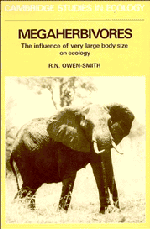
    Megaherbivores

    The Influence of Very Large Body Size on Ecology

    AvR. Norman Owen-Smith

    Häftad, Engelska, 1992

    Del i serien Cambridge Studies in Ecology

    973 kr

    Beställningsvara. Skickas inom 10-15 vardagar. Fri frakt över 249 kr.

    Beskrivning

    The largest land mammals are constrained in their activities by their large body size, a theme that is emphasized in this account of their general ecology. The book begins by raising the question as to why these once abundant and widely distributed 'megaherbivores' - elephants, rhinos, hippos and giraffes - have all but gone extinct, and ends by considering the implications of the answer for the conservation of the remaining populations. Existing megaherbivores are placed in the context of the more numerous species which occurred worldwide until the end of the last Ice Age, and knowledge of the ecology of surviving species is used to analyse the cause of the extinctions. The information and ideas contained in this book are of crucial importance to all concerned with halting the rapidly worsening conservation status of remaining elephant and rhinoceros species, and carries a wider message for those concerned with the ramifying effects of man on ecosystem processes. Graduate students and research scientists in ecology, conservation biology and wildlife management will find this book of value.

    Produktinformation

    • Utgivningsdatum:1992-03-05
    • Mått:151 x 228 x 28 mm
    • Vikt:640 g
    • Format:Häftad
    • Språk:Engelska
    • Serie:Cambridge Studies in Ecology
    • Antal sidor:388
    • Förlag:Cambridge University Press
    • ISBN:9780521426374

    Utforska kategorier

    • Biovetenskap inom Naturvetenskap och teknik
    • Däggdjur inom Djur och Natur
    • Däggdjur inom Naturvetenskap och teknik

    Innehållsförteckning

    • Prologue; 1. Morphology, evolutionary history and recent distribution; 2. Food and other habitat resources; 3. Space-time patterns of habitat use; 4. Body size and nutritional physiology; 5. Body size and feeding ecology; 6. Social organisation and behaviour; 7. Life history; 8. Body size and sociobiology; 9. Body size and reproductive patterns; 10. Demography; 11. Community interactions; 12. Body size and population regulation; 13. Body size and ecosystem processes; 14. Late Pleistocene extinctions; 15. Conservation; Epilogue: the megaherbivore syndrome; Appendixes; References; Index.