• Fri frakt över 249 kr
  • •
  • Snabba leveranser
  • •
  • Billiga böcker
Kundservice

Du är på sajten för privatpersoner.

Företag, bibliotek eller offentlig verksamhet?

Du handlar på classic.bokus.com, där alla dina funktioner finns intakta.
Till classic.bokus.com
Bokus logotyp. Gå till startsidan.
  • Erbjudanden
  • Nyheter
  • Student
  • Topplistor
  • Barn & ungdom
  • Bokus Play
  • E-böcker
  • Pocketböcker
  • Spel & pussel

10% studentrabatt med kod TERM26

Sidfot

Mina sidor

    Hjälp

    • Kundservice
    • Vanliga frågor och svar
    • Frakt och leverans
    • Retur vid ångerrätt
    • Reklamera vara
    • Betalning
    • Köpvillkor
    • Allmänna villkor
    • Information om webbplatsens tillgänglighet

    Om Bokus

    • Om oss
    • Pressrum
    • För studenter
    • För företag
    • För bibliotek och offentlig verksamhet
    • För leverantörer
    • Hållbarhet

    Populärt

    • Aktuella erbjudanden
    • Presentkort
    • Studentlitteratur
    • Nya böcker
    • Topplistor
    • Signerade böcker
    • Engelska böcker

    Inspiration

    • Boktips
    • BookTok
    • Populära bokserier
    • Barnbokskaraktärer
    • Populära författare
    Logotyp för Bokus
    Följ oss på Facebook (extern länk)Följ oss på Instagram (extern länk)Följ oss på YouTube (extern länk)Följ oss på TikTok (extern länk)
    bokus @ CookiesAnpassa cookiesIntegritetspolicyKöpvillkor
    Till Citymail hemsida (extern länk)Till Budbee hemsida (extern länk)Till Postnord hemsida (extern länk)Till Schenker hemsida (extern länk)Till Early Bird hemsida (extern länk)Till Walleys hemsida (extern länk)
    1. Samhälle och politik
    2. Sociologi och antropologi
    3. Antropologi

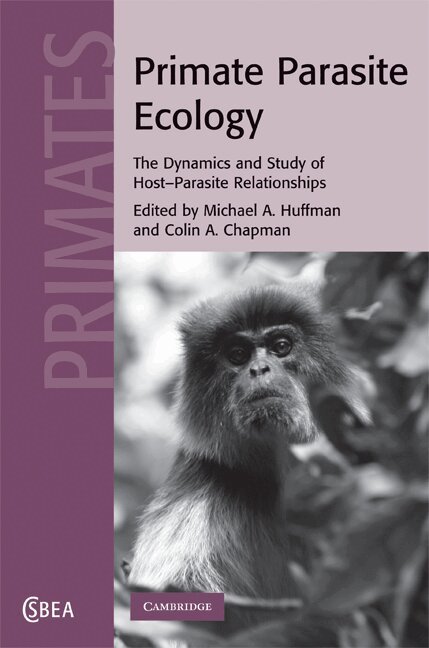
    Primate Parasite Ecology

    The Dynamics and Study of Host-Parasite Relationships

    AvMichael A. Huffman,Colin A. Chapman

    Inbunden, Engelska, 2009

    Del 57 i serien Cambridge Studies in Biological and Evolutionary Anthropology

    1 482 kr

    Beställningsvara. Skickas inom 10-15 vardagar. Fri frakt över 249 kr.

    Beskrivning

    Anyone who has spent an extended period in the tropics has an idea, through caring for others or first-hand experience, just what it is like to be a primate parasite host. Monkeys and apes often share parasites with humans, for example the HIV viruses which evolved from related viruses of chimpanzees and sooty mangabeys, and so understanding the ecology of infectious diseases in non-human primates is of paramount importance. Furthermore, there is accumulating evidence that environmental change may promote contact between humans and non-human primates and increase the possibility of sharing infectious disease. Written for academic researchers, this book addresses these issues and provides up-to-date information on the methods of study, natural history and ecology/theory of the exciting field of primate parasite ecology.

    Produktinformation

    • Utgivningsdatum:2009-02-19
    • Mått:157 x 235 x 30 mm
    • Vikt:990 g
    • Format:Inbunden
    • Språk:Engelska
    • Serie:Cambridge Studies in Biological and Evolutionary Anthropology
    • Antal sidor:548
    • Förlag:Cambridge University Press
    • ISBN:9780521872461

    Utforska kategorier

    • Antropologi inom Samhälle och politik
    • Människans biologi inom Naturvetenskap och teknik

    Mer om författaren

    Michael Huffman is an Associate Professor, and the first North American tenured faculty member, at Kyoto University's Primate Research Institute. He is currently an editor for the American Journal of Primatology, and has been the PI of several multi-disciplinary international collaborations spanning over 15 countries. Colin Chapman is a Professor in the Department of Anthropology and McGill School of Environment at McGill University. He has been an associate scientist with the Wildlife Conservation Society since 1995 and for the last 17 years has conducted research in the Kibale National Park, Uganda.

    Recensioner i media

    'this book is useful to both graduate students or researchers.' Mammalia

    Innehållsförteckning

    • Primate disease ecology: an integrative approach; Part I. Methods to Study Primate-Parasite Interactions: 1. Collection methods and diagnostic procedures for primate parasitology; 2. Methods of collection and identification of minute nematodes from the feces of primates, with special application to coevolutionary study of pinworms; 3. The utility of molecular methods for elucidating primate-pathogen relationships – the Oesophagostomum bifurcum example; 4. The application of endocrine measures in primate parasite ecology; 5. Using agent-based models to investigate primate disease ecology; Part II. The Natural History of Primate–Parasite Interactions: 6. What does a parasite see when it looks at a chimpanzee?; 7. Primate malarias: evolution, adaptation, and species jumping; 8. Disease avoidance and the evolution of primate social connectivity: Ebola, bats, gorillas, and chimpanzees; 9. Primate-parasitic zoonoses and anthropozoonses: a literature review; 10. Lice and other parasites as markers of primate evolutionary history; 11. Cryptic species and biodiversity of lice from primates; 12. Prevalence of Clostridium perfringens in intestinal microflora of non-human primates; 13. Intestinal bacteria of chimpanzees in the wild and in captivity - an application of molecular ecological methodologies; 14. Gastrointestinal parasites of bonobos in the Lomako Forest, Democratic Republic of Congo; 15. Habitat disturbance and seasonal fluctuations of lemur parasites in the rain forest of Ranomafana National Park, Madagascar; 16. Chimpanzee-parasite ecology at Budongo Forest (Uganda) and the Mahale Mountains (Tanzania): influence of climatic differences on self-medicative behavior; Part III. The Ecology of Primate–Parasite Interactions: 17. Primate exposure and the emergence of novel retroviruses; 18. Overview of parasites infecting howler monkeys, Alouatta sp., and potential consequences of human-howler interactions; 19. Primate parasite ecology: patterns and predictions from an ongoing study of Japanese macaques; 20. Crop raiding: the influence of behavioral and nutritional changes on primate-parasite relationships; 21. Can parasites infections be a selective force influencing primate group size? A test with red colobus; 22. How does diet quality affect the parasite ecology of mountain gorillas?; 23 Host-parasite Dynamics: Connecting Primate Field Data to Theory; Part IV. Conclusions: 24. Ways forward in the study of primate disease ecology; 25. Useful diagnostic references and images of protozoans, helminths, and nematodes commonly found in wild primates.