• Fri frakt över 249 kr
  • •
  • Snabba leveranser
  • •
  • Billiga böcker
Kundservice

Du är på sajten för privatpersoner.

Företag, bibliotek eller offentlig verksamhet?

Du handlar på classic.bokus.com, där alla dina funktioner finns intakta.
Till classic.bokus.com
Bokus logotyp. Gå till startsidan.
  • Erbjudanden
  • Nyheter
  • Student
  • Topplistor
  • Barn & ungdom
  • Bokus Play
  • E-böcker
  • Pocketböcker
  • Spel & pussel

10% rabatt på allt med kod NYSTART10 →

Sidfot

Mina sidor

    Hjälp

    • Kundservice
    • Vanliga frågor och svar
    • Frakt och leverans
    • Retur vid ångerrätt
    • Reklamera vara
    • Betalning
    • Köpvillkor
    • Allmänna villkor
    • Information om webbplatsens tillgänglighet

    Om Bokus

    • Om oss
    • Pressrum
    • För studenter
    • För företag
    • För bibliotek och offentlig verksamhet
    • För leverantörer
    • Hållbarhet

    Populärt

    • Aktuella erbjudanden
    • Presentkort
    • Studentlitteratur
    • Nya böcker
    • Topplistor
    • Signerade böcker
    • Engelska böcker

    Inspiration

    • Boktips
    • BookTok
    • Populära bokserier
    • Barnbokskaraktärer
    • Populära författare
    Logotyp för Bokus
    Följ oss på Facebook (extern länk)Följ oss på Instagram (extern länk)Följ oss på YouTube (extern länk)Följ oss på TikTok (extern länk)
    bokus @ CookiesAnpassa cookiesIntegritetspolicyKöpvillkor
    Till Citymail hemsida (extern länk)Till Budbee hemsida (extern länk)Till Postnord hemsida (extern länk)Till Schenker hemsida (extern länk)Till Early Bird hemsida (extern länk)Till Walleys hemsida (extern länk)
    1. Samhälle och politik
    2. Politik och statsskick
    3. Centralt styre och förvaltning

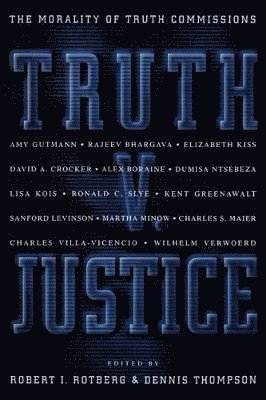
    Truth v. Justice

    The Morality of Truth Commissions

    AvRobert I. Rotberg,Dennis F. Thompson

    Häftad, Engelska, 2000

    Del i serien University Center for Human Values Series

    504 kr

    Beställningsvara. Skickas inom 5-8 vardagar. Fri frakt över 249 kr.

    Beskrivning

    The truth commission is an increasingly common fixture of newly democratic states with repressive or strife-ridden pasts. From South Africa to Haiti, truth commissions are at work with varying degrees of support and success. To many, they are the best--or only--way to achieve a full accounting of crimes committed against fellow citizens and to prevent future conflict. Others question whether a restorative justice that sets the guilty free, that cleanses society by words alone, can deter future abuses and allow victims and their families to heal. Here, leading philosophers, lawyers, social scientists, and activists representing several perspectives look at the process of truth commissioning in general and in post-apartheid South Africa. They ask whether the truth commission, as a method of seeking justice after conflict, is fair, moral, and effective in bringing about reconciliation. The authors weigh the virtues and failings of truth commissions, especially the South African Truth and Reconciliation Commission, in their attempt to provide restorative rather than retributive justice.They examine, among other issues, the use of reparations as social policy and the granting of amnesty in exchange for testimony. Most of the contributors praise South Africa's decision to trade due process for the kinds of truth that permit closure. But they are skeptical that such revelations produce reconciliation, particularly in societies that remain divided after a compromise peace with no single victor, as in El Salvador. Ultimately, though, they find the truth commission to be a worthy if imperfect instrument for societies seeking to say "never again" with confidence. At a time when truth commissions have been proposed for Bosnia, Kosovo, Cyprus, East Timor, Cambodia, Nigeria, Palestine, and elsewhere, the authors' conclusion that restorative justice provides positive gains could not be more important. In addition to the editors, the contributors are Amy Gutmann, Rajeev Bhargava, Elizabeth Kiss, David A. Crocker, Andre du Toit, Alex Boraine, Dumisa Ntsebeza, Lisa Kois, Ronald C. Slye, Kent Greenawalt, Sanford Levinson, Martha Minow, Charles S. Maier, Charles Villa-Vicencio, and Wilhelm Verwoerd.

    Produktinformation

    • Utgivningsdatum:2000-08-27
    • Mått:152 x 235 x 19 mm
    • Vikt:408 g
    • Format:Häftad
    • Språk:Engelska
    • Serie:University Center for Human Values Series
    • Antal sidor:344
    • Förlag:Princeton University Press
    • ISBN:9780691050720

    Utforska kategorier

    • Centralt styre och förvaltning inom Samhälle och politik
    • Statsvetenskap och politisk teori inom Samhälle och politik
    • Filosofiska discipliner inom Filosofi och religion

    Mer om författaren

    Robert I. Rotberg is President of the World Peace Foundation and Director of the Program on Intrastate Conflict at Harvard's Kennedy School. He is author or editor of dozens of books on Africa, Asia, and the Caribbean, including Creating Peace in Sri Lanka: Civil War and Reconciliation (1999), War and Peace in Southern Africa (1998), Vigilance and Vengeance: NGOs Preventing Ethnic Conflict in Divided Societies (1996), and The Founder: Cecil Rhodes and the Pursuit of Power (1988). Dennis Thompson is Alfred North Whitehead Professor of Political Philosophy and Director of the Program in Ethics and the Professions at Harvard University. He is author of Political Ethics and Public Office (1987) and coauthor, with Amy Gutmann, of Democracy and Disagreement (1996).

    Recensioner i media

    "This volume of essays, which concentrates on the South African experience while drawing on others elsewhere, is a useful and timely reminder of the tough and messy compromises that were made between the competing demands of justice and retribution, peace and forgiveness."--The Economist "This is an important book for those interested in contemporary efforts to deal with modern atrocities ... The diverse group of contributors brings exceptionally wide exposure and depth to the subject."--Booklist "An engaging collection of essays ... "--Reed Brody, The Nation "The essays themselves are accessible clear, well-written, and engaging and extraordinarily relevant as we struggle to develop an appropriate response to oppressive regime throughout the world. Truth v. Justice's greatest strength lies in both the individual and collective force of the essays each of which not only is intelligently written and important in its own right, but also demonstrative of the author's clear engagement with one another's concerns. The result is a comprehensive and thought-provoking analysis of the truth commission."--Karen Newirth, International Law and Politics "One of the most painful and conspicuous gaps is the impunity usually enjoyed, after their removal from power, by men who, while in power, trampled on the human rights of their own pwople or even waged war against them. Truth v. Justice focuses on the most promising device our civilization has invented to remedy that particular and all too familiar shortfall of justice."--Geoffrey Best, Times Literary Supplement "A highly civilized, lively and provocative exchange between interesting people of diverse backgrounds and positions."--Saul Smilansky, Times Literary Supplement

    Innehållsförteckning

    • Acknowledgments vii I. Truth Commissions and the Provision of Truth, Justice, and Reconciliation by Robert I. Rotbtrg 3 II. The Moral Foundations of Truth Commissions by Amy Gutmann and Dennis Thompson 22 III. Restoring Decency to Barbaric Societies by Rajeev Bhargava 45 IV Moral Ambition Within and Beyond Political Constraints: Reflections on Restorative Justice by Elizabeth Kiss 68 V Truth Commissions, Transitional Justice, and Civil Society by David A Crockcr 99 VI. The Moral Foundations of the South African TRC: Truth as Acknowledgment and Justice as Recognition by Andre du Toit 122 VII. Truth and Reconciliation in South Africa: The Third Way by Alex Boraine 141 VIII. The Uses of Truth Commissions: Lessons for the World by Dumisa B. Ntsebexa 158 IX. Amnesty, Truth, and Reconciliation: Reflections on the South African Amnesty Process by Ronald C. Slye 170 X. Amnesty's Justice by Kent Greenawalt 189 XI. Trials, Commissions, and Investigating Committees: The Elusive Search for Norms of Due Process by Sanford Levinson 211 XII. The Hope for Healing: What Can Truth Commissions Do? by Martha Minow 235 XIII. Doing History, Doing Justice: The Narrative of the Historian and of the Truth Commission by Charles S. Mater 261 XIV Constructing a Report: Writing Up the "Truth" by Charles Villa-Yicencio and Wilhelm Yerwoerd 279 The Contributors 295 Index 299