• Fri frakt över 249 kr
  • •
  • Snabba leveranser
  • •
  • Billiga böcker
Kundservice

Du är på sajten för privatpersoner.

Företag, bibliotek eller offentlig verksamhet?

Du handlar på classic.bokus.com, där alla dina funktioner finns intakta.
Till classic.bokus.com
Bokus logotyp. Gå till startsidan.
  • Erbjudanden
  • Nyheter
  • Student
  • Topplistor
  • Barn & ungdom
  • Bokus Play
  • E-böcker
  • Pocketböcker
  • Spel & pussel

10% rabatt på allt med kod NYSTART10 →

Sidfot

Mina sidor

    Hjälp

    • Kundservice
    • Vanliga frågor och svar
    • Frakt och leverans
    • Retur vid ångerrätt
    • Reklamera vara
    • Betalning
    • Köpvillkor
    • Allmänna villkor
    • Information om webbplatsens tillgänglighet

    Om Bokus

    • Om oss
    • Pressrum
    • För studenter
    • För företag
    • För bibliotek och offentlig verksamhet
    • För leverantörer
    • Hållbarhet

    Populärt

    • Aktuella erbjudanden
    • Presentkort
    • Studentlitteratur
    • Nya böcker
    • Topplistor
    • Signerade böcker
    • Engelska böcker

    Inspiration

    • Boktips
    • BookTok
    • Populära bokserier
    • Barnbokskaraktärer
    • Populära författare
    Logotyp för Bokus
    Följ oss på Facebook (extern länk)Följ oss på Instagram (extern länk)Följ oss på YouTube (extern länk)Följ oss på TikTok (extern länk)
    bokus @ CookiesAnpassa cookiesIntegritetspolicyKöpvillkor
    Till Citymail hemsida (extern länk)Till Budbee hemsida (extern länk)Till Postnord hemsida (extern länk)Till Schenker hemsida (extern länk)Till Early Bird hemsida (extern länk)Till Walleys hemsida (extern länk)
    1. Samhälle och politik
    2. Samhälle och kultur
    3. Kultur och medier
    4. Referensverk och tvärvetenskap

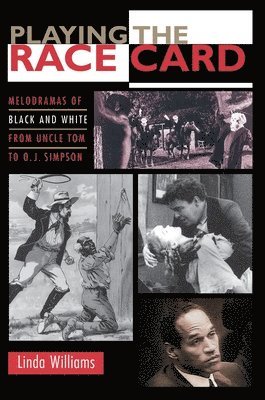
    Playing the Race Card

    Melodramas of Black and White from Uncle Tom to O. J. Simpson

    AvLinda Williams

    Häftad, Engelska, 2002

    414 kr

    Beställningsvara. Skickas inom 5-8 vardagar. Fri frakt över 249 kr.

    Fler format och utgåvor

    E-bok

    616 kr

    Beskrivning

    The black man suffering at the hands of whites, the white woman sexually threatened by the black man. Both images have long been burned into the American conscience through popular entertainment, and today they exert a powerful and disturbing influence on Americans' understanding of race. So argues Linda Williams in this boldly inquisitive book, where she probes the bitterly divisive racial sentiments aroused by such recent events as O. J. Simpson's criminal trial. Williams, the author of Hard Core, explores how these images took root, beginning with melodramatic theater, where suffering characters acquire virtue through victimization. The racial sympathies and hostilities that surfaced during the trial of the police in the beating of Rodney King and in the O. J. Simpson murder trial are grounded in the melodramatic forms of Uncle Tom's Cabin and The Birth of a Nation. Williams finds that Stowe's beaten black man and Griffith's endangered white woman appear repeatedly throughout popular entertainment, promoting interracial understanding at one moment, interracial hate at another.The black and white racial melodrama has galvanized emotions and fueled the importance of new media forms, such as serious, "integrated" musicals of stage and film, including The Jazz Singer and Show Boat. It also helped create a major event out of the movie Gone With the Wind, while enabling television to assume new moral purpose with the broadcast of Roots. Williams demonstrates how such developments converged to make the televised race trial a form of national entertainment. When prosecutor Christopher Darden accused Simpson's defense team of "playing the race card," which ultimately trumped his own team's gender card, he feared that the jury's sympathy for a targeted black man would be at the expense of the abused white wife. The jury's verdict, Williams concludes, was determined not so much by facts as by the cultural forces of racial melodrama long in the making. Revealing melodrama to be a key element in American culture, Williams argues that the race images it has promoted are deeply ingrained in our minds and that there can be no honest discussion about race until Americans recognize this predicament.

    Produktinformation

    • Utgivningsdatum:2002-09-23
    • Mått:154 x 234 x 24 mm
    • Vikt:620 g
    • Format:Häftad
    • Språk:Engelska
    • Antal sidor:424
    • Förlag:Princeton University Press
    • ISBN:9780691102832
    • Utmärkelser:Short-listed for Theatre Library Association Award 2002

    Utforska kategorier

    • Referensverk och tvärvetenskap inom Samhälle och politik
    • Diskriminering och rättvisa inom Samhälle och politik
    • Film inom Kultur

    Mer om författaren

    Linda Williams is Professor of Film Studies and Rhetoric at the University of California, Berkeley, where she directs the Film Studies Program. She is the author of "Hard Core: Power, Pleasure, and the Frenzy of the Visible" and "Figures of Desire: A Theory and Analysis of Surrealist Film". Her edited volumes include "Viewing Positions: Ways of Seeing Film" and, with Christine Gledhill, "Reinventing Film Studies".

    Recensioner i media

    Finalist for the Theatre Library Association Award for Outstanding Book in Recorded or Broadcast Performance "Williams makes the best theoretical case for descriptive representation for marginalized groups to achieve democratic equality. Her review of democratic theory is both exhaustive and masterful."--Katherine Tate, Annals of the American Academy of Political and Social Sciences "It seems like a long leap to make 'from Lillian Gish to ... Leonardo Dicaprio and from Uncle Tom to Rodney King,' but in this dazzling, benchmark work ... Williams does it with panache and enormous insight... This is a vital contribution to American studies as well as film and race studies."--Publishers Weekly (starred review) "But the real elegance is in her thinking... [Williams's writing impresses] wherever melodrama lands, it brings the same set of concerns, an Playing the Race Card is at it protean best when it is tracing these from medium to medium."--Lisa Kennedy, Village Voice "For any honest discussion about race relations in America, [Williams] argues, we must first acknowledge the indeterminate influence of melodrama. Conscientiously researched ... this insightful book is essential for academic libraries and students in film studies."--Library Journal "In her intellectually rousing book, Playing the Race Card, Williams find the root of [melodramatic] characterizations throughout American popular culture... Such images, she argues, continue to feed attitudes of racial empathy and enmity... With its thought-provoking analysis and textbook scholarship, Playing the Race Card is a ... passionately crafted book. But Williams greatest contribution may be liberating a discussion of race from the incendiary rhetoric and polemics that accompany such a discourse. She creates a new dialogue about how popular entertainment has fostered racial sympathy as well as mistrust, and how those images still shape us today."--Renee Graham, The Boston Globe "[Williams] dispenses with the cant and silliness that tangles much academic talk about racial matters... Steeped in the details of text and context, she invites the reader to see familiar works in fresh ways. Williams's achievement is to recapture the complexity of our tangled racial history without sanitizing racism."--Jonathan Rieder, New York Times Book Review "Williams offers a fresh and insightful exploration of some of the roots of the American racial dilemma... Well written and persuasively argued."--Choice "A work that is extremely valuable to historians who wish to enhance the sophistication of their own thinking about teaching with film and other visual media... I believe the author succeeds at what she sets out to do. In such a large, sweeping, and ambitious book as this, that is high praise indeed."--Alecia P. Long, H-Net Reviews "This book would be valuable just for its scholarly insights, sharp contextual readings, well-selected illustrations, and imaginative genealogy of melodramatic practices across various eras. What gives it special urgency is that by locating those moments when new media (print, film, TV, video) were shaping new ways of conceiving race, Williams creates a moving picture of racial melodrama in the United States that manages to connect the polemic of Uncle Tom's Cabin to the ... televised O. J. Simpson murder trial"--Kurt Eisen, American Literature "Broad and brilliant, a combination rare in serious books these days, Playing the Race Card argues persuasively that melodrama has profoundly affected American attitudes toward race over the last century and a half... Williams's success is to spell out exactly how the melodramatic imagination of our popular culture shapes how we live and understand race in America and how these stories make as well as narrative history."--Grace Elizabeth Hale, The Historian

    Innehållsförteckning

    • Illustrations ix Preface xiii Acknowledgments xvii Introduction: Playing the Race Card 3 Chapter One: The American Melodramatic Mode 10 Chapter Two: "A Wonderful, 'Leaping 'Fish": Varieties of Uncle Tom 45 Chapter Three: Anti-Tom and The Birth of a Nation 96 Chapter Four: Posing as Black, Passing as White: The Melos of Black and White Melodrama in the Jazz Age 136 Chapter Five: Rewriting the Plantation Legend: Scarlett "Totes a Weary Load" 187 Chapter Six: Home Sweet Africa: Alex Haley's and TV's Roots 220 Chapter Seven: Trials of Black and White: California v. Powell and The People v. Orenthal James Simpson 252 Conclusion: Our Melodramatic Racial Fix 296 Notes 311 Bibliography 369 Index 385