• Fri frakt över 249 kr
  • •
  • Snabba leveranser
  • •
  • Billiga böcker
Kundservice

Du är på sajten för privatpersoner.

Företag, bibliotek eller offentlig verksamhet?

Du handlar på classic.bokus.com, där alla dina funktioner finns intakta.
Till classic.bokus.com
Bokus logotyp. Gå till startsidan.
  • Erbjudanden
  • Nyheter
  • Student
  • Topplistor
  • Barn & ungdom
  • Bokus Play
  • E-böcker
  • Pocketböcker
  • Spel & pussel

10% rabatt på allt med kod NYSTART10 →

Sidfot

Mina sidor

    Hjälp

    • Kundservice
    • Vanliga frågor och svar
    • Frakt och leverans
    • Retur vid ångerrätt
    • Reklamera vara
    • Betalning
    • Köpvillkor
    • Allmänna villkor
    • Information om webbplatsens tillgänglighet

    Om Bokus

    • Om oss
    • Pressrum
    • För studenter
    • För företag
    • För bibliotek och offentlig verksamhet
    • För leverantörer
    • Hållbarhet

    Populärt

    • Aktuella erbjudanden
    • Presentkort
    • Studentlitteratur
    • Nya böcker
    • Topplistor
    • Signerade böcker
    • Engelska böcker

    Inspiration

    • Boktips
    • BookTok
    • Populära bokserier
    • Barnbokskaraktärer
    • Populära författare
    Logotyp för Bokus
    Följ oss på Facebook (extern länk)Följ oss på Instagram (extern länk)Följ oss på YouTube (extern länk)Följ oss på TikTok (extern länk)
    bokus @ CookiesAnpassa cookiesIntegritetspolicyKöpvillkor
    Till Citymail hemsida (extern länk)Till Budbee hemsida (extern länk)Till Postnord hemsida (extern länk)Till Schenker hemsida (extern länk)Till Early Bird hemsida (extern länk)Till Walleys hemsida (extern länk)
    1. Naturvetenskap och teknik
    2. Geovetenskap
    3. Miljövetenskap och miljöpolitik

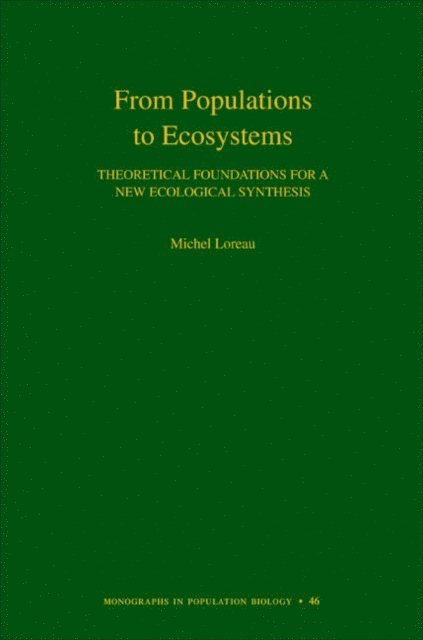
    From Populations to Ecosystems

    Theoretical Foundations for a New Ecological Synthesis

    AvMichel Loreau

    Häftad, Engelska, 2010

    Del i serien Monographs in Population Biology

    634 kr

    Beställningsvara. Skickas inom 5-8 vardagar. Fri frakt över 249 kr.

    Fler format och utgåvor

    E-bok

    900 kr

    Beskrivning

    The major subdisciplines of ecology--population ecology, community ecology, ecosystem ecology, and evolutionary ecology--have diverged increasingly in recent decades. What is critically needed today is an integrated, real-world approach to ecology that reflects the interdependency of biodiversity and ecosystem functioning. From Populations to Ecosystems proposes an innovative theoretical synthesis that will enable us to advance our fundamental understanding of ecological systems and help us to respond to today's emerging global ecological crisis. Michel Loreau begins by explaining how the principles of population dynamics and ecosystem functioning can be merged. He then addresses key issues in the study of biodiversity and ecosystems, such as functional complementarity, food webs, stability and complexity, material cycling, and metacommunities. Loreau describes the most recent theoretical advances that link the properties of individual populations to the aggregate properties of communities, and the properties of functional groups or trophic levels to the functioning of whole ecosystems, placing special emphasis on the relationship between biodiversity and ecosystem functioning.Finally, he turns his attention to the controversial issue of the evolution of entire ecosystems and their properties, laying the theoretical foundations for a genuine evolutionary ecosystem ecology. From Populations to Ecosystems points the way to a much-needed synthesis in ecology, one that offers a fuller understanding of ecosystem processes in the natural world.

    Produktinformation

    • Utgivningsdatum:2010-07-21
    • Mått:152 x 235 x 22 mm
    • Vikt:454 g
    • Format:Häftad
    • Språk:Engelska
    • Serie:Monographs in Population Biology
    • Antal sidor:320
    • Förlag:Princeton University Press
    • ISBN:9780691122700

    Utforska kategorier

    • Miljövetenskap och miljöpolitik inom Naturvetenskap och teknik
    • Biovetenskap inom Naturvetenskap och teknik

    Mer om författaren

    Michel Loreau is professor and Canada Research Chair in theoretical ecology at McGill University.

    Recensioner i media

    "This reviewer was particularly intrigued by the author's resurrection of the hypothesis that ecosystem complexity and biodiversity supports ecosystem stability, an early romantic notion that turned out to be extremely difficult to demonstrate. He makes a convincing case that this hypothesis may have merit after all."--Choice "This is a superbly written book about a very important challenge, namely that the theories of population, community and ecosystem ecology, and of evolution, have developed separately and are not entirely compatible. We need a synthesis of theories of population dynamics and ecosystem function and, faced with a global environmental crisis, we need it badly. This book is an excellent start... I strongly recommend this book to researchers in any branch of ecology."--Alan J. Butler, Austral Ecology "I found the text both informative and interesting, and certainly relied upon my background in population ecology and genetics in reviewing this text. In the classroom environment, I could see this text being used in a graduate seminar or perhaps a senior-level honors class in biology, ecology, environmental science, or any of the related disciplines (as a paleontologist, I would certainly recommend it!)."--Ryan F. Morgan, Priscum

    Innehållsförteckning

    • Acknowledgments vii Preface: On Unifying Approaches in Ecology ix Chapter 1: Population and Ecosystem Approaches in Ecology 1 Chapter 2: The Maintenance and Functional Consequences of Species Diversity 19 Chapter 3: Biodiversity and Ecosystem Functioning 56 Chapter 4: Food Webs, Interaction Webs, and Ecosystem Functioning 79 Chapter 5: Stability and Complexity of Ecosystems: New Perspectives on an Old Debate 123 Chapter 6: Material Cycling and the Overall Functioning of Ecosystems 164 Chapter 7: Spatial Dynamics of Biodiversity and Ecosystem Functioning: Metacommunities and Metaecosystems 196 Chapter 8: Evolution of Ecosystems and Ecosystem Properties 225 Chapter 9: Postface: Toward an Integrated, Predictive Ecology 260 References 269 Index 291