• Fri frakt över 249 kr
  • •
  • Snabba leveranser
  • •
  • Billiga böcker
Kundservice

Du är på sajten för privatpersoner.

Företag, bibliotek eller offentlig verksamhet?

Du handlar på classic.bokus.com, där alla dina funktioner finns intakta.
Till classic.bokus.com
Bokus logotyp. Gå till startsidan.
  • Erbjudanden
  • Student
  • Topplistor
  • Barn & ungdom
  • Bokus Play
  • E-böcker
  • Ljudböcker
  • Pocketböcker
  • Spel & pussel

10% rabatt på allt med kod NYSTART10 →

Sidfot

Mina sidor

    Hjälp

    • Kundservice
    • Vanliga frågor och svar
    • Frakt och leverans
    • Retur vid ångerrätt
    • Reklamera vara
    • Betalning
    • Köpvillkor
    • Allmänna villkor
    • Information om webbplatsens tillgänglighet

    Om Bokus

    • Om oss
    • Pressrum
    • För studenter
    • För företag
    • För bibliotek och offentlig verksamhet
    • För leverantörer
    • Hållbarhet

    Populärt

    • Aktuella erbjudanden
    • Presentkort
    • Studentlitteratur
    • Nya böcker
    • Topplistor
    • Signerade böcker
    • Engelska böcker

    Inspiration

    • Boktips
    • BookTok
    • Populära bokserier
    • Barnbokskaraktärer
    • Populära författare
    Logotyp för Bokus
    Följ oss på Facebook (extern länk)Följ oss på Instagram (extern länk)Följ oss på YouTube (extern länk)Följ oss på TikTok (extern länk)
    bokus @ CookiesAnpassa cookiesIntegritetspolicyKöpvillkor
    Till Citymail hemsida (extern länk)Till Budbee hemsida (extern länk)Till Postnord hemsida (extern länk)Till Schenker hemsida (extern länk)Till Early Bird hemsida (extern länk)Till Walleys hemsida (extern länk)
    1. Naturvetenskap och teknik
    2. Matematik och naturvetenskap
    3. Astronomi

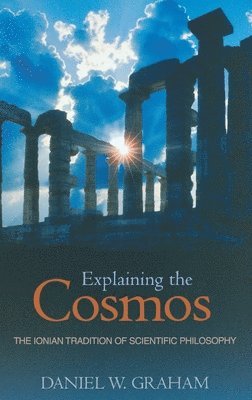
    Explaining the Cosmos

    The Ionian Tradition of Scientific Philosophy

    AvDaniel W. Graham

    Inbunden, Engelska, 2006

    805 kr

    Beställningsvara. Skickas inom 5-8 vardagar. Fri frakt över 249 kr.

    Fler format och utgåvor

    E-bok

    1 133 kr

    Beskrivning

    Explaining the Cosmos is a major reinterpretation of Greek scientific thought before Socrates. Focusing on the scientific tradition of philosophy, Daniel Graham argues that Presocratic philosophy is not a mere patchwork of different schools and styles of thought. Rather, there is a discernible and unified Ionian tradition that dominates Presocratic debates. Graham rejects the common interpretation of the early Ionians as "material monists" and also the view of the later Ionians as desperately trying to save scientific philosophy from Parmenides' criticisms. In Graham's view, Parmenides plays a constructive role in shaping the scientific debates of the fifth century BC. Accordingly, the history of Presocratic philosophy can be seen not as a series of dialectical failures, but rather as a series of theoretical advances that led to empirical discoveries. Indeed, the Ionian tradition can be seen as the origin of the scientific conception of the world that we still hold today.

    Produktinformation

    • Utgivningsdatum:2006-08-06
    • Mått:152 x 235 x 28 mm
    • Vikt:653 g
    • Format:Inbunden
    • Språk:Engelska
    • Antal sidor:368
    • Förlag:Princeton University Press
    • ISBN:9780691125404

    Utforska kategorier

    • Astronomi inom Naturvetenskap och teknik
    • Filosofiska discipliner inom Filosofi och religion
    • Naturvetenskapens historia inom Naturvetenskap och teknik

    Mer om författaren

    Daniel W. Graham is A. O. Smoot Professor of Philosophy at Brigham Young University. He is the author of "Aristotle's Two Systems"; editor of the two-volume collected papers of Gregory Vlastos, "Studies in Greek Philosophy" (Princeton); and translator of and commentator on "Aristotle: Physics, Book VIII". He is a member of the editorial boards of "Apeiron" and "History of Philosophy Quarterly".

    Recensioner i media

    "Essential... Due to the depth and breadth of its research, its lucidity, and the cogency of its arguments, Explaining the Cosmos will undoubtedly become a new standard against which future work on the pre-Socratics is measured."--Choice "Graham harks back to Harold Cherniss's critical reading of Aristotle as more of an engaged interpreter than objective historian of the Presocratics... This is a genuine achievement... [M]uch of what Graham offers ... is persuasive, illuminating, and occasionally brilliant."--Simon Trepanier, Isis "[S]cholars everywhere will be grateful for this engaging intellectual adventure."--Robert Hahn, Journal of the History of Philosophy

    Innehållsförteckning

    • PREFACE xi ABBREVIATIONS AND BRIEF REFERENCES xv Chapter 1: The Ionian Program 1 1.1 Anaximander's Project 4 1.2 Anaximander's Project as a Scientific Program 14 1.3 Toward an Understanding of the Ionian Tradition 18 Chapter 2: Anaximander's Principles 28 2.1 Out of the Boundless 28 2.2 Powers in Conflict 34 2.3 Elements and Powers 39 Chapter 3: Anaximenes' Theory of Change 45 3.1 The Theory of Change 45 3.2 Material Monism 48 3.3 Problems with Material Monism 50 3.4 Anaximenes and the Generating Substance Theory 67 3.5 Anaximenes' Achievement 82 Chapter 4: The Generating Substance Theory as an Explanatory Hypothesis 85 4.1 GST Formalized 85 4.2 A Compromise View? 88 4.3 GST as a Paradigm of Explanation 91 4.4 Advantages of GST 98 4.5 Disadvantages of GST 106 Chapter 5: Heraclitus's Criticism of Ionian Philosophy 113 5.1 Extreme Interpretations 113 5.2 Barnes's Argument for Heraclitus-F 118 5.3 The Unity of Opposites 122 5.4 The Flux Thesis 129 5.5 Heraclitus and GST 137 Chapter 6: Parmenides' Criticism of Ionian Philosophy 148 6.1 Parmenides' Response to Heraclitus 148 6.2 Parmenides' Criticism 155 6.3 Properties of What-Is 162 6.4 Deceptive Cosmology 169 6.5 Parmenides' Scientific Discovery 179 6.6 Parmenides' Response to GST 182 Chapter 7: Anaxagoras and Empedocles: Eleatic Pluralists 186 7.1 The Standard Interpretation 186 7.2 Questions about the Standard Intepretation 188 7.3 The Elemental Substance Theory 195 7.4 Parmenides and Origins of the Elemental Substance Theory 201 7.5 Two Theories of Elements 208 7.6 Empirical Advances 220 Chapter 8: The Elemental Substance Theory as an Explanatory Hypothesis 224 8.1 EST Formalized 224 8.2 EST and Eleatic Theory 227 8.3 EST with and without Emergence 229 8.4 Advantages of EST 233 8.5 Disadvantages of EST 241 Chapter 9: The Atomist Reform 250 9.1 The Challenge 250 9.2 Foundational Arguments 256 9.3 Atomism and EST 269 9.4 Birth of the Cosmos 271 Chapter 10: Diogenes of Apollonia and Material Monism 277 10.1 Diogenes in Modern Accounts 277 10.2 Diogenes in a New Light 279 10.3 Diogenes in Historical Context 284 10.4 A New Theory of Matter 290 Chapter 11: The Ionian Legacy 294 11.1 Paradigms of Explanation 294 11.2 Explanatory Progress 298 11.3 The Primacy of Ionian Research 302 REFERENCES 309 INDEX LOCORUM 327 GENERAL INDEX 337