• Fri frakt över 249 kr
  • •
  • Snabba leveranser
  • •
  • Billiga böcker
Kundservice

Du är på sajten för privatpersoner.

Företag, bibliotek eller offentlig verksamhet?

Du handlar på classic.bokus.com, där alla dina funktioner finns intakta.
Till classic.bokus.com
Bokus logotyp. Gå till startsidan.
  • Erbjudanden
  • Nyheter
  • Student
  • Topplistor
  • Barn & ungdom
  • Bokus Play
  • E-böcker
  • Pocketböcker
  • Spel & pussel

10% rabatt på allt med kod NYSTART10 →

Sidfot

Mina sidor

    Hjälp

    • Kundservice
    • Vanliga frågor och svar
    • Frakt och leverans
    • Retur vid ångerrätt
    • Reklamera vara
    • Betalning
    • Köpvillkor
    • Allmänna villkor
    • Information om webbplatsens tillgänglighet

    Om Bokus

    • Om oss
    • Pressrum
    • För studenter
    • För företag
    • För bibliotek och offentlig verksamhet
    • För leverantörer
    • Hållbarhet

    Populärt

    • Aktuella erbjudanden
    • Presentkort
    • Studentlitteratur
    • Nya böcker
    • Topplistor
    • Signerade böcker
    • Engelska böcker

    Inspiration

    • Boktips
    • BookTok
    • Populära bokserier
    • Barnbokskaraktärer
    • Populära författare
    Logotyp för Bokus
    Följ oss på Facebook (extern länk)Följ oss på Instagram (extern länk)Följ oss på YouTube (extern länk)Följ oss på TikTok (extern länk)
    bokus @ CookiesAnpassa cookiesIntegritetspolicyKöpvillkor
    Till Citymail hemsida (extern länk)Till Budbee hemsida (extern länk)Till Postnord hemsida (extern länk)Till Schenker hemsida (extern länk)Till Early Bird hemsida (extern länk)Till Walleys hemsida (extern länk)
    1. Ekonomi och Ledarskap
    2. Nationalekonomi
    3. Ekonomisk politik

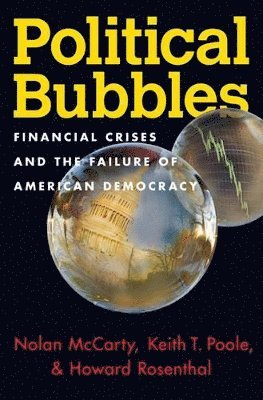
    Political Bubbles

    Financial Crises and the Failure of American Democracy

    AvNolan McCarty,Keith T. Poole

    Häftad, Engelska, 2015

    276 kr

    Beställningsvara. Skickas inom 5-8 vardagar. Fri frakt över 249 kr.

    Beskrivning

    Behind every financial crisis lurks a "political bubble"--policy biases that foster market behaviors leading to financial instability. Rather than tilting against risky behavior, political bubbles--arising from a potent combination of beliefs, institutions, and interests--aid, abet, and amplify risk. Demonstrating how political bubbles helped create the real estate-generated financial bubble and the 2008 financial crisis, this book argues that similar government oversights in the aftermath of the crisis undermined Washington's response to the "popped" financial bubble, and shows how such patterns have occurred repeatedly throughout US history. The authors show that just as financial bubbles are an unfortunate mix of mistaken beliefs, market imperfections, and greed, political bubbles are the product of rigid ideologies, unresponsive and ineffective government institutions, and special interests. Financial market innovations--including adjustable-rate mortgages, mortgage-backed securities, and credit default swaps--become subject to legislated leniency and regulatory failure, increasing hazardous practices.The authors shed important light on the politics that blinds regulators to the economic weaknesses that create the conditions for economic bubbles and recommend simple, focused rules that should help avoid such crises in the future. The first full accounting of how politics produces financial ruptures, Political Bubbles offers timely lessons that all sectors would do well to heed.

    Produktinformation

    • Utgivningsdatum:2015-03-22
    • Mått:146 x 229 x 23 mm
    • Vikt:454 g
    • Format:Häftad
    • Språk:Engelska
    • Antal sidor:368
    • Förlag:Princeton University Press
    • ISBN:9780691165721

    Utforska kategorier

    • Ekonomisk politik inom Ekonomi och Ledarskap
    • Statsskick: demokrati inom Samhälle och politik
    • Finanskriser inom Ekonomi och Ledarskap

    Mer om författaren

    Nolan McCarty is the Susan Dod Brown Professor of Politics and Public Affairs and chair of the Department of Politics at Princeton University. Keith T. Poole is the Philip H. Alston Jr. Distinguished Professor in the Department of Political Science at the University of Georgia. Howard Rosenthal is professor of politics at New York University and the Roger Williams Straus Professor of Social Sciences, Emeritus, at Princeton University.

    Recensioner i media

    "As pundits debate the causes of the 2008 economic crisis, the authors contend that financial crises have inherently political dimensions. McCarty, Poole, and Rosenthal argue persuasively that political bubbles and market bubbles are highly similar, with policy biases contributing to and amplifying market behavior... The authors provide an exhaustive review of structural problems that they believe impede effective government response to new catastrophic economic developments. Their arguments transcend the academic to include historical precedents and specifics on Wall Street machinations."--Publishers Weekly "McCarty, Poole, and Rosenthal have crafted a masterful analysis of the 2008 financial crisis. Their central thesis is that the underlying cause of the Great Recession was the 'political bubble'... The warnings for the U.S. political system are dire, and the authors make the case for political courage in dealing with wealth inequalities. This book would be an excellent addition to the library of any student of political economy and an excellent start in generating policy proposals on how to deal with future crises."--Choice "Greatly expanding upon and enriching prior work on political polarization, Political Bubbles persuasively shows that the 2008 financial crisis was the product of potent political forces."--Philip Rocco, Public Administration

    Innehållsförteckning

    • Acknowledgments vii Introduction 1 Part I: The Political Bubble - Why Washington Allows Financial Crises to Occur Chapter 1 Bubble Expectations 31 Chapter 2 Ideology 38 Chapter 3 Interests 71 Chapter 4 Institutions 90 Chapter 5 The Political Bubble of the Crisis of 2008 117 Part II: Pops - Why Washington Delays in Solving Financial Crises Chapter 6 Historical Lessons of the Responses to Pops 153 Chapter 7 The Pop of 2008 184 Chapter 8 "Pop"ulism 228 Chapter 9 How to Waste a Crisis 251 Epilogue 275 Notes 283 Bibliography 305 Name Index 327 Subject Index 333