• Fri frakt över 249 kr
  • •
  • Snabba leveranser
  • •
  • Billiga böcker
Kundservice

Du är på sajten för privatpersoner.

Företag, bibliotek eller offentlig verksamhet?

Du handlar på classic.bokus.com, där alla dina funktioner finns intakta.
Till classic.bokus.com
Bokus logotyp. Gå till startsidan.
  • Erbjudanden
  • Nyheter
  • Student
  • Topplistor
  • Barn & ungdom
  • Bokus Play
  • E-böcker
  • Pocketböcker
  • Spel & pussel

Upp till 20% på populära nyheter →

Sidfot

Mina sidor

    Hjälp

    • Kundservice
    • Vanliga frågor och svar
    • Frakt och leverans
    • Retur vid ångerrätt
    • Reklamera vara
    • Betalning
    • Köpvillkor
    • Allmänna villkor
    • Information om webbplatsens tillgänglighet

    Om Bokus

    • Om oss
    • Pressrum
    • För studenter
    • För företag
    • För bibliotek och offentlig verksamhet
    • För leverantörer
    • Hållbarhet

    Populärt

    • Aktuella erbjudanden
    • Presentkort
    • Studentlitteratur
    • Nya böcker
    • Topplistor
    • Signerade böcker
    • Engelska böcker

    Inspiration

    • Boktips
    • BookTok
    • Populära bokserier
    • Barnbokskaraktärer
    • Populära författare

    Mina sidor

      Hjälp

      • Kundservice
      • Vanliga frågor och svar
      • Frakt och leverans
      • Retur vid ångerrätt
      • Reklamera vara
      • Betalning
      • Köpvillkor
      • Allmänna villkor
      • Information om webbplatsens tillgänglighet

      Om Bokus

      • Om oss
      • Pressrum
      • För studenter
      • För företag
      • För bibliotek och offentlig verksamhet
      • För leverantörer
      • Hållbarhet

      Populärt

      • Aktuella erbjudanden
      • Presentkort
      • Studentlitteratur
      • Nya böcker
      • Topplistor
      • Signerade böcker
      • Engelska böcker

      Inspiration

      • Boktips
      • BookTok
      • Populära bokserier
      • Barnbokskaraktärer
      • Populära författare
      Logotyp för Bokus
      Följ oss på Facebook (extern länk)Följ oss på Instagram (extern länk)Följ oss på YouTube (extern länk)Följ oss på TikTok (extern länk)
      bokus @ CookiesAnpassa cookiesIntegritetspolicyKöpvillkor
      Till Citymail hemsida (extern länk)Till Budbee hemsida (extern länk)Till Postnord hemsida (extern länk)Till Schenker hemsida (extern länk)Till Early Bird hemsida (extern länk)Till Walleys hemsida (extern länk)
      1. Samhälle och politik
      2. Samhälle och kultur
      3. Kultur och medier
      4. Medievetenskap

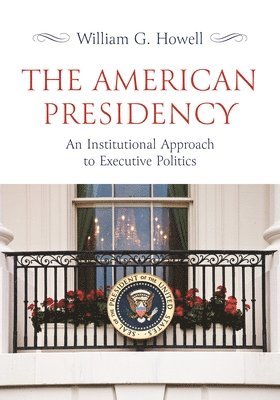
      American Presidency

      An Institutional Approach to Executive Politics

      AvWilliam G. Howell

      Häftad, Engelska, 2023

      418 kr

      Beställningsvara. Skickas inom 5-8 vardagar. Fri frakt över 249 kr.

      Fler format och utgåvor

      Inbunden

      829 kr

      E-bok

      580 kr

      Beskrivning

      How institutions shape the American presidencyThis incisive undergraduate textbook emphasizes the institutional sources of presidential power and executive governance, enabling students to think more clearly and systematically about the American presidency at a time when media coverage of the White House is awash in anecdotes and personalities. William Howell offers unparalleled perspective on the world’s most powerful office, from its original design in the Constitution to its historical growth over time; its elections and transitions to governance; its interactions with Congress, the courts, and the federal bureaucracy; and its persistent efforts to shape public policy. Comprehensive in scope and rooted in the latest scholarship, The American Presidency is the perfect guide for studying the presidency at a time of acute partisan polarization and popular anxiety about the health and well-being of the republic.Focuses on the institutional structures that presidents must navigate, the incentives and opportunities that drive them, and the constraints they routinely confrontShows how legislators, judges, bureaucrats, the media, and the broader public shape the contours and limits of presidential powerEncourages students to view the institutional presidency as not just an object of study but a way of thinking about executive politicsHighlights the lasting effects of important historical moments on the institutional presidencyEnables students to grapple with enduring themes of power, rules, norms, and organization that undergird democracy

      Produktinformation

      • Utgivningsdatum:2023-02-21
      • Mått:178 x 254 x 40 mm
      • Vikt:1 302 g
      • Format:Häftad
      • Språk:Engelska
      • Antal sidor:664
      • Förlag:Princeton University Press
      • ISBN:9780691225579

      Utforska kategorier

      • Medievetenskap inom Samhälle och politik
      • Statsskick: demokrati inom Samhälle och politik
      • Politik och statsskick inom Samhälle och politik

      Mer om författaren

      William G. Howell is the Sydney Stein Professor in American Politics at the University of Chicago, where he is director of the Center for Effective Government and cohost of Not Another Politics Podcast. He has taught courses on the American presidency for more than twenty years, and his many books include Presidents, Populism, and the Crisis of Democracy; The Wartime President; and Power without Persuasion (Princeton).

      Innehållsförteckning

      • AcknowledgmentsPrefaceIntroduction: Thinking Institutionally about an American Presidency0.1 The Personal President0.1.1 The Personal President: Pundits0.1.2 The Personal President: Academics0.1.3 The Personal President: A Brief Critique0.2 The Institutional Presidency0.2.1 What Is an Institution?0.2.2 What Is the Institutional Presidency?0.2.3 What Is an Institutional Approach to Studying the Presidency?0.3 Outline of the BookConclusionKey Terms, Questions for Discussion, Suggested Readings, and NotesPart I. Foundations1 Constitutional Origins1.1 The Articles of Confederation1.1.1 Weaknesses of the Articles of Confederation1.1.2 The Call to Amend the Articles of Confederation1.2 An American Presidency, Defined1.2.1 Executive Independence1.2.2 Executive Responsibilities, Divided and Shared1.2.3 A Singular Executive1.2.4 Executive Selection and Succession1.3 Textual Meanings1.3.1 Ambiguity1.3.2 Silence1.3.3 Context and MeaningConclusionKey Terms, Questions for Discussion, Suggested Readings, and Notes2 The Ascendance of an Institutional Presidency2.1 Nineteenth-Century Presidents2.2 The Progressive Era and Institutional Change2.2.1 Theodore Roosevelt’s Stewardship2.2.2 Woodrow Wilson: Progressivism Continued2.3 Scientific Management and Institutional Change2.3.1 A Brief, and Ultimately Discredited, Conservative Resurgence2.3.2 Franklin Delano Roosevelt: Engineering a New American State2.4 War and Institutional Change2.4.1 World War I2.4.2 World War II2.5 The Long Civil Rights Movement and Institutional ChangeConclusionKey Terms, Questions for Discussion, Suggested Readings, and Notes3 The Modern Institutional Presidency3.1 The Basic Architecture3.1.1 The Executive Office of the President3.1.2 The Cabinet3.1.3 Independent Agencies and Government Corporations3.2 Partners to the President3.2.1 The Office of the Vice President3.2.2 The Office of the First Spouse3.3 For Any Policy, a Crowded Field of InstitutionsConclusionKey Terms, Questions for Discussion, Suggested Readings, and Notes4 Power and the Institutional Presidency4.1 What Is Political “Power”?4.2 Great Expectations4.3 Power and Executive Action4.4 Evaluating the President’s Powers4.4.1 Constitutionally Enumerated Powers4.4.2 Additional Sources of Power4.5 Constraints and Backlash4.6 An Enduring Interest in PowerConclusionKey Terms, Questions for Discussion, Suggested Readings, and NotesPart II. Selection5 The Nomination of Presidential Candidates5.1 Presidential Nominations: Institutions of the Past5.1.1 King Caucus: 1796–18245.1.2 National Party Conventions, Local Control: 1832–19125.1.3 Trial-and-Error Primaries: 1912–19685.2 Presidential Nominations: The Modern Institution5.2.1 The Pool of Primary Candidates5.2.2 Open Primaries, Closed Primaries, and Caucuses5.2.3 The Primary Electorate5.2.4 The Nominating Season5.2.5 Allocation of Delegates5.2.6 Party Conventions5.3 Institutional Biases in Candidate Selection5.3.1 The Early State Advantage5.3.2 The Influence of Parties5.4 Campaign Spending5.4.1 Money Matters5.4.2 Citizens United v. FEC (2010)5.5 Selecting a Running Mate5.5.1 Balancing the Ticket5.5.2 Battleground Magnates5.5.3 Descriptive RepresentationConclusionKey Terms, Questions for Discussion, Suggested Readings, and Notes6 General Elections6.1 Presidential Electorates6.1.1 Tacking to the Ideological Middle6.1.2 Swing States6.1.3 Appealing to a Changing National Electorate6.2 The Economy and the Presidential Vote6.2.1 Pocketbook versus Sociotropic Voting6.2.2 Implications for Candidate Strategy6.3 The Marginal, but Consequential, Effects of Campaigns6.3.1 Campaign Advertising6.3.2 Presidential Debates6.3.3 Campaign Scandals6.3.4 October Surprises6.4 Declaring a Winner6.4.1 Counting Votes, Certifying Elections6.4.2 Contested Elections6.4.3 Democratic VulnerabilitiesConclusionKey Terms, Questions for Discussion, Suggested Readings, and Notes7 Transitions of Governance7.1 Planning the Transition7.1.1 Pre-Election Planning7.1.2 Personnel Decisions7.1.3 Prepping a Policy Agenda7.2 Managing Campaign and Party Operatives7.2.1 Campaign Operatives7.2.2 When Campaigners Don’t Help in Governance7.2.3 Intraparty Rivals7.3 Soliciting Help from the Outgoing Administration7.3.1 Responding to Events in Real Time7.3.2 Information Transfers7.3.3 When Cooperation Proves DifficultConclusionKey Terms, Questions for Discussion, Suggested Readings, and NotesPart III. Governance8 Relations with Congress8.1 Power through Persuasion8.1.1 An Archetypal Case: LBJ and the Civil Rights Act8.1.2 The Limits of Persuasion8.1.3 The Subjects of Persuasion8.2 Predicting Legislative Success and Failure8.2.1 Timing8.2.2 Unified versus Divided Government8.2.3 Party Polarization8.2.4 Nationalized Politics8.2.5 Foreign versus Domestic Policy8.3 Veto Politics8.3.1 Vetoes and Overrides8.3.2 Veto Threats and Concessions8.3.3 The Line-Item Veto8.4 Appropriations8.4.1 Proposing a Budget: Ex Ante Influence8.4.2 Manipulating the Budget: Ex Post Influence8.4.3 Impoundment Authority8.5 Battles over Institutional Power8.5.1 Congressional Delegations of Authority8.5.2 Congressional Oversight8.5.3 Attempting to Dismantle Presidential Power: The Bricker Amendment8.6 Removing the President from Office8.6.1 The Purposes of Impeachment8.6.2 Johnson’s Impeachment8.6.3 Nixon’s Resignation8.6.4 Clinton’s Impeachment8.6.5 Trump’s First Impeachment8.6.6 Trump’s Second Impeachment8.6.7 The Politics of ImpeachmentConclusionKey Terms, Questions for Discussion, Suggested Readings, and Notes9 Unilateral Powers9.1 Power without Persuasion9.1.1 Unilateral Directives9.1.2 Unilateral Decisions9.1.3 Trends in Unilateral Activity9.2 The Legal Basis for Unilateral Action9.2.1 Constitutional Authority9.2.2 Statutory Authority9.2.3 Emergency Powers9.3 Institutional Checks on Unilateral Action9.3.1 Reporting Requirements9.3.2 Budgets9.3.3 Bureaucratic Resistance9.3.4 Presidents Checking Presidents9.3.5 The Public as a Final Line of Defense?9.4 The Demonstration of Presidential Influence9.4.1 The Strategic Exercise of Unilateral Powers9.4.2 Implementing Public Policy9.4.3 Enhanced Control over the Bureaucracy9.4.4 Getting onto the Legislative AgendaConclusionKey Terms, Questions for Discussion, Suggested Readings, and Notes10 Control of the Bureaucracy10.1 Administrative and Political Problems10.1.1 The Long History of Administrative Reform10.1.2 Enter Politics10.1.3 Whose Bureaucracy?10.2 Politicization10.2.1 What Politicization Looks Like10.2.2 Opportunities for Politicization10.2.3 When Do Presidents Politicize?10.2.4 Politicization’s Close Cousin: Patronage10.3 Centralization10.3.1 White House Staff10.3.2 Policy Czars10.3.3 When Do Presidents Centralize?10.4 Bureaucratic Redesign: Cutting, Restructuring, and Creating Anew10.5 Downsides, Limitations, and Scandal10.5.1 Downsides10.5.2 Limitations10.5.3 ScandalConclusionKey Terms, Questions for Discussion, Suggested Readings, and Notes11 Relations with the Federal Judiciary11.1 Foundations of Judicial Decision Making11.1.1 Applying Legal Norms and Principles11.1.2 Ideological Convictions11.1.3 Concerns about Institutional Legitimacy11.1.4 In Practice, More than One Motivation11.2 Implications for Cases Involving the President11.2.1 Political Question Doctrine11.2.2 The “Zone of Twilight”11.2.3 Chevron Deference11.3 Taking on the President11.3.1 Challenging an Executive’s Special Privileges11.3.2 Challenging an Executive’s Newly Acquired Powers11.3.3 Suing the President11.3.4 Striking Down a President’s Policy11.4 All the President’s Lawyers11.4.1 Lending Advice and Legal Cover11.4.2 Representing the President in the Federal Judiciary11.5 Judicial Nominations11.5.1 Appointing Co-Partisans to the Bench11.5.2 Selecting Judges with Expansive Views of Presidential Power11.5.3 The Politics of District and Appellate Court Nominations11.5.4 Increasingly Partisan Supreme Court Nominations11.5.5 Eroding Norms of ConsiderationConclusionKey Terms, Questions for Discussion, Suggested Readings, and NotesPart IV. Media and Public12 Relations with the Media12.1 Foundations of the Plebiscitary Presidency12.2 New Media Technologies12.2.1 Radio12.2.2 Television12.2.3 Digital Media12.3 The Modern Media Landscape12.3.1 An Increasingly Polarized Viewing Audience?12.3.2 Political Disinformation12.4 Institutionalizing Presidential Relations with the Press12.4.1 The President’s Press Operation12.4.2 The White House Press Corps12.5 Navigating the Media Landscape12.5.1 Constraining the Press12.5.2 Managing Information Flows12.5.3 Working around the Press12.6 The Media: Watchdog or Lapdog?ConclusionKey Terms, Questions for Discussion, Suggested Readings, and Notes13 Public Opinion13.1 Foundations of Public Opinion13.1.1 Party Membership13.1.2 Issue Positions13.1.3 Political Elites13.1.4 Economic Evaluations13.2 The Shape of Public Opinion13.2.1 General Decline13.2.2 Rally Effects13.3 Taking Stock of Public Opinion13.3.1 White House Polls13.3.2 Putting Polls (and the Public) to Use13.3.3 The Measured Significance of Public Opinion13.4 Influencing Public Opinion13.4.1 Evaluations of Presidential Policies13.4.2 Evaluations of PresidentsConclusionKey Terms, Questions for Discussion, Suggested Readings, and NotesPart V. Policy14 Domestic Policy14.1 A National Outlook14.1.1 Case Study: Trillions in Pandemic Relief14.2 Power Considerations14.2.1 Case Study: Budgetary Powers14.3 Legacy14.3.1 Case Study: Harry Truman and Civil RightsConclusionKey Terms, Questions for Discussion, Suggested Readings, and Notes15 Foreign Policy15.1 Presidential Advantages in Foreign Policy15.1.1 Military Capabilities15.1.2 Economic Considerations15.2 International Constraints on Foreign Policymaking15.2.1 Alliances15.2.2 International Law15.3 Domestic Constraints on Foreign Policymaking15.3.1 Formal Congressional Checks on Presidential Foreign Policymaking15.3.2 Informal Congressional Checks on Presidential Foreign Policymaking15.3.3 Intrabranch Checks on Presidential Foreign PolicymakingConclusionKey Terms, Questions for Discussion, Suggested Readings, and Notes16 Wartime Policymaking at Home16.1 War and Presidential Power: A Brief Intellectual History16.2 Evidence That Wars Expand Presidential Influence16.2.1 Wartime Appropriations16.2.2 Congressional Voting in War and Peace16.3 Three Cases of Wartime Policymaking at Home16.3.1 World War II16.3.2 The Vietnam War and Johnson’s Great Society16.3.3 September 11, 2001, and ThereafterConclusionKey Terms, Questions for Discussion, Suggested Readings, and NotesAppendix AAppendix BAppendix CGlossaryIndex
      Hoppa över listan

      Mer från samma författare

      William G. Howell, George C. Edwards III - Oxford Handbook of the American Presidency, E-bok

      Oxford Handbook of the American Presidency

      William G. Howell, George C. Edwards III

      E-bok
      2009

      568 kr

      William G. Howell, George C. Edwards III - Oxford Handbook of the American Presidency, E-bok

      Oxford Handbook of the American Presidency

      William G. Howell, George C. Edwards III

      E-bok
      2009

      568 kr

      George C. Edwards III, William G. Howell - The Oxford Handbook of the American Presidency, Häftad

      The Oxford Handbook of the American Presidency

      George C. Edwards III, William G. Howell

      Häftad, 2011

      831 kr

      William G. Howell, Saul P. Jackman, Jon C. Rogowski - Wartime President, Häftad

      Wartime President

      William G. Howell, Saul P. Jackman, Jon C. Rogowski

      Häftad, 2013

      287 kr

      Jon C. Rogowski, Saul P. Jackman, William G. Howell - Wartime President, E-bok

      Wartime President

      Jon C. Rogowski, Saul P. Jackman, William G. Howell

      E-bok
      2013

      575 kr

      William G Howell, Terry M Moe - Presidents, Populism, and the Crisis of Democracy, Inbunden

      Presidents, Populism, and the Crisis of Democracy

      William G Howell, Terry M Moe

      Inbunden, 2020

      854 kr

      William G Howell, Terry M Moe - Presidents, Populism, and the Crisis of Democracy, Häftad

      Presidents, Populism, and the Crisis of Democracy

      William G Howell, Terry M Moe

      Häftad, 2020

      155 kr

      William G. Howell - Power without Persuasion, Häftad

      Power without Persuasion

      William G. Howell

      Häftad, 2003

      917 kr

      William G. Howell, Jon Pevehouse - While Dangers Gather, Häftad

      While Dangers Gather

      William G. Howell, Jon Pevehouse

      Häftad, 2007

      525 kr

      William G. Howell - Thinking about the Presidency, Inbunden

      Thinking about the Presidency

      William G. Howell

      Inbunden, 2013

      418 kr

      Hoppa över listan

      Du kanske också är intresserad av

      William G. Howell - American Presidency, E-bok

      American Presidency

      William G. Howell

      E-bok
      2023

      580 kr

      William G. Howell - American Presidency, Inbunden

      American Presidency

      William G. Howell

      Inbunden, 2023

      829 kr

      William G. Howell - Power without Persuasion, E-bok

      Power without Persuasion

      William G. Howell

      E-bok
      2015

      665 kr

      William G. Howell, Paul E. Peterson - Education Gap, Häftad

      Education Gap

      William G. Howell, Paul E. Peterson

      Häftad, 2006

      291 kr

      Jon C. Rogowski, Saul P. Jackman, William G. Howell - Wartime President, E-bok

      Wartime President

      Jon C. Rogowski, Saul P. Jackman, William G. Howell

      E-bok
      2013

      575 kr

      Jon Pevehouse, William G. Howell - While Dangers Gather, E-bok

      While Dangers Gather

      Jon Pevehouse, William G. Howell

      E-bok
      2011

      718 kr

      William G. Howell, George C. Edwards III - Oxford Handbook of the American Presidency, E-bok

      Oxford Handbook of the American Presidency

      William G. Howell, George C. Edwards III

      E-bok
      2009

      568 kr

      George C. Edwards III, William G. Howell - The Oxford Handbook of the American Presidency, Häftad

      The Oxford Handbook of the American Presidency

      George C. Edwards III, William G. Howell

      Häftad, 2011

      831 kr

      William G. Howell - Besieged, Häftad

      Besieged

      William G. Howell

      Häftad, 2005

      359 kr

      William G. Howell - Power without Persuasion, Häftad

      Power without Persuasion

      William G. Howell

      Häftad, 2003

      917 kr