• Fri frakt över 249 kr
  • •
  • Snabba leveranser
  • •
  • Billiga böcker
Kundservice

Du är på sajten för privatpersoner.

Företag, bibliotek eller offentlig verksamhet?

Du handlar på classic.bokus.com, där alla dina funktioner finns intakta.
Till classic.bokus.com
Bokus logotyp. Gå till startsidan.
  • Erbjudanden
  • Nyheter
  • Student
  • Topplistor
  • Barn & ungdom
  • Bokus Play
  • E-böcker
  • Pocketböcker
  • Spel & pussel

10% rabatt på allt med kod NYSTART10 →

Sidfot

Mina sidor

    Hjälp

    • Kundservice
    • Vanliga frågor och svar
    • Frakt och leverans
    • Retur vid ångerrätt
    • Reklamera vara
    • Betalning
    • Köpvillkor
    • Allmänna villkor
    • Information om webbplatsens tillgänglighet

    Om Bokus

    • Om oss
    • Pressrum
    • För studenter
    • För företag
    • För bibliotek och offentlig verksamhet
    • För leverantörer
    • Hållbarhet

    Populärt

    • Aktuella erbjudanden
    • Presentkort
    • Studentlitteratur
    • Nya böcker
    • Topplistor
    • Signerade böcker
    • Engelska böcker

    Inspiration

    • Boktips
    • BookTok
    • Populära bokserier
    • Barnbokskaraktärer
    • Populära författare
    Logotyp för Bokus
    Följ oss på Facebook (extern länk)Följ oss på Instagram (extern länk)Följ oss på YouTube (extern länk)Följ oss på TikTok (extern länk)
    bokus @ CookiesAnpassa cookiesIntegritetspolicyKöpvillkor
    Till Citymail hemsida (extern länk)Till Budbee hemsida (extern länk)Till Postnord hemsida (extern länk)Till Schenker hemsida (extern länk)Till Early Bird hemsida (extern länk)Till Walleys hemsida (extern länk)
    1. Naturvetenskap och teknik
    2. Matematik och naturvetenskap
    3. Biologi
    4. Biovetenskap

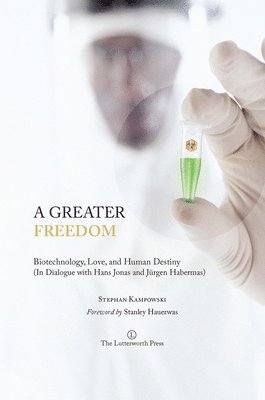
    Greater Freedom

    Biotechnology, Love, and Human Destiny (In Dialogue with Hans Jonas and Jürgen Habermas)

    AvStephan Kampowski

    Häftad, Engelska, 2014

    Del i serien The Lutterworth Press

    286 kr

    Beställningsvara. Skickas inom 5-8 vardagar. Fri frakt över 249 kr.

    Fler format och utgåvor

    Inbunden

    421 kr

    Häftad

    273 kr

    E-bok

    470 kr

    Beskrivning

    A study in theological ethics, analysing the promises of biotechnology and the risks that it poses to a proper understanding of human freedom and destiny.How does biotechnology touch on human destiny? What are its promises and challenges? In search for a response, the present volume turns to the thought of Hans Jonas, one of the pioneers and founding fathers of bioethics. The continued relevance of his ideas is exemplified by the way Jürgen Habermas applies them to the current debate. The chief promise of biotechnology is to increase our freedom by overcoming the limits of the human condition. The main risk of biotechnology, as both Jonas and Habermas see it, is to diminish or outright abolish our capacity for responsibility and morality. It is argued that the greater freedom is not simply freedom from constraints but freedom for our destiny: the freedom to be the benevolent, responsible, and spontaneous authors of our lives, capable of communion and love. The touchstone for evaluating any biotechnological procedure has to be this greater freedom.

    Produktinformation

    • Utgivningsdatum:2014-02-27
    • Mått:152 x 229 x 15 mm
    • Vikt:312 g
    • Format:Häftad
    • Språk:Engelska
    • Serie:The Lutterworth Press
    • Antal sidor:204
    • Förlag:Boydell & Brewer Ltd
    • ISBN:9780718893194

    Utforska kategorier

    • Biovetenskap inom Naturvetenskap och teknik
    • Biokemisk teknik inom Naturvetenskap och teknik

    Mer om författaren

    STEPHAN KAMPOWSKI is Associate Professor of Philosophical Anthropology at the Pontifical John Paul II Institute for Studies on Marriage and Family in Rome. He is the author of Arendt, Augustine, and the New Beginning: The Action Theory and Moral Thought of Hannah Arendt in the Light of Her Dissertation on St. Augustine (2008).

    Recensioner i media

    Kampowski shows the enduring relevance of Jonas's thought for engaging the thorny challenges facing humanity today. Overall, the book provides the English-speaking bioethicist with an effective introduction to the German conversation.... Kampowski's engagement with Jonas offers a promising way forward for addressing biotechnology.

    Innehållsförteckning

    • Foreword by Stanley Hauerwas Acknowledgments Introduction Freedom, Technology, and Destiny The Context and Procedure of Our Study 1 Hans Jonas' Philosophy of the Organism Toward an Ontology of Life Panvitalism Dualism Idealism and Materialism Jonas' Attempt at a Solution The Fundamental Characteristics of the Organism Metabolism and Freedom Natural Teleology An Appreciation of The Phenomenon of Life Maintaining the Specific Difference between Humans and Animals The Possibility of the Soul's Survival after Death The Ontology of Life and the Problem of Death The Organism and Love 2 Jonas' Philosophy of Responsibility Analysis of the Modern Predicament and Justification for the Need of a New Ethics The New Categorical Imperative and Its Foundation Logical Coherence? Rights? An 'Ontological' Argument Being, Purpose, and Value Responsibility Some Practical Principles of the Ethics of Responsibility The Recognition of Ignorance The Exclusion of the Va-banque Game A Heuristics of Fear Jonas' Critique of Utopianism The Identification of the Utopian Ideal The Feasibility or Practical Achievability of the Utopian Ideal The Desirability of the Utopian Ideal Concluding Remarks on Utopia: The 'True Human Being' Is Always There Already An Appreciation of The Imperative of Responsibility The Relation between the Sheer Existence and the Good Existence of Humanity The Notion of Responsibility 3 Jürgen Habermas and Genetic Enhancement: Jonas' Contribution to the Contemporary Debate Habermas' Life and Thought The Basic Argument of The Future of Human Nature Some Presuppositions The Distinction between Therapy and Enhancement Habermas and Jonas: The Question of Domination Genetic Determinism? Habermas and Jonas: Genetic Engineering vs. Education Dependence as Part of the Human Condition Excursus: The Question of Artificial Procreation Habermas' Response to Objections Concluding Remarks Conclusion: A Greater Freedom Bibliography