• Fri frakt över 249 kr
  • •
  • Snabba leveranser
  • •
  • Billiga böcker
Kundservice

Du är på sajten för privatpersoner.

Företag, bibliotek eller offentlig verksamhet?

Du handlar på classic.bokus.com, där alla dina funktioner finns intakta.
Till classic.bokus.com
Bokus logotyp. Gå till startsidan.
  • Erbjudanden
  • Nyheter
  • Student
  • Topplistor
  • Barn & ungdom
  • Bokus Play
  • E-böcker
  • Pocketböcker
  • Spel & pussel

10% rabatt på allt med kod: NYSTART10 →

Sidfot

Mina sidor

    Hjälp

    • Kundservice
    • Vanliga frågor och svar
    • Frakt och leverans
    • Retur vid ångerrätt
    • Reklamera vara
    • Betalning
    • Köpvillkor
    • Allmänna villkor
    • Information om webbplatsens tillgänglighet

    Om Bokus

    • Om oss
    • Pressrum
    • För studenter
    • För företag
    • För bibliotek och offentlig verksamhet
    • För leverantörer
    • Hållbarhet

    Populärt

    • Aktuella erbjudanden
    • Presentkort
    • Studentlitteratur
    • Nya böcker
    • Topplistor
    • Signerade böcker
    • Engelska böcker

    Inspiration

    • Boktips
    • BookTok
    • Populära bokserier
    • Barnbokskaraktärer
    • Populära författare
    Logotyp för Bokus
    Följ oss på Facebook (extern länk)Följ oss på Instagram (extern länk)Följ oss på YouTube (extern länk)Följ oss på TikTok (extern länk)
    bokus @ CookiesAnpassa cookiesIntegritetspolicyKöpvillkor
    Till Citymail hemsida (extern länk)Till Budbee hemsida (extern länk)Till Postnord hemsida (extern länk)Till Schenker hemsida (extern länk)Till Early Bird hemsida (extern länk)Till Walleys hemsida (extern länk)
    1. Samhälle och politik
    2. Sociologi och antropologi
    3. Antropologi

    Human Thought and Social Organization

    Anthropology on a New Plane

    AvMurray J. Leaf,Dwight Read

    Häftad, Engelska, 2014

    839 kr

    Beställningsvara. Skickas inom 10-15 vardagar. Fri frakt över 249 kr.

    Beskrivning

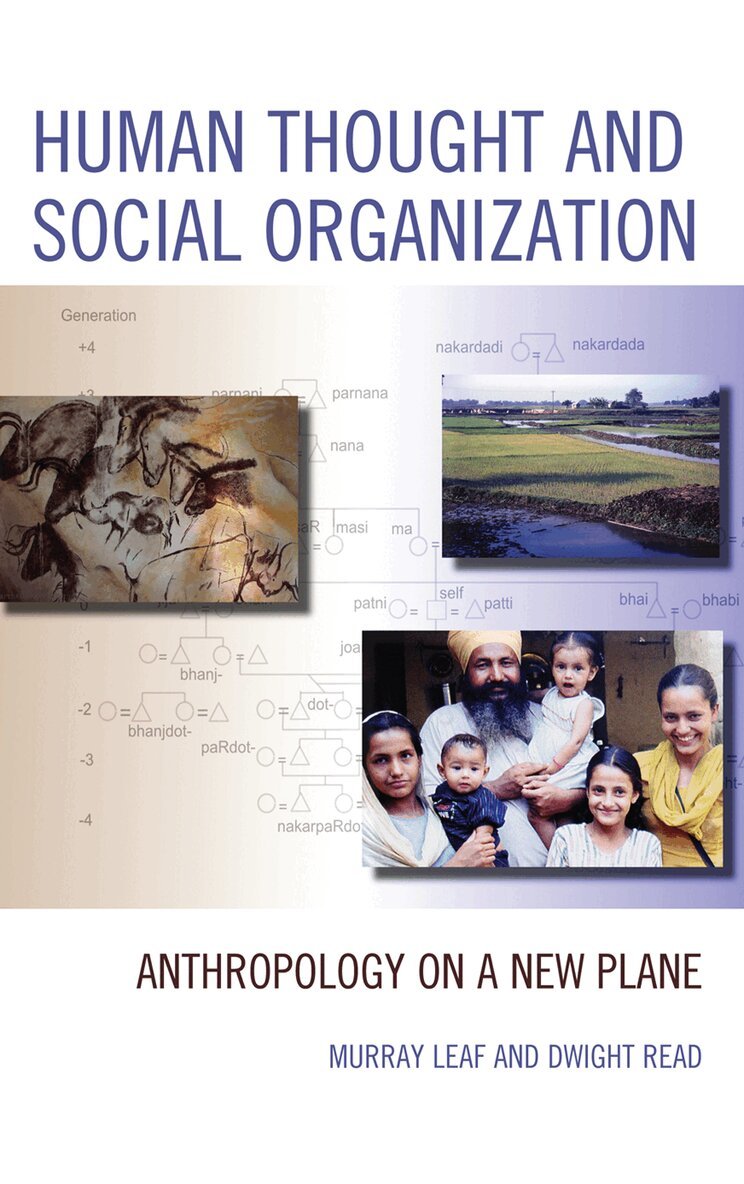
    Human beings have two outstanding characteristics compared to all other species: the apparently enormous elaboration of our thought through language and symbolism and the elaboration of our forms of social organization. The view taken in Human Thought and Social Organization: Anthropology on a New Plane is that these are intimately interconnected. To understand this connection, the book compares the structure of the systems of thought that organizations are built upon with the organizational basis of human thinking as such. An experimental method is used, leading to a new science of the structure of human social organizations in two senses. First, it gives rise to a new kind of ethnology that has the combination of empirical solidity and formal analytical rigor associated with the “paradigmatic” sciences. Second, it makes evident that social organizations have distinctive properties and require distinctive explanations of a sort that cannot be reduced to the explanations drawn from, or grounded in, these other sciences.Human social organizations are created by people using systems of ideas with very specific logical properties. This book describes what these idea-systems are with an unbroken chain of analysis that begins with field elicitation, and continues by working out their most fundamental, logico-mathematical generative elements. This enables us to see precisely how these idea systems are used to generate organizations that give pattern to ongoing behavior. The book shows how organizations are objectified by community members through symbolic representations that provide them with shared conceptions of organizations, roles, or relations that they see each other as participating in. The case for this constructive process being pan-Homo sapiens is described, spanning all human communities from the Upper Paleolithic to today, and from the most seemingly primitive Australian tribes to modern-day America and India. While focusing primarily on kinship, Human Thought and Social Organization shows how the analysis applies with equal precision to other social areas ranging from farming to political factionalism.

    Produktinformation

    • Utgivningsdatum:2014-06-12
    • Mått:154 x 227 x 28 mm
    • Vikt:748 g
    • Format:Häftad
    • Språk:Engelska
    • Antal sidor:476
    • Förlag:Bloomsbury Publishing Plc
    • ISBN:9780739197974

    Utforska kategorier

    • Antropologi inom Samhälle och politik
    • Sociala grupper och identitet inom Samhälle och politik
    • Relationer inom Hälsa och familj

    Mer om författaren

    Murray J. Leaf is professor of anthropology and political economy at the University of Texas at Dallas and author of several books, including Human Organizations and Social Theory.Dwight W. Read is distinguished professor of anthropology at the University of California, Los Angeles. He is author of Artifact Classification: A Conceptual and Methodological Approach.

    Recensioner i media

    Continuing their collaboration, in this book Leaf and Read provide the view of kinship organization’s underlying cognitive processes and then lay out their formal analysis of kinship terminologies that should transform the field into a bona fide science equivalent to theoretical physics. It is a volume of formidable scope and clarity of exposition. . . .This book has potentially a very wide readership and should . . . be on the list of cultural anthropologists, evolutionary ecologists, archaeologists, linguists, psychologists, and applied anthropologists.

    Innehållsförteckning

    • AcknowledgmentsOrthography and NotationList of Figures and TablesPreface1. Introduction 2. Assumptions 3. The Organizational Rubicon of the Upper Paleolithic 4. Fundamentals of Human Social Organization 5. Elicitation of Kinship Terminology Structure 6. Theory of Kinship Terminology Structures 7. Construction of a Kinship Algebra Model 8. Kin Terminology and Social Structure: The Kariera Case 9. Formal Algebraic Construction of the Kariera Terminology 10. The Physical Farm Budget: a Social Charter 11. Idea-Systems and Communication Theory 12. Conclusion ReferencesIndexAbout the Authors