• Fri frakt över 249 kr
  • •
  • Snabba leveranser
  • •
  • Billiga böcker
Kundservice

Du är på sajten för privatpersoner.

Företag, bibliotek eller offentlig verksamhet?

Du handlar på classic.bokus.com, där alla dina funktioner finns intakta.
Till classic.bokus.com
Bokus logotyp. Gå till startsidan.
  • Erbjudanden
  • Nyheter
  • Student
  • Topplistor
  • Barn & ungdom
  • Bokus Play
  • E-böcker
  • Pocketböcker
  • Spel & pussel

10% rabatt på allt med kod NYSTART10 →

Sidfot

Mina sidor

    Hjälp

    • Kundservice
    • Vanliga frågor och svar
    • Frakt och leverans
    • Retur vid ångerrätt
    • Reklamera vara
    • Betalning
    • Köpvillkor
    • Allmänna villkor
    • Information om webbplatsens tillgänglighet

    Om Bokus

    • Om oss
    • Pressrum
    • För studenter
    • För företag
    • För bibliotek och offentlig verksamhet
    • För leverantörer
    • Hållbarhet

    Populärt

    • Aktuella erbjudanden
    • Presentkort
    • Studentlitteratur
    • Nya böcker
    • Topplistor
    • Signerade böcker
    • Engelska böcker

    Inspiration

    • Boktips
    • BookTok
    • Populära bokserier
    • Barnbokskaraktärer
    • Populära författare
    Logotyp för Bokus
    Följ oss på Facebook (extern länk)Följ oss på Instagram (extern länk)Följ oss på YouTube (extern länk)Följ oss på TikTok (extern länk)
    bokus @ CookiesAnpassa cookiesIntegritetspolicyKöpvillkor
    Till Citymail hemsida (extern länk)Till Budbee hemsida (extern länk)Till Postnord hemsida (extern länk)Till Schenker hemsida (extern länk)Till Early Bird hemsida (extern länk)Till Walleys hemsida (extern länk)
    1. Ekonomi och Ledarskap
    2. Företagsekonomi
    3. Entreprenörskap

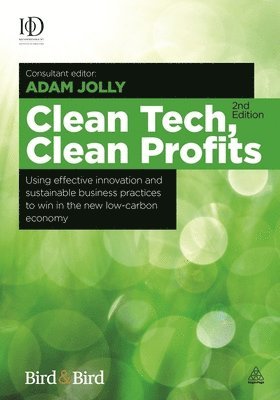
    Clean Tech Clean Profits

    Using Effective Innovation and Sustainable Business Practices to Win in the New Low-carbon Economy

    AvAdam Jolly,Adam Jolly

    Inbunden, Engelska, 2014

    551 kr

    Beställningsvara. Skickas inom 5-8 vardagar. Fri frakt över 249 kr.

    Fler format och utgåvor

    E-bok

    521 kr

    Beskrivning

    Through a mixture of innovation and regulation, a future is being mapped out free of carbon and pollutants. The consequences of these changes could be as far-reaching as those triggered in the last 25 years by the web. Just as many winners and losers are likely to be created by the squeeze on carbon and the growth of clean technologies. Designed for a wide management audience, Clean Tech, Clean Profits provides a practical guide to how organizations can re-think their operations, develop an innovative response, commercialize clean technologies and improve their efficiency. Its emphasis is on the specific steps that can be taken now in reviewing options, drawing up plans, upgrading a process, writing a specification or making an investment.

    Produktinformation

    • Utgivningsdatum:2014-07-03
    • Mått:177 x 244 x 20 mm
    • Vikt:607 g
    • Format:Inbunden
    • Språk:Engelska
    • Antal sidor:264
    • Upplaga:2
    • Förlag:Kogan Page Ltd
    • ISBN:9780749470418

    Utforska kategorier

    • Entreprenörskap inom Ekonomi och Ledarskap
    • Affärsetik inom Ekonomi och Ledarskap
    • Affärsutveckling inom Ekonomi och Ledarskap

    Mer om författaren

    Adam Jolly is a business writer and editor, specializing in the management of growth, innovation, technology and risk. He has produced titles for many of Britain's leading business organizations, and his work appears regularly in the national press. He is the consultant editor of The Innovation Handbook, The Growing Business Handbook and The Handbook of European Intellectual Property Management, all published by Kogan Page.

    Recensioner i media

    "Clean Tech, Clean Profits is a refreshing surprise. Filled with facts on the impact of our lifestyles on the planet's resources, the book illustrates how business can incorporate clean technology principles into their operations, and commercialise new products and procedures which will improve eco-efficiency."

    Innehållsförteckning

    • Section - ONE: The size of the challenge;Chapter - 1.1: Towards the circular economy – Ellen MacArthur;Chapter - 1.2: Energy innovation – Rob Saunders;Chapter - 1.3: Zero Carbon Britain – Paul Allen;Chapter - 1.4: Powering change – David Handley;Section - TWO: The potential for innovation;Chapter - 2.1: Low-carbon growth – Andy Eastlake;Chapter - 2.2: Smarter buildings – Richard Solomon;Chapter - 2.3: Efficiency gains – Andrew Mitchell;Chapter - 2.4: Changes in corporate behaviour – Matt Bonass;Chapter - 2.5: Clean options on major projects – Tom Woollard and Nick Cottam;Section - THREE: How the market works;Chapter - 3.1: Funding future energy – Jeremy Biggs;Chapter - 3.2: The value of measuring carbon – Melanie Eddis and Nick Cottam;Chapter - 3.3: Structuring techniques for demand-side management solutions – Michael Rudd;Chapter - 3.4: Responsibly sourced – Ian Nicholson;Chapter - 3.5: Energy system modelling – George Day;Chapter - 3.6: Intellectual property for clean tech – Nick Sutcliffe;Section - FOUR: Re-thinking energy;Chapter - 4.1: New demands on electricity – Mark Thompson and Martin Queen;Chapter - 4.2: Smart energy – Andrew Mitchell;Chapter - 4.3: The supergrid – Godfrey Spickernell;Chapter - 4.4: Prospects for self-generation – Jodie Huggett;Chapter - 4.5: Pumped storage hydropower – Catherine Anderson;Chapter - 4.6: Carbon capture and storage – Judith Shapiro;Section - FIVE: Renewable sources;Chapter - 5.1: De-risking ocean energy – Raymond Alcorn, Gordon Dalton, Mark Healy and Michael O’Connor;Chapter - 5.2: Solar technology – Lee Sutton;Chapter - 5.3: Offshore renewable energy – Nick Medic;Chapter - 5.4: Biomass – Professor Mike Bradley;Section - SIX: Environment;Chapter - 6.1: Water – Cees Buisman and Leon Korving, Wetsus;Chapter - 6.2: Current priorities for air pollution control – Professor Duncan Laxen;Chapter - 6.3: Resource efficiency – Katherine Adams;Section - SEVEN: Transport;Chapter - 7.1: Powering tomorrow’s electric vehicles – Dr Mark Crittenden and Huw Hampson-Jones;Chapter - 7.2: Transport design – Paul Priestman;Chapter - 7.3: Low-carbon mobility – Liam Lidstone;Chapter - 7.4: LPG Autogas – Rob Shuttleworth