• Fri frakt över 249 kr
  • •
  • Snabba leveranser
  • •
  • Billiga böcker
Kundservice

Du är på sajten för privatpersoner.

Företag, bibliotek eller offentlig verksamhet?

Du handlar på classic.bokus.com, där alla dina funktioner finns intakta.
Till classic.bokus.com
Bokus logotyp. Gå till startsidan.
  • Erbjudanden
  • Nyheter
  • Student
  • Topplistor
  • Barn & ungdom
  • Bokus Play
  • E-böcker
  • Pocketböcker
  • Spel & pussel

10% rabatt på allt med kod NYSTART10 →

Sidfot

Mina sidor

    Hjälp

    • Kundservice
    • Vanliga frågor och svar
    • Frakt och leverans
    • Retur vid ångerrätt
    • Reklamera vara
    • Betalning
    • Köpvillkor
    • Allmänna villkor
    • Information om webbplatsens tillgänglighet

    Om Bokus

    • Om oss
    • Pressrum
    • För studenter
    • För företag
    • För bibliotek och offentlig verksamhet
    • För leverantörer
    • Hållbarhet

    Populärt

    • Aktuella erbjudanden
    • Presentkort
    • Studentlitteratur
    • Nya böcker
    • Topplistor
    • Signerade böcker
    • Engelska böcker

    Inspiration

    • Boktips
    • BookTok
    • Populära bokserier
    • Barnbokskaraktärer
    • Populära författare
    Logotyp för Bokus
    Följ oss på Facebook (extern länk)Följ oss på Instagram (extern länk)Följ oss på YouTube (extern länk)Följ oss på TikTok (extern länk)
    bokus @ CookiesAnpassa cookiesIntegritetspolicyKöpvillkor
    Till Citymail hemsida (extern länk)Till Budbee hemsida (extern länk)Till Postnord hemsida (extern länk)Till Schenker hemsida (extern länk)Till Early Bird hemsida (extern länk)Till Walleys hemsida (extern länk)
    1. Samhälle och politik
    2. Samhälle och kultur
    3. Kultur och medier
    4. Kulturvetenskap

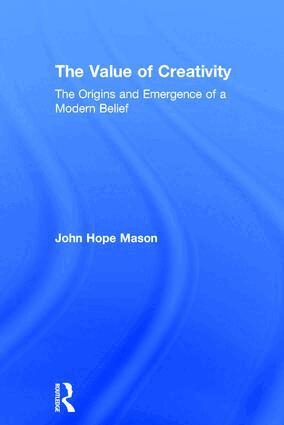
    Value of Creativity

    The Origins and Emergence of a Modern Belief

    AvJohn Hope Mason

    Inbunden, Engelska, 2003

    1 393 kr

    Tillfälligt slut

    Fler format och utgåvor

    E-bok

    805 kr

    E-bok

    807 kr

    Beskrivning

    In the middle of the 19th century a new value began to appear in Western Europe - the belief that (in the words of Matthew Arnold) 'the exercise of a creative activity is the true function of man'. This book gives an account of the stages by which, and the reasons why, this development occurred at that time. In so doing it reveals a historical puzzle, for the main factors which can be seen to have given rise to the new value - mainly scientific, technological, economic and political - were not reflected in the value itself, for that was applied almost exclusively to artistic and cultural activity. John Hope Mason sets out to explain this puzzle by showing how throughout European history there have been two radically different views of the creative attribute. An early example of one view was the character of Prometheus in Greek mythology; influential examples of the second were the figures of God the Creator in Judaeo-Christian theology and the neo-Platonic One in Hellenistic philosophy. The book shows how the contrast represented by those figures informed discussions of genius in the 18th century and indicates why the notion of creativity which came to prevail then assimilated it with purely aesthetic and moral concerns. Combining a broad perspective with a close analysis of key figures - from Adam Smith, Rousseau and Kant, to Arnold, Marx and Nietzsche - this book casts a new light on a central value of the modern world.

    Produktinformation

    • Utgivningsdatum:2003-02-07
    • Mått:156 x 234 x undefined mm
    • Vikt:603 g
    • Format:Inbunden
    • Språk:Engelska
    • Antal sidor:316
    • Förlag:Taylor & Francis Ltd
    • ISBN:9780754607601

    Utforska kategorier

    • Kulturvetenskap inom Samhälle och politik
    • Filosofiska discipliner inom Filosofi och religion
    • Kognitiv psykologi inom Psykologi och pedagogik

    Mer om författaren

    John Hope Mason, Middlesex University, UK

    Recensioner i media

    'John Hope Mason has written a complex, subtle and important book on the history of the idea of creativity ... the argument is always careful, the detail telling, and the author always has an intimate knowledge of his material ... The book deserves to be read, both in part and in whole ” and after that, reread, for there is more to it than may be apparent on first acquaintance. Its reputation will grow over time, and its arguments will be widely influential.' The History of Political Thought 'Creativity is one of the biggest fetishes of our time, and John Hope Mason has excavated its history with a remarkable combination of acumen and verve. The Value of Creativity delivers a powerful criticism of the present as well as a vivid depiction of the past. An elegant and original exploration of a vital and fascinating problem.' Jonathan Rée 'This is a book of great depth and originality...its range of references is both wide and demanding...John Hope Mason's 20-year scholarly dedication reaches a conclusion of Zen-like wisdom.' Bernard Crick, The Independent 'Scholarly enjoyment was provided by John Hope Mason's The Value of Creativity, [...] profound, important and neglected. Those who waffle about creativity must find the history of ideas too demanding.' Bernard Crick, The Guardian '... it is a genuine pleasure to come across a book that is so wide-ranging and stimulating, yet so learned and meticulous... this book is an excellent one which accomplishes much more than many far longer... it deserves to be widely read, long pondered, and highly influential.' History of European Ideas

    Innehållsförteckning

    • Contents: Preface; Prologue: the divine wanderer: aims ” themes ” limits; Creation myths and virgin birth: Ancient Greek writings ” Judaeo-Christian theology; The lion, the fox, and celestial harmony: Machiavelli ” Ficino ” poets and poetics; New worlds: Bacon - Sprat - Defoe; Action and imagination: Mandeville ” Hume ” A. Smith; Genius: Blackwell ” Diderot ” Rousseau ” Goethe; Intuition and judgement: Shaftesbury ” Young ” Kant; Progress: Condorcet ” Herder ” Hegel; 'The true function of man': Carlyle ” Coleridge ” Arnold ” Marx; Radiant twilight: Nietzsche; Epilogue: the fire and the fennel-stalk: creativity as a value now; Notes; Index.