• Fri frakt över 249 kr
  • •
  • Snabba leveranser
  • •
  • Billiga böcker
Kundservice

Du är på sajten för privatpersoner.

Företag, bibliotek eller offentlig verksamhet?

Du handlar på classic.bokus.com, där alla dina funktioner finns intakta.
Till classic.bokus.com
Bokus logotyp. Gå till startsidan.
  • Erbjudanden
  • Nyheter
  • Student
  • Topplistor
  • Barn & ungdom
  • Bokus Play
  • E-böcker
  • Pocketböcker
  • Spel & pussel

10% rabatt på allt med kod: NYSTART10 →

Sidfot

Mina sidor

    Hjälp

    • Kundservice
    • Vanliga frågor och svar
    • Frakt och leverans
    • Retur vid ångerrätt
    • Reklamera vara
    • Betalning
    • Köpvillkor
    • Allmänna villkor
    • Information om webbplatsens tillgänglighet

    Om Bokus

    • Om oss
    • Pressrum
    • För studenter
    • För företag
    • För bibliotek och offentlig verksamhet
    • För leverantörer
    • Hållbarhet

    Populärt

    • Aktuella erbjudanden
    • Presentkort
    • Studentlitteratur
    • Nya böcker
    • Topplistor
    • Signerade böcker
    • Engelska böcker

    Inspiration

    • Boktips
    • BookTok
    • Populära bokserier
    • Barnbokskaraktärer
    • Populära författare
    Logotyp för Bokus
    Följ oss på Facebook (extern länk)Följ oss på Instagram (extern länk)Följ oss på YouTube (extern länk)Följ oss på TikTok (extern länk)
    bokus @ CookiesAnpassa cookiesIntegritetspolicyKöpvillkor
    Till Citymail hemsida (extern länk)Till Budbee hemsida (extern länk)Till Postnord hemsida (extern länk)Till Schenker hemsida (extern länk)Till Early Bird hemsida (extern länk)Till Walleys hemsida (extern länk)
    1. Filosofi och religion
    2. Filosofi

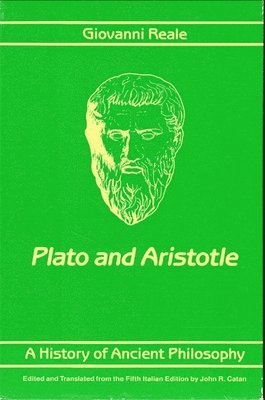
    History of Ancient Philosophy II

    Plato and Aristotle

    AvGiovanni Reale

    Häftad, Engelska, 1990

    Del i serien SUNY series in Philosophy

    488 kr

    Beställningsvara. Skickas inom 5-8 vardagar. Fri frakt över 249 kr.

    Beskrivning

    In this book Reale presents Plato and Aristotle.At the center of Reale's interpretation of Plato is the fulcrum of the supersensible, the metaphysical discovery that Plato presented as a result of the Second Voyage. This discovery of the supersensible is, in Reale's view, not only the fundamental phase of ancient thought, but it also constitutes a milestone on the path of western philosophy.Reale presents Plato in three different dimensions: the theoretic, the mystical-religious, and the political. Each of these components takes on meaning from the Second Voyage. In addition, Reale has shown that only in the light of the Unwritten Doctrines handed down through the indirect tradition, do these three components, and the Second Voyage itself, acquire their full meaning, and only in this way is a unitary conception of Plato's thought achieved.The interpretation of Aristotle that Reale proposes depends on his interpretation of Plato. Aristotle read without preconceptions is not the antithesis of Plato. Reale points out that Aristotle was unique among thinkers close to Plato, in being the one who developed, at least in part, his Second Voyage. The systematic-unitary interpretation of Aristotle which Reale has previously supported converges with the new systematic-unitary interpretation of Plato. Certain doctrinal positions which are usually reserved to treatments in monographs will be explored, because only in this way can the two distinctive traits of Aristotle's thought emerge: the way in which he tries to overcome and confirm the Socratic-Platonic positions, and the way in which he formally creates the system of philosophical knowledge.

    Produktinformation

    • Utgivningsdatum:1990-11-08
    • Mått:154 x 231 x 31 mm
    • Vikt:689 g
    • Format:Häftad
    • Språk:Engelska
    • Serie:SUNY series in Philosophy
    • Antal sidor:437
    • Förlag:State University of New York Press
    • ISBN:9780791405178

    Utforska kategorier

    • Filosofi inom Filosofi och religion

    Mer om författaren

    Giovanni Reale is Professor and holder of the Chair in History of Ancient Philosophy at the Catholic University of Milan. John R. Catan is Professor of Philosophy at the State University of New York, College at Brockport.

    Innehållsförteckning

    • PrefacePreface to the American EditionTranslator's NotesFirst Part: PLATO AND THE DISCOVERY OF THE SUPERSENSIBLE CAUSE: THE SECOND VOYAGE First SectionTHE GREAT RIFT BETWEEN THE WRITTEN CULTURE AND THE ORAL CULTURE AND THE DIFFERENT WAYS OF COMMUNICATING THE PHILOSOPHICAL DOCTRINE OF PLATO I. The Mediation Attempted by Plato between the Written and the Oral and the Structural Relationship between the Written and the Unwritten 1. Why it is necessary to surpass the traditional criterion and acquire a new one to understand the thought of Plato2. The judgment of Plato on writing in the Phaedrus3. The self-testimony contained in the Seventh Letter4. The essential attributes of the Unknown Doctrine of Plato were preserved through the indirect tradition5. How the term esoteric is understood when referred to the Unwritten Doctrine of Plato6. Significance, characteristics, and purpose of the Platonic writings7. The assistance that the indirect tradition brings to the Platonic writingsII. The Important Problems that Have Beset the Interpretation of Plato and Their Most Plausible Solution in the Light of the New Research1. The problem of the unity of Platonic thought2. The problem of irony and its function in Platonic dialogues3. The critical problem of the evolution of Platonic thought4. Myth and logos in Plato5. The multiphased and polyvalent character of Platonic philosophySecond SectionTHE METAPHYSICAL-DIALECTICAL COMPONENT OF PLATONIC THOUGHT I. The Second Voyage as a Journey from the Physical Inquiries of the Presocatics to the Metaphysical Level1. The meeting with the Physicists and the verification of the inconsistency of their teachings2. The meeting with Anaxagoras and the verification of the inadequacy of the Anaxagorean theory of cosmic mind as it was proposed by him3. The important metaphor of the Second Voyage as a symbol of the ascent to the supersensible4. The two phases of the Second Voyage: the theory of the Ideas and the doctrine of the Principles5. The three great focal points of Platonic philosophy: the theories of the Ideas, of the Principles, and of the DemiurgeII. The Platonic Theory of Ideas and Some Problems Connected to It1. Some determinations of the term Idea and its meaning2. The metaphysical and ontological attributes of the Ideas3. The highest metaphysical character of the unity of the ideas4. Platonic dualism is an expression of transcendence5. The important problems about the relationship between the world of Ideas and the world of the sensesIII. The Unwritten Doctrines of the First Principles and the Highest and Most Important Metaphysical Concepts Connected to Them1. The first Principles are identical with the One and the Dyad of the great-and-the-small2. Being as the synthesis (mixture) of the two Principles3. The categoreal division of reality4. Ideal numbers and the numerical structure of reality5. Mathematical entitiesIV. The Metaphysics of the Ideas in the Light of the Protologic of the Unwritten Doctrine and the Allusions That Plato Makes to the Doctrine of the Principles1. The interest paid by Plato in the Republic toward the Good and the remaining debt2. The Parmenides and its meaning3. The ontology of the highest genera in the Sophist and the metaphor of the parricide of Parmenides4. The importance metaphysical theses of the Philebus: the bipolar structure of reality, the four highest genera, and the supreme Measure as AbsoluteV. The Doctrine of the Demiurge and Cosmology1. The position of the physical world in the sphere of the real according to Plato2. The Demiurge and his metaphysical role3. The material principle of the sensible world, its metaphysical role, and its connections with the Dyad4. The One as an emblematic key to the activity and works of the Demiurge5. The creationlike activities of the Platonic Demiurge against the Hellenic background6. The Demiurge (and not the Idea of the Good) is the God of PlatoVI. Epistemology and Dialectic1. Anamnesis, root, and condition of knowledge in the Meno2. Reconfirmation of the doctrine of anamnesis in the subsequent dialogues3. The kinds of knowledge delineated in the Republic4. Dialectic5. The protologic system of dialectic hinges on the one and the manyVII. The Conception of Art and Rhetoric1. Art as far from being and truth2. Rhetoric as the mystification of truthThird SectionTHE ETHICAL-RELIGIOUS-ASCETIC COMPONENT OF PLATONIC THOUGHT AND ITS NEXUSES WITH THE PROTOLOGIC OF THE UNWRITTEN DOCTRINES I. Relevance of the Mystical-Religious-Ascetic Component of PlatonismII. The Immortality of the Soul, Its Ultraterrestrial Destiny, and Its Reincarnation1. The proofs of the immortality of the soul2. The eschatological destiny of the soul3. MetempsychosisIII. The New Moral Ascetic1. Anthropological dualism and the importance of the paradox connected to it2. The systematization and foundation of the new list of values3. Platonic antihedonsim4. The Purification of the soul, virtue, and knowledgeIV. The Mysticism of Philia and Eros1. Friendship (love) and the "Primary Friend"2. "Platonic love"V. Plato a Prophet?VI. The Ethical-Religious Component of Platonic Thought and Its Relationship with the Protologic of the Unwritten DoctrinesFourth SectionTHE POLITICAL COMPONENT OF PLATONISM AND ITS NEXUSES WITH THE PROTOLOGIC OF THE UNWRITTEN DOCTRINES I. The Importance and Significance of the Political Component of Platonism1. The affirmations of the Seventh Letter2. Differences between the Platonic conception and the modern conception of politicsII. The Republic or the Construction of the Ideal City-State1. Perspectives for reading the Republic2. The perfect City-State and the type of man corresponding to it3. The system of community of life of the warriors and the education of women in the ideal City-State4. The philosopher and the ideal City-State5. The education of philosophers in the ideal City-State and "highest knowledge"6. The corrupt City-State and the type of man corresponding to it7. The City-State, terrestrial and ultraterrestrial happiness8. The City-State in the interior of manIII. The Man of the State, Written Laws, and Constitutions1. The problem of the Statesman2. The forms of possible constitution3. The "just mean" and the art of politicsIV. The "Second State" of the Laws1. The purpose of the "Laws" and its relationship with the "Republic"2. Some fundamental concepts of the "Laws"V. The Political Component of Platonic Thought and Its Relationship with the Protologic of the Unwritten DoctrinesFifth SectionCONCLUSIONS CONCERNING PLATONIC THOUGHT I. The Myth of the Cave as a Symbol of Platonic Thought in All Its Fundamental ValencesII. Some Summits of the Thought of Plato Remain Reference Points in the History of Western ThoughtSecond PartARISTOTLE AND THE SYSTEMIZATION OF PHILOSOPHICAL KNOWLEDGE