• Fri frakt över 249 kr
  • •
  • Snabba leveranser
  • •
  • Billiga böcker
Kundservice

Du är på sajten för privatpersoner.

Företag, bibliotek eller offentlig verksamhet?

Du handlar på classic.bokus.com, där alla dina funktioner finns intakta.
Till classic.bokus.com
Bokus logotyp. Gå till startsidan.
  • Erbjudanden
  • Nyheter
  • Student
  • Topplistor
  • Barn & ungdom
  • Bokus Play
  • E-böcker
  • Pocketböcker
  • Spel & pussel

10% rabatt på allt med kod NYSTART10 →

Sidfot

Mina sidor

    Hjälp

    • Kundservice
    • Vanliga frågor och svar
    • Frakt och leverans
    • Retur vid ångerrätt
    • Reklamera vara
    • Betalning
    • Köpvillkor
    • Allmänna villkor
    • Information om webbplatsens tillgänglighet

    Om Bokus

    • Om oss
    • Pressrum
    • För studenter
    • För företag
    • För bibliotek och offentlig verksamhet
    • För leverantörer
    • Hållbarhet

    Populärt

    • Aktuella erbjudanden
    • Presentkort
    • Studentlitteratur
    • Nya böcker
    • Topplistor
    • Signerade böcker
    • Engelska böcker

    Inspiration

    • Boktips
    • BookTok
    • Populära bokserier
    • Barnbokskaraktärer
    • Populära författare
    Logotyp för Bokus
    Följ oss på Facebook (extern länk)Följ oss på Instagram (extern länk)Följ oss på YouTube (extern länk)Följ oss på TikTok (extern länk)
    bokus @ CookiesAnpassa cookiesIntegritetspolicyKöpvillkor
    Till Citymail hemsida (extern länk)Till Budbee hemsida (extern länk)Till Postnord hemsida (extern länk)Till Schenker hemsida (extern länk)Till Early Bird hemsida (extern länk)Till Walleys hemsida (extern länk)
    1. Skönlitteratur
    2. Litteraturvetenskap
    3. Litteraturteori

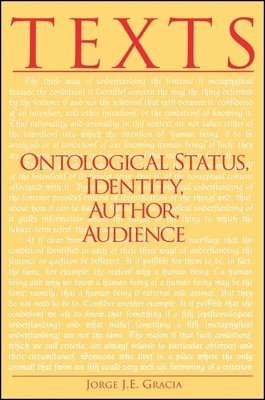
    Texts

    Ontological Status, Identity, Author, Audience

    AvJorge J. E. Gracia

    Inbunden, Engelska, 1996

    Del i serien SUNY series in Philosophy

    1 432 kr

    Beställningsvara. Skickas inom 5-8 vardagar. Fri frakt över 249 kr.

    Fler format och utgåvor

    Häftad

    Tillf. slut

    Beskrivning

    Provides an ontological characterization of texts, explores the issues raised by the identity of various texts, and presents a view of the function of authors and audiences, and of their relations to texts.This book completes the theory of textuality whose logical and epistemological dimensions were presented in Gracia's book, A Theory of Textuality: The Logic and Epistemology (SUNY Press). It provides an ontological characterization of texts consistent with the conception of texts defended in the earlier book; it explores the issues raised by the identity of various texts; and it presents a view of the identity and function of authors and audiences and of their relations to texts. The discussion is systematic, comprehensive, and detailed. Gracia raises all of the important issues related to texts within the areas he explores and takes into account the pertinent literature. The style is argumentative and clear, and the position Gracia defends is based on common sense. He stays clear of the extreme views some contemporary authors have taken with respect to texts and textuality.This is the only book of its kind. It is the first to develop a comprehensive theory and to adopt an integrative approach where the issues and their solutions are seen as closely connected.

    Produktinformation

    • Utgivningsdatum:1996-07-03
    • Mått:152 x 229 x 22 mm
    • Vikt:445 g
    • Format:Inbunden
    • Språk:Engelska
    • Serie:SUNY series in Philosophy
    • Antal sidor:226
    • Förlag:State University of New York Press
    • ISBN:9780791429013

    Utforska kategorier

    • Litteraturteori inom Skönlitteratur

    Mer om författaren

    Jorge J. E. Gracia is Professor in the Department of Philosophy at State University of New York at Buffalo. His other works include Philosophy and Literature in Latin America: A Critical Assessment of the Current Situation (with Mireye Camurati); Individuality: An Essay on the Foundations of Metaphysics; Philosophy and Its History: Issues in Philosophical Historiography; Individuation in Scholasticism: The Later Middle Ages and the Counter-Reformation, 1150–1650; Individuation and Identity in Early Modern Philosophy: Descartes to Kant (with Kenneth F. Barber), and A Theory of Textuality: The Logic and Epistemology, all published by SUNY Press.

    Recensioner i media

    "Gracia's argument is impressively clear and to the point. He develops a complex taxonomy of the distinctions he must marshal in order to fully explain what a text is, describing and defending each distinction with care and in detail. His conclusions follow reasonably from his arguments and he does an excellent job anticipating criticisms and answering them. Gracia is fully informed by the relevant philosophical scholarship on texts and on the wide range of metaphysical issues of which he must take account in order to establish his position." — George Allan, Dickinson College

    Innehållsförteckning

    • Preface Introduction I. The Logic of TextsII. Outline1. Ontological Status I. Are Texts Individual or Universal?A. Individuality and Universality of ECTsB. Individuality and Universality of MeaningsC. Individuality and Universality of TextsII. Individuation of TextsIII. Are Texts Physical or NonPhysical?A. Physical TextsB. Mental TextsIV. Relation of Texts to Meanings and ECTsV. Are Texts Substances or Features?VI. Are Texts Aggregates or Nonaggregates?VII. Existence and Location of TextsVIII. Historicity of TextsIX. Conclusion2. Identity I. SamenessA. Achronic Sameness of TextsB. Synchronic Sameness of TextsC. Diachronic Sameness of TextsII. DifferenceIII. Identification and Reidentification of TextsIV. Conclusion3. Author I. Identity of the AuthorA. Historical AuthorB. Pseudo-Historical AuthorC. Composite AuthorD. Interpretative AuthorII. Function of the AuthorA. Function of the Historical AuthorB. Function of the Composite AuthorC. Function of the Pseudo-Historical AuthorD. Function of the Interpretative AuthorIII. Need for an AuthorA. Need for the Historical authorB.Need for the Pseudo-Historical AuthorC. Need for the Composite AuthorD. Need for the Interpretative AuthorIV. Repressive Character of the AuthorV. Subjectivity of the AuthorVI. Conclusion4. Audience I. Identity of the AudienceA. Types of AudienceB. Composition of the AudienceII. Function of the AudienceIII. Need for an AudienceIV. Character of the AudienceA. Subversive CharacterB. Repressive CharacterV. Subjectivity of the AudienceVI. ConclusionConclusion Notes Select Bibliography Index of Authors Index of Subjects