• Fri frakt över 249 kr
  • •
  • Snabba leveranser
  • •
  • Billiga böcker
Kundservice

Du är på sajten för privatpersoner.

Företag, bibliotek eller offentlig verksamhet?

Du handlar på classic.bokus.com, där alla dina funktioner finns intakta.
Till classic.bokus.com
Bokus logotyp. Gå till startsidan.
  • Erbjudanden
  • Nyheter
  • Student
  • Topplistor
  • Barn & ungdom
  • Bokus Play
  • E-böcker
  • Pocketböcker
  • Spel & pussel

10% rabatt på allt med kod NYSTART10 →

Sidfot

Mina sidor

    Hjälp

    • Kundservice
    • Vanliga frågor och svar
    • Frakt och leverans
    • Retur vid ångerrätt
    • Reklamera vara
    • Betalning
    • Köpvillkor
    • Allmänna villkor
    • Information om webbplatsens tillgänglighet

    Om Bokus

    • Om oss
    • Pressrum
    • För studenter
    • För företag
    • För bibliotek och offentlig verksamhet
    • För leverantörer
    • Hållbarhet

    Populärt

    • Aktuella erbjudanden
    • Presentkort
    • Studentlitteratur
    • Nya böcker
    • Topplistor
    • Signerade böcker
    • Engelska böcker

    Inspiration

    • Boktips
    • BookTok
    • Populära bokserier
    • Barnbokskaraktärer
    • Populära författare
    Logotyp för Bokus
    Följ oss på Facebook (extern länk)Följ oss på Instagram (extern länk)Följ oss på YouTube (extern länk)Följ oss på TikTok (extern länk)
    bokus @ CookiesAnpassa cookiesIntegritetspolicyKöpvillkor
    Till Citymail hemsida (extern länk)Till Budbee hemsida (extern länk)Till Postnord hemsida (extern länk)Till Schenker hemsida (extern länk)Till Early Bird hemsida (extern länk)Till Walleys hemsida (extern länk)
    1. Samhälle och politik
    2. Sociologi och antropologi
    3. Antropologi

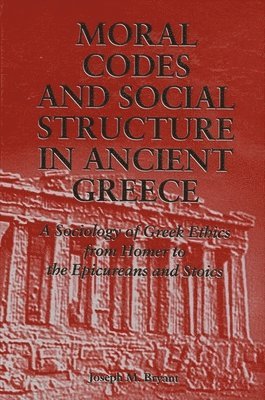
    Moral Codes and Social Structure in Ancient Greece

    A Sociology of Greek Ethics From Homer to the Epicureans and Stoics

    AvJoseph M. Bryant

    Inbunden, Engelska, 1996

    Del i serien SUNY series in the Sociology of Culture

    1 108 kr

    Tillfälligt slut

    Fler format och utgåvor

    Häftad

    527 kr

    Beskrivning

    An exercise in cultural sociology, Moral Codes and Social Structure in Ancient Greece seeks to explicate the dynamic currents of classical Hellenic ethics and social philosophy by situating those idea-complexes in their socio-historical and intellectual contexts. Central to this enterprise is a comprehensive historical-sociological analysis of the Polis form of social organization, which charts the evolution of its basic institutions, roles, statuses, and class relations. From the Dark Age period of "genesis" on to the Hellenistic era of "eclipse" by the emergent forces of imperial patrimonialism, Polis society promoted and sustained corresponding normative codes which mobilized and channeled the requisite emotive commitments and cognitive judgments for functional proficiency under existing conditions of life. The aristocratic warrior-ethos canonized in the Homeric epics; the civic ideology of equality and justice espoused by reformist lawgivers and poets; the democratization of status honor and martial virtue that attended the shift to hoplite warfare; the philosophical exaltation of the Polis-citizen bond as found in the architectonic visions of Plato and Aristotle; and the subsequent retreat from civic virtues and the interiorization of value articulated by the Skeptics, Epicureans, and Stoics, new age philosophies in a world remade by Alexander's conquests-these are the key phases in the evolving currents of Hellenic moral discourse, as structurally framed by transformations within the institutional matrix of Polis society.

    Produktinformation

    • Utgivningsdatum:1996-07-03
    • Mått:153 x 229 x 30 mm
    • Vikt:953 g
    • Format:Inbunden
    • Språk:Engelska
    • Serie:SUNY series in the Sociology of Culture
    • Antal sidor:575
    • Förlag:State University of New York Press
    • ISBN:9780791430415

    Utforska kategorier

    • Antropologi inom Samhälle och politik
    • Forntidens historia inom Historia och arkeologi
    • Europas historia inom Historia och arkeologi

    Mer om författaren

    Joseph M. Bryant is Associate Professor of Sociology at the University of New Brunswick, Canada.

    Recensioner i media

    "This is a challenging reappraisal of major developments in Greek society between the Dark Ages and the flowering of Hellenistic culture. Historians of Greek political life and of Greek philosophy will need to think again about the relationships between social structures and philosophical ethics, between brute economic or material facts and moral ideology. Bryant makes a strong case for the pertinence of historical sociology of a broadly Weberian kind to the understanding of ancient Greek civilization. Anyone inclined to take the historical dimension of ethics seriously will welcome this detailed case study of the interactions between politics, sociology, and moral theory in classical Greek culture."—Brad Inwood, University of Toronto"This is as sociologically and culturally deep and thorough a work on ancient Greek life and thought, up through the Hellenistic period, as one can find in the literature. I found it an enjoyable, at times fascinating, work to read." — Randall Collins, University of California, Riverside

    Innehållsförteckning

    • Acknowledgements Preface: The Sociology of Knowledge and Historical Sociology Introduction: The Polis and the "Spirit" of Hellenism 1. The End of the Bronze Age2. Dark Age Greece I. Social Structure: The Oikos and the Community II. Norms and Values: The Ethos of the Warrior-Aristocracy 3. Archaic Greece I. Social Structure: The Emergence of Polis Society i. Social Change in the Early Archaic Ageii. Hoplites and Tyrants in an Age of Transitioniii. Sparta's Perfection of the Warriors' Guildiv. Toward Democracy in Athens II. Norms and Values: The Articulation of the Polis-Citizen Bond i. Aristocratic Supremacy in the Early Archaic Age: Hereditary Virtue and the Agonal Idealii. The Dêmos in Dependency: Peasant Values and the Cry for Social Justiceiii. The Rise of Hoplite Heroes and Codification of the Polis Idealiv. Troubled Aristocrats, Confident Commoners, and the Contest for Status Honor and Self-Affirmationv. From Myth to Science, and the Occult: The Quest for Knowledge and Salvation 4. Classical Greece I. Slavery and the Material Foundations of Classical Civilization II. The Persian Challenge: Military Triumph and Cultural Affirmation III. The Classical Polis: Institutions and Normative Ideals IV. The Sophists and Sokrates: Critical Rationalism and the Revaluation of Conventional Morality V. Democratic Imperialism and the Expansion of Athenian Power VI. The Peloponnesian War, Civic Factionalism, and the Rupturing of Polis Communalism 5. Fourth-Century Greece and the Decline of the Polis I. Hegemonial Rivalries, Class Struggle, and the Deepening Crisis of Social Disorganization II. Mercenaries, Military Monarchs, and the Erosion of Citizen Politics III. Plato and the Dilemmas of Politics and Reason: The Polis as Philosophical Project IV. The Minor Sokratics and the Onset of Normative Individualism V. The Macedonian Conquest and the Suppression of Polis Autonomy VI. Aristotle's Social Philosophy and the Sociology of Power VII. Diogenes and Cynic Antinomianism 6. The Hellenistic Age I. Alexander and the Graeco-Macedonian Conquest of the East II. Wars of the Successors and the Consolidation of Imperial Patrimonialism III. Ethics in a New Key: The Retreat from Polis-Citizen Ideals and the Interiorization of Moral Value i. Epicureanism: Pleasure and Tranquillity in the Gardenii. Stoicism: The Ethos of "Self-Hardening"iii. Syncretism Triumphant: External Unfreedom and the Quest for Inner Plenitude and Immunity Epilogue: On Reductionism, Relativism, and the Sociology of Morals and Philosophy Glossary of Greek Terms Notes Selected Bibliography Index