• Fri frakt över 249 kr
  • •
  • Snabba leveranser
  • •
  • Billiga böcker
Kundservice

Du är på sajten för privatpersoner.

Företag, bibliotek eller offentlig verksamhet?

Du handlar på classic.bokus.com, där alla dina funktioner finns intakta.
Till classic.bokus.com
Bokus logotyp. Gå till startsidan.
  • Erbjudanden
  • Nyheter
  • Student
  • Topplistor
  • Barn & ungdom
  • Bokus Play
  • E-böcker
  • Pocketböcker
  • Spel & pussel

10% rabatt på allt med kod: NYSTART10 →

Sidfot

Mina sidor

    Hjälp

    • Kundservice
    • Vanliga frågor och svar
    • Frakt och leverans
    • Retur vid ångerrätt
    • Reklamera vara
    • Betalning
    • Köpvillkor
    • Allmänna villkor
    • Information om webbplatsens tillgänglighet

    Om Bokus

    • Om oss
    • Pressrum
    • För studenter
    • För företag
    • För bibliotek och offentlig verksamhet
    • För leverantörer
    • Hållbarhet

    Populärt

    • Aktuella erbjudanden
    • Presentkort
    • Studentlitteratur
    • Nya böcker
    • Topplistor
    • Signerade böcker
    • Engelska böcker

    Inspiration

    • Boktips
    • BookTok
    • Populära bokserier
    • Barnbokskaraktärer
    • Populära författare
    Logotyp för Bokus
    Följ oss på Facebook (extern länk)Följ oss på Instagram (extern länk)Följ oss på YouTube (extern länk)Följ oss på TikTok (extern länk)
    bokus @ CookiesAnpassa cookiesIntegritetspolicyKöpvillkor
    Till Citymail hemsida (extern länk)Till Budbee hemsida (extern länk)Till Postnord hemsida (extern länk)Till Schenker hemsida (extern länk)Till Early Bird hemsida (extern länk)Till Walleys hemsida (extern länk)
    1. Historia och arkeologi
    2. Historia
    3. Historia: teori och metod

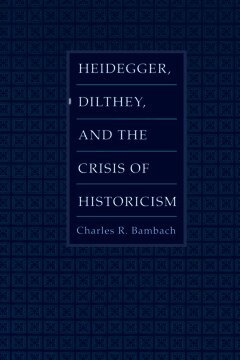
    Heidegger, Dilthey, and the Crisis of Historicism

    AvCharles R. Bambach

    Häftad, Engelska, 1995

    534 kr

    Beställningsvara. Skickas inom 10-15 vardagar. Fri frakt över 249 kr.

    Fler format och utgåvor

    Inbunden

    1 617 kr

    Beskrivning

    The collapse of historicism was not merely the demise of an academic tradition but signified a shift in the understanding of hermeneutics and metaphysics. Whereas earlier books have explored the rise and dominance of historicism within academic history, this is the first to trace its collapse and to show how it was shaped by larger philosophical and scientific concerns. Charles R. Bambach's lucid account of the demise of historicism within the context of German metaphysics provides a rich new perspective on the development of the young Heidegger's concept of "historicity" and on the origins of postmodern thought.Bambach reconstructs the methodological debates arising from a pervasive sense of crisis among German philosophers in the late nineteenth century. He details the divergent attempts by the Neo-Kantians, Nietzsche, and Dilthey to overcome the limitations of historical relativism. Heidegger's view of "historicity," Bambach shows, radically transforms the problematic of historicism into a discourse concerning the crisis of philosophical modernity.
    Produktinformation

    • Utgivningsdatum:1995-07-13
    • Mått:152 x 229 x 21 mm
    • Vikt:907 g
    • Format:Häftad
    • Språk:Engelska
    • Antal sidor:304
    • Förlag:Cornell University Press
    • ISBN:9780801482601

    Utforska kategorier

    • Historia: teori och metod inom Historia och arkeologi
    • Filosofiska discipliner inom Filosofi och religion

    Mer om författaren

    Charles R. Bambach is Associate Professor of History of Ideas/Philosophy, University of Texas at Dallas.

    Recensioner i media

    Charles Bambach is a philosopher who aims to make philosophical discussions of Heidegger more historical and closer to the context of Heidegger's thought. The central point of Bambach's book about the place of politics and rootedness in Heidegger's thought is that Heidegger's philosophical work in the 1930s was deeply connected to National Socialism.... There is still important sorting to be done in relation to what is living and what is dead in Heidegger, but Bambach's book is a significant contribution to this discussion. Heidegger's vision of the world was far from the mainstream of contemporary American academic discourse, and this is Bambach's main concern: to caution us about the selective appropriation of Heidegger's ideas about ecology.(Journal of Modern History) Bambach offers a close reading of Heidegger's texts both in the immediate historical an apolitical context of the years in which they were written and in the context of Heidegger's overall project of deconstructing the Western metaphysical tradition of calculative thinking that objectifies beings and transforms all forms of existence into resources to gain mastery over the earth.(H-Net Reviews) Mr. Bambach's signal achievement is to show, by a scrupulous reading of Heidegger's work, that he was not simply a political naïf caught up in a political maelstrom, as he tried to portray himself after the war. Nor was his decision to become Nazi Rector of his university merely a personal mistake, unrelated to his thought. Rather, Mr. Bambach shows that the very roots of his philosophy grow out of a poisonous soil.... Mr. Bambach shows conclusively that Heidegger did not just disgrace himself with his Nazism; he revealed something essentially dangerous about his thought.(New York Sun) This book is not an expose; we've been through Martin Heidegger's none-too-salubrious laundry hamper before. But it is a book that asks the right question. It is time, Charles Bambach argues, for intellectual historians to get beyond apologies on the one hand, and attempts at total definition and dismissal on the other; rather, he insists, 'we need to ask, what kind of National Socialism did Heidegger aspire to establish? How did Heidegger's own inimitable brand of National Socialism affect the questions he raised about Germany and its place in the history of the West?' (p. xviii). To answer these questions, Bambach make a series of extremely careful and interesting excursuses into specific political, intellectual, and linguistic contexts that shaped Heidegger's thinking, uncovering the ways in which that master punster and merge/sorter of idea fashioned his public statements.(Central European History)