• Fri frakt över 249 kr
  • •
  • Snabba leveranser
  • •
  • Billiga böcker
Kundservice

Du är på sajten för privatpersoner.

Företag, bibliotek eller offentlig verksamhet?

Du handlar på classic.bokus.com, där alla dina funktioner finns intakta.
Till classic.bokus.com
Bokus logotyp. Gå till startsidan.
  • Erbjudanden
  • Student
  • Topplistor
  • Barn & ungdom
  • Bokus Play
  • E-böcker
  • Ljudböcker
  • Pocketböcker
  • Spel och pussel

Pocketfynda! Hundratals böcker för 49 kr/st →

Sidfot

Mina sidor

    Hjälp

    • Kundservice
    • Vanliga frågor och svar
    • Frakt och leverans
    • Retur vid ångerrätt
    • Reklamera vara
    • Betalning
    • Köpvillkor
    • Allmänna villkor
    • Information om webbplatsens tillgänglighet

    Om Bokus

    • Om oss
    • Pressrum
    • För studenter
    • För företag
    • För bibliotek och offentlig verksamhet
    • För leverantörer
    • Hållbarhet

    Populärt

    • Aktuella erbjudanden
    • Presentkort
    • Studentlitteratur
    • Nya böcker
    • Topplistor
    • Signerade böcker
    • Engelska böcker

    Inspiration

    • Boktips
    • BookTok
    • Barnbokskaraktärer
    • Populära författare
    Logotyp för Bokus
    Följ oss på Facebook (extern länk)Följ oss på Instagram (extern länk)Följ oss på YouTube (extern länk)Följ oss på TikTok (extern länk)
    bokus @ CookiesAnpassa cookiesIntegritetspolicyKöpvillkor
    Till Citymail hemsida (extern länk)Till Budbee hemsida (extern länk)Till Postnord hemsida (extern länk)Till Schenker hemsida (extern länk)Till Early Bird hemsida (extern länk)Till Walleys hemsida (extern länk)
    1. Ekonomi och Ledarskap
    2. Företagsekonomi
    3. Entreprenörskap

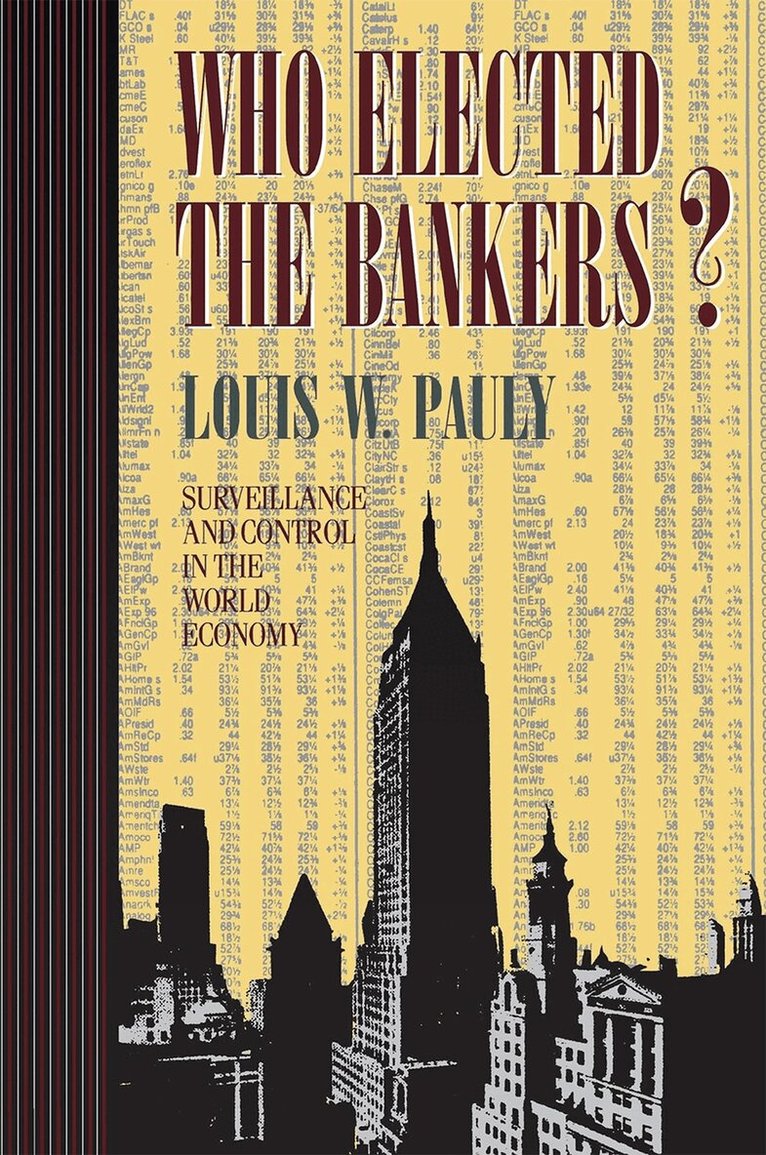
    Who Elected the Bankers?

    Surveillance and Control in the World Economy

    AvLouis W. Pauly

    Häftad, Engelska, 1998

    Del i serien Cornell Studies in Political Economy

    349 kr

    Beställningsvara. Skickas inom 10-15 vardagar. Fri frakt över 249 kr.

    Fler format och utgåvor

    Inbunden

    811 kr

    Beskrivning

    A former banker and staff member of the International Monetary Fund, Louis W. Pauly explains why people are deeply concerned about the emergence of a global economy and the increasingly integrated capital markets at its heart. In nations as diverse as France, Canada, Russia, and Mexico, the lives of citizens are disrupted when national policy falls out of line with the expectations of international financiers. Such dilemmas, ever more conspicuous around the world, arise from the disjuncture between a rapidly changing international economic system and a political order still constituted by sovereign states. The evolution of global capital markets inspires an understandable fear among people that the governing authorities accountable to them are losing the power to make substantive decisions affecting their own material prospects and those of their children. Pauly points out that today's capital markets resulted from decisions taken over many years by sovereign states, and particularly by the leading industrial democracies, who simultaneously crafted the instrument of multilateral economic surveillance. The effort to build adequate political foundations for global capital markets spans the twentieth century and links the histories of such institutions as the League of Nations, the International Monetary Fund, the European Union, and the Group of Seven.

    Produktinformation

    • Utgivningsdatum:1998-09-02
    • Mått:152 x 229 x 16 mm
    • Vikt:454 g
    • Format:Häftad
    • Språk:Engelska
    • Serie:Cornell Studies in Political Economy
    • Antal sidor:200
    • Förlag:Cornell University Press
    • ISBN:9780801483752

    Utforska kategorier

    • Entreprenörskap inom Ekonomi och Ledarskap
    • Ekonomisk politik inom Ekonomi och Ledarskap
    • Finansiering inom Ekonomi och Ledarskap

    Mer om författaren

    Louis W. Pauly is Professor of Political Science and Director of the Centre for International Studies at the University of Toronto. He is the coeditor of Governing the World's Money and the author of Opening Financial Markets: Banking Politics on the Pacific Rim, both from Cornell, and coauthor or coeditor of several other books, including Complex Sovereignty.

    Recensioner i media

    A clear, concise, and well-argued historical analysis.... Who Elected the Bankers? can provide the foundation of historical knowledge that interested citizens need in order to engage in the public discussion over international integration that the leaders of powerful states now avoid. I recommend it highly.(Journal of Interdisciplinary History) Louis Pauly's very interesting and readable book examines the relationship between global finance, democracy, and international institutions in the context of OECD countries. Its arguments are important and innovative not just for those studying the political economy of global finance, a field in which Pauly has been a leading figure over the last decade. They are also highly significant to anyone interested in broader debates about globalization and the future of democracy in advanced industrial states.... Who Elected the Bankers? will be seen by all as a very welcome and major contribution to debates on the political economy of global finance, the history of international financial policy making and analyses of the relationship between politics and globalization. It deserves a wide audience.(Canadian Journal of Political Science) A welcome book.... Pauly organizes his claims and evidence in an innovative and effective manner.... A provocative introduction and masterly consideration of the main issues.... An excellent book.... This is a well-written book, expertly edited, and a delight to read.... This is an excellent contribution to the literature on international capital mobility and multilateral economic surveillance.... Sensitive in analysis, dynamic in its identification of crucial contradictions, thoughtful in interpretation, this book will be a benchmark for future contributions to international political economy.(International Relations) As a former staff member of the IMF, Pauly is in a unique position to give a fresh perspective. He traces the development of the IMF from its roots in the League of Nations and gives an excellent account of how it redefined its role after the demise of fixed exchange rates in the 1970s.(International Journal) Louis Pauly obviously was intent upon startling people when he set out to write the story of the International Monetary Fund, a group that he believes is credited with wielding far more power than it really has. In a careful discussion of the failings of the League of Nations, Pauly details how industrialized nations moved to create the IMF in the midst of World War II in the belief that an organization that balances international monetary policy would help prevent future conflagrations.... He shows how the IMF has become intertwined with the political foundations of today's global economy.(Chicago Tribune) The reader interested in the evolution of the international monetary system in the postwar period will find in Pauly's book a very readable description, and an often insightful interpretation, of events, supported by detailed notes and references.(Finance and Development)

    Innehållsförteckning

    • 1. Global Markets and National Politics2. The Political Economy of International Capital Mobility3. The League of Nations and Roots of Multilateral Oversight4. The Transformation of Economic Oversight in the League5. Global Aspirations and the Early International Monetary Fund6. The Reinvention of Multilateral Economic Surveillance7. The Political Foundations of Global MarketsNotesSelected BibliographyIndex