Louis W. Pauly - Böcker
Visar alla böcker från författaren Louis W. Pauly. Handla med fri frakt och snabb leverans.
12 produkter
12 produkter
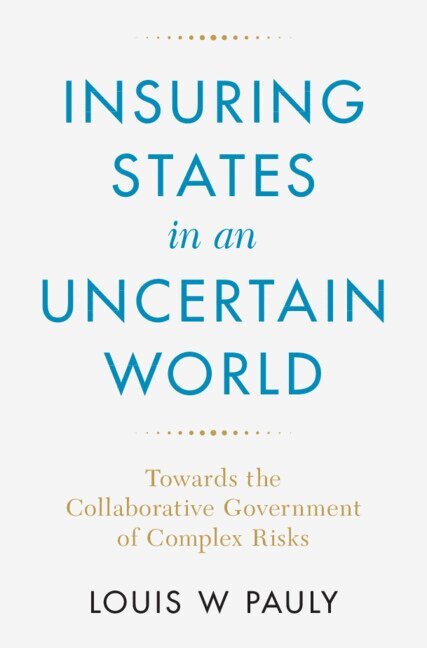
Insuring States in an Uncertain World
Towards the Collaborative Government of Complex Risks
Inbunden, Engelska, 2025
385 kr
Skickas inom 7-10 vardagar
Of the sectors comprising international capital markets, insurance and reinsurance have attracted relatively little attention from students of politics. New social conventions and financial instruments arising from the invention of probabilistic calculation and the discovery of risk began to spread around the world five centuries ago. Today, states and firms are harnessing the logic of insurance to address an expansive array of risks confronting their societies. In Insuring States in an Uncertain World, Louis Pauly examines the history and politics of pragmatic experiments aimed at governing complex global risks. His fascinating and accessible narrative explores the promise and the challenges of multi-faceted insurance arrangements in arenas ranging from nuclear energy production and international financial intermediation to those focused on environmental change, infectious diseases, and disruptive new technologies. At a time when the foundations of global order are under mounting stress, Pauly makes the case for limited and effective political innovation.
2 024 kr
Skickas inom 10-15 vardagar
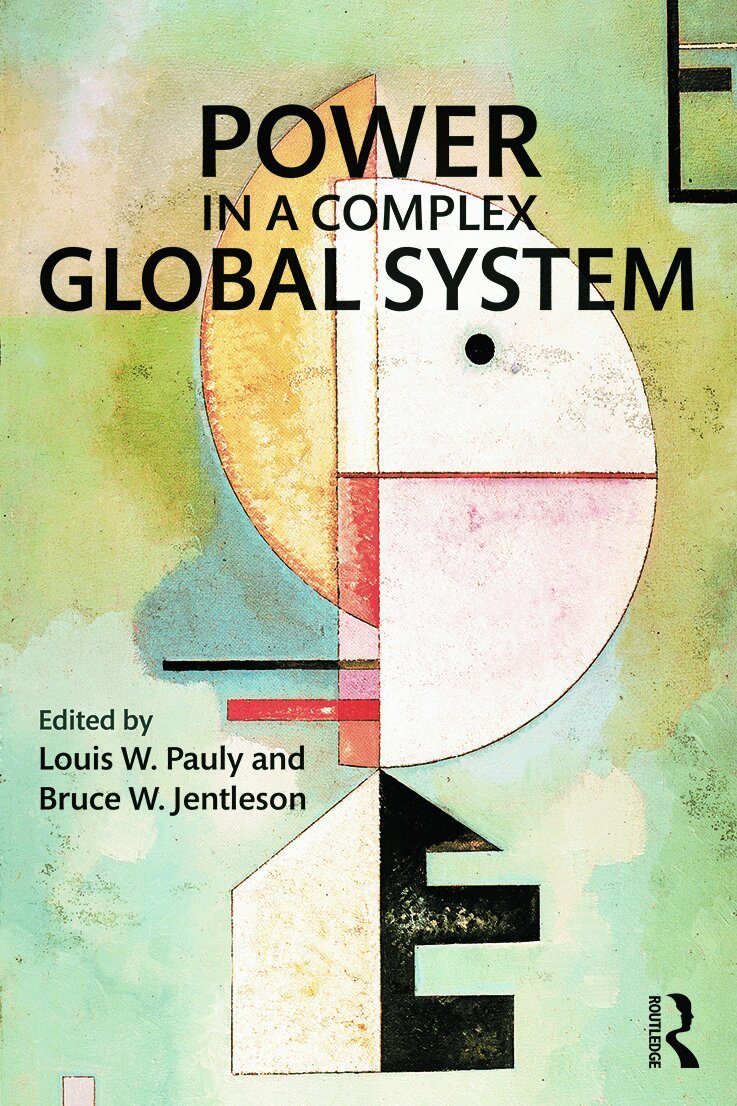
Can twenty-first century global challenges be met through the limited adaptation of existing political institutions and prevailing systemic norms, or is a more fundamental reconstitution of governing authority unavoidable? Are the stresses evident in domestic social compacts capable of undermining the fundamental policy capacity of contemporary governments? This book, inspired by the work of the distinguished scholar Peter J. Katzenstein, examines these important and pressing questions. In a period of complex political transition, the authors combine original research and intensive dialogue to build on Katzenstein’s innovative insights. They highlight his seminal work on variations in domestic structures, on the role of ideologies of social partnership, on the regionally differentiated foundations of political legitimation, on diverse conceptions of "civilization," and on the idea and practice of power in a tenuous American imperium. Together, the chapters map the complex terrain upon which legitimate political authority and effective policy capacity will have to be reconstituted to address twenty-first-century global, regional and state-level challenges. The book will be of great interest to students and scholars in international organization, global governance, foreign policy analysis, and comparative politics.
699 kr
Skickas inom 10-15 vardagar
Can twenty-first century global challenges be met through the limited adaptation of existing political institutions and prevailing systemic norms, or is a more fundamental reconstitution of governing authority unavoidable? Are the stresses evident in domestic social compacts capable of undermining the fundamental policy capacity of contemporary governments? This book, inspired by the work of the distinguished scholar Peter J. Katzenstein, examines these important and pressing questions. In a period of complex political transition, the authors combine original research and intensive dialogue to build on Katzenstein’s innovative insights. They highlight his seminal work on variations in domestic structures, on the role of ideologies of social partnership, on the regionally differentiated foundations of political legitimation, on diverse conceptions of "civilization," and on the idea and practice of power in a tenuous American imperium. Together, the chapters map the complex terrain upon which legitimate political authority and effective policy capacity will have to be reconstituted to address twenty-first-century global, regional and state-level challenges. The book will be of great interest to students and scholars in international organization, global governance, foreign policy analysis, and comparative politics.
404 kr
Skickas inom 7-10 vardagar
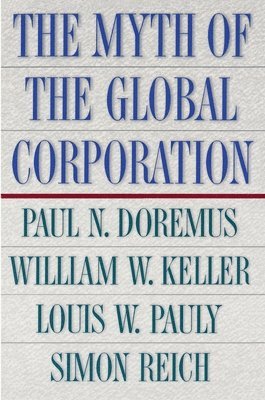
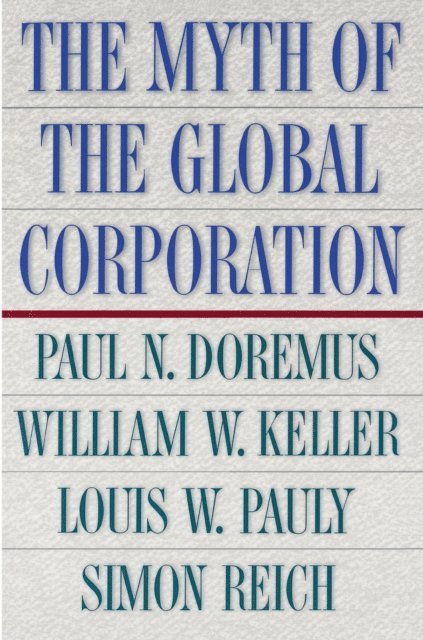
Critics and defenders of multinational corporations often agree on at least one thing: that the activities of multinationals are creating an overwhelmingly powerful global market that is quickly rendering national borders obsolete. The authors of this book, however, argue that such expectations commonly rest on a myth. They examine key activities of multinational corporations in the United States, Japan, and Europe and explore the relationship between corporate behavior and national institutions and cultures. They demonstrate that the world's leading multinationals continue to be shaped decisively by the policies and values of their home countries and that their core operations are not converging to create a seamless global market. With a wealth of fresh evidence, the authors show that Japanese and German multinationals, in particular, remain only weakly committed to laissez-faire policy orientations and continue to exhibit strong allegiance to national goals in such areas as investment and employment. They also bring to light the consequences of enduring differences in government policies on, for example, industrial cartels, capital markets, and research and development.The authors agree that the world economy is becoming more complex and integrated as overt barriers to trade and investment fall away. But they conclude that the extent of this integration is decisively limited by structural divergence at the level of the firm. The book will be essential reading for those seeking to understand the growing interdependence of still-distinctive industrial societies and the wellsprings of the true global economy.
389 kr
Skickas inom 7-10 vardagar
Despite myriad global forces influencing the lives of individuals, societies, and polities, people continue to value their personal and communal independence. They insist on shaping the conditions of their existence to the fullest extent possible. At the same time, many formal and informal institutions – from transnational legal and financial regimes to new governance arrangements for aboriginal communities in environmentally sensitive regions – are evolving, adapting to meet new challenges, or failing to adjust rapidly enough.Global Ordering examines the key institutions and organizations that mediate the increasingly complex relationship between globalization and autonomy. Bringing together an outstanding group of scholars, this ground-breaking book contributes significantly to the work of re-imagining the circumstances under which integrative systemic forces can be brought into alignment with irreducible commitments to individual and collective autonomy. It is important work that maps the new frontier of globalization studies.
1 018 kr
Skickas inom 7-10 vardagar
Examines the possibilities of global governance in the wake of the challenges of globalization.Many years ago, John Gerard Ruggie coined the phrase "embedded liberalism" to describe the grand post-1945 political compromise between free-market liberalism and domestic political interventionism that stabilized the multilateral economic order. In Global Liberalism and Political Order, leading scholars of political economy and international relations assess the challenges facing today's increasingly interdependent world as globalization redefines the old political order. They address the unraveling and/or reinvention of a grand compromise in global governance from a variety of theoretical perspectives and issue areas, including trade, finance, networked governance, North-South relations, and the environment. Focusing on the foundations of political authority at the global level, the contributors imagine the implications of success or failure for international economic order and political stability. Ruggie, whose work inspired many of this book's scholars, contributes a chapter on the prospects for a new global-as opposed to international-grand bargain.
364 kr
Skickas inom 7-10 vardagar
Examines the possibilities of global governance in the wake of the challenges of globalization.Many years ago, John Gerard Ruggie coined the phrase "embedded liberalism" to describe the grand post-1945 political compromise between free-market liberalism and domestic political interventionism that stabilized the multilateral economic order. In Global Liberalism and Political Order, leading scholars of political economy and international relations assess the challenges facing today's increasingly interdependent world as globalization redefines the old political order. They address the unraveling and/or reinvention of a grand compromise in global governance from a variety of theoretical perspectives and issue areas, including trade, finance, networked governance, North-South relations, and the environment. Focusing on the foundations of political authority at the global level, the contributors imagine the implications of success or failure for international economic order and political stability. Ruggie, whose work inspired many of this book's scholars, contributes a chapter on the prospects for a new global-as opposed to international-grand bargain.
807 kr
Skickas inom 3-6 vardagar
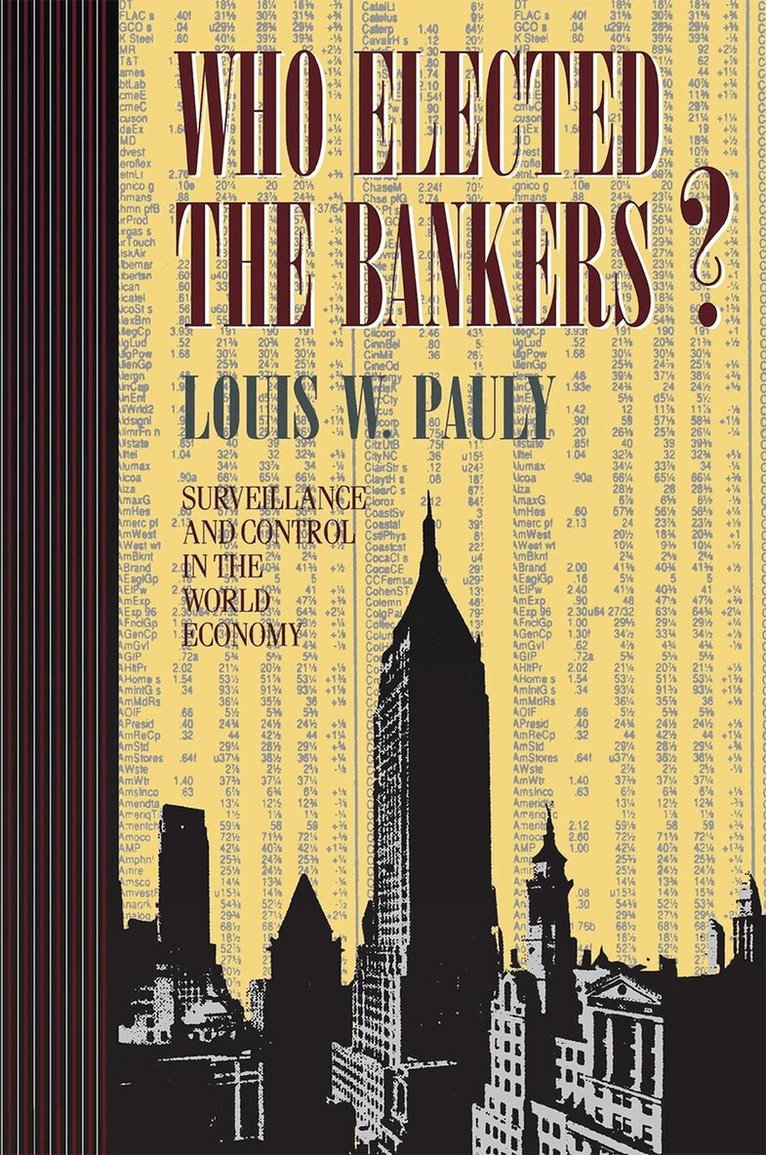
A former banker and staff member of the International Monetary Fund, Louis W. Pauly explains why people are deeply concerned about the emergence of a global economy and the increasingly integrated capital markets at its heart. In nations as diverse as France, Canada, Russia, and Mexico, the lives of citizens are disrupted when national policy falls out of line with the expectations of international financiers. Such dilemmas, ever more conspicuous around the world, arise from the disjuncture between a rapidly changing international economic system and a political order still constituted by sovereign states. The evolution of global capital markets inspires an understandable fear among people that the governing authorities accountable to them are losing the power to make substantive decisions affecting their own material prospects and those of their children. Pauly points out that today's capital markets resulted from decisions taken over many years by sovereign states, and particularly by the leading industrial democracies, who simultaneously crafted the instrument of multilateral economic surveillance. The effort to build adequate political foundations for global capital markets spans the twentieth century and links the histories of such institutions as the League of Nations, the International Monetary Fund, the European Union, and the Group of Seven.
889 kr
Skickas inom 10-15 vardagar
The effective governance of global money and finance is under enormous stress. Deep changes over the last decade in capital markets, exchange rate systems, and government finances suggest dramatic shifts in the contours of monetary power, with tensions rising between the functional logic of international economics and the geographic logic of state-centered politics. Governing the World's Money assesses those tensions and the prospects for their peaceful resolution. Governing the World's Money surveys the frontiers of the global monetary system in ten original essays. Leading scholars of international relations and economics explore the evolution of the instruments available to policy officials for monetary governance. As they analyze the contemporary reordering of political authority in a market-oriented global economy, they open new pathways for the study of regional monetary integration and international institutional reform.
337 kr
Skickas inom 10-15 vardagar
A former banker and staff member of the International Monetary Fund, Louis W. Pauly explains why people are deeply concerned about the emergence of a global economy and the increasingly integrated capital markets at its heart. In nations as diverse as France, Canada, Russia, and Mexico, the lives of citizens are disrupted when national policy falls out of line with the expectations of international financiers. Such dilemmas, ever more conspicuous around the world, arise from the disjuncture between a rapidly changing international economic system and a political order still constituted by sovereign states. The evolution of global capital markets inspires an understandable fear among people that the governing authorities accountable to them are losing the power to make substantive decisions affecting their own material prospects and those of their children. Pauly points out that today's capital markets resulted from decisions taken over many years by sovereign states, and particularly by the leading industrial democracies, who simultaneously crafted the instrument of multilateral economic surveillance. The effort to build adequate political foundations for global capital markets spans the twentieth century and links the histories of such institutions as the League of Nations, the International Monetary Fund, the European Union, and the Group of Seven.
Complex Sovereignty
Reconstituting Political Authority in the Twenty-First Century
Häftad, Engelska, 2007
408 kr
Skickas inom 10-15 vardagar
The way humanity governs itself is today changing very rapidly. Profound transformations in structures of political authority are underway in Europe, North America, and beyond. Nation-states remain central, but they cannot address the most pressing problems facing their own citizens without moving away from traditional understandings of sovereignty itself. Complex Sovereignty contends that just such a movement is underway.Editors Edgar Grande and Louis W. Pauly and the contributors to this volume elucidate the meaning of complex sovereignty through a set of conceptual and empirical studies including governance in the European Union and North America, the emergence of private-public partnerships, the adaptation of established international organizations, and the search for innovative mechanisms to manage risk. They reveal a fascinating and vitally important struggle to give coherence to a complicated governing system of multiple and overlapping hierarchies. This is an original, collaborative study crossing the disciplines of political science, international relations, sociology, and political economy.
581 kr
Skickas inom 10-15 vardagar
Political authority in today’s leading democracies rests on generally shared perceptions by a given people that their government is responsible to them and considers each individual citizen equal under the law. Yet since the dawn of the industrial age, democratic governments have presided over economies that function on the basis of an unequal distribution of real resources. As globalization opens these economies, the gap between legal, ideal and economic reality widens and boundaries separating “the people” of different democracies erode. This thought-provoking book explores the consequent challenge posed for the inherent legitimacy of democratic systems. When distinctive bonds between political power and social obligation break down, that erosion creates “democratic deficits.” Pressures build to reconstitute political authority beyond the state, and governance-in-practice grows ever more distant from democracy-in-principle.Nowhere is the deepening dilemma more evident than in the European Union. This book examines the contemporary breakdown and transformation of the democratic welfare state in Europe and draws fascinating contrasts with North America. In a cohesive and insightful collection of essays, a group of distinguished political scientists debates the implications of these trends both for theory and for policy.