• Fri frakt över 249 kr
  • •
  • Snabba leveranser
  • •
  • Billiga böcker
Kundservice

Du är på sajten för privatpersoner.

Företag, bibliotek eller offentlig verksamhet?

Du handlar på classic.bokus.com, där alla dina funktioner finns intakta.
Till classic.bokus.com
Bokus logotyp. Gå till startsidan.
  • Erbjudanden
  • Nyheter
  • Student
  • Topplistor
  • Barn & ungdom
  • Bokus Play
  • E-böcker
  • Pocketböcker
  • Spel & pussel

10% rabatt på allt med kod: NYSTART10 →

Sidfot

Mina sidor

    Hjälp

    • Kundservice
    • Vanliga frågor och svar
    • Frakt och leverans
    • Retur vid ångerrätt
    • Reklamera vara
    • Betalning
    • Köpvillkor
    • Allmänna villkor
    • Information om webbplatsens tillgänglighet

    Om Bokus

    • Om oss
    • Pressrum
    • För studenter
    • För företag
    • För bibliotek och offentlig verksamhet
    • För leverantörer
    • Hållbarhet

    Populärt

    • Aktuella erbjudanden
    • Presentkort
    • Studentlitteratur
    • Nya böcker
    • Topplistor
    • Signerade böcker
    • Engelska böcker

    Inspiration

    • Boktips
    • BookTok
    • Populära bokserier
    • Barnbokskaraktärer
    • Populära författare
    Logotyp för Bokus
    Följ oss på Facebook (extern länk)Följ oss på Instagram (extern länk)Följ oss på YouTube (extern länk)Följ oss på TikTok (extern länk)
    bokus @ CookiesAnpassa cookiesIntegritetspolicyKöpvillkor
    Till Citymail hemsida (extern länk)Till Budbee hemsida (extern länk)Till Postnord hemsida (extern länk)Till Schenker hemsida (extern länk)Till Early Bird hemsida (extern länk)Till Walleys hemsida (extern länk)
    1. Medicin
    2. Medicin: allmänt
    3. Den medicinska professionen
    4. Medicinsk etik och läkaretik

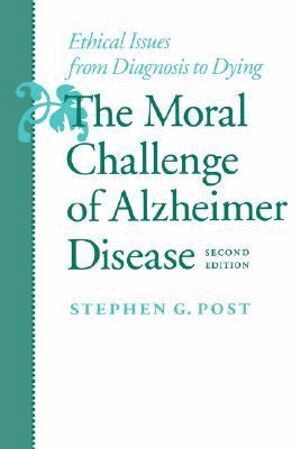
    Moral Challenge of Alzheimer Disease

    Ethical Issues from Diagnosis to Dying

    AvStephen G. Post

    Häftad, Engelska, 2000

    Del i serien Gerontology

    377 kr

    Beställningsvara. Skickas inom 5-8 vardagar. Fri frakt över 249 kr.

    Beskrivning

    Society today, writes Stephen Post, is "hypercognitive": it places inordinate emphasis on people's powers of rational thinking and memory. Thus, Alzheimer disease and other dementias, which over an extended period incrementally rob patients of exactly those functions, raise many dilemmas. How are we to view-and value-persons deprived of what some consider the most important human capacities? In the second edition of The Moral Challenge of Alzheimer Disease, Post updates his highly praised account of the major ethical issues relating to dementia care. With chapters organized to follow the progression from mild to severe and then terminal stages of dementia, Post discusses topics including the experience of dementia, family caregiving, genetic testing for Alzheimer disease, quality of life, and assisted suicide and euthanasia. New to this edition are sections dealing with end-of-life issues (especially artificial nutrition and hydration), the emerging cognitive-enhancing drugs, distributive justice, spirituality, and hospice, as well as a critique of rationalistic definitions of personhood.The last chapter is a new summary of practical solutions useful to family members and professionals.

    Produktinformation

    • Utgivningsdatum:2000-11-10
    • Mått:152 x 229 x 11 mm
    • Vikt:255 g
    • Format:Häftad
    • Språk:Engelska
    • Serie:Gerontology
    • Antal sidor:176
    • Upplaga:2
    • Förlag:Johns Hopkins University Press
    • ISBN:9780801864100

    Utforska kategorier

    • Medicinsk etik och läkaretik inom Medicin
    • Hälso- och sjukvård inom Medicin
    • Etiska frågor och debatter inom Samhälle och politik

    Mer om författaren

    Stephen G. Post is a professor at the Center for Biomedical Ethics, School of Medicine, Case Western Reserve University.

    Recensioner i media

    With this second edition of The Moral Challenge of Alzheimer Disease, Post has enlarged upon his original work in a way to make it even more useful and current. The updated version now gives a highly readable strategy for dealing with end-of-life issues, such as artificial tube feeding and dehydration. In his characteristically clear manner, Post equips us with the necessary facts and then cogently suggest how to proceed humanely and with absolute consideration of the person who should be at the center of concern. -- Peter M. Jucovey Perspectives in Biology and Medicine Post has provided a well-researched book with an outstanding bibliography that will be helpful to all caregivers as well as health care providers. The text provides information to guide readers before and during ethical and moral decision making and is very sensitive to the various emotions one endures when the diagnosis is AD. Health Progress In summary, then, Post proposes a new ethic in regard to terminal dementia care. The considerations proposed in this book offer a meaningful guide to both health care professionals and families in dealing with these special issues and advocate a natural death for these patients, freeing families from the sometimes enormous sense of guilt they encounter in making decisions about life extending interventions. Baylor University Medical Center Proceedings

    Innehållsförteckning

    • PrefaceAcknowledgmentsChapter 1. The Moral Challenge of Alzheimer Disease: Defining the TaskChapter 2. The Family Caregiver: Partnership in HopeChapter 3. Fairhill Guidelines on Ethics and the Care of People with Alzheimer DiseaseChapter 4. Genetic Education for a Too-Hopeful PublicChapter 5. The Humane Goal: Enhancing the Well-Being of Persons with DementiaChapter 6. Dying with Dignity: The Case Against Artificial Nutrition and HydrationChapter 7. An Argument Against Assisted Suicide and Euthanasia in the Context of Progressive Dementia Chapter 8. Toward a New Ethics of Dementia CareReferencesIndex