• Fri frakt över 249 kr
  • •
  • Snabba leveranser
  • •
  • Billiga böcker
Kundservice

Du är på sajten för privatpersoner.

Företag, bibliotek eller offentlig verksamhet?

Du handlar på classic.bokus.com, där alla dina funktioner finns intakta.
Till classic.bokus.com
Bokus logotyp. Gå till startsidan.
  • Erbjudanden
  • Student
  • Topplistor
  • Barn & ungdom
  • Bokus Play
  • Bokus Play
  • E-böcker
  • Ljudböcker
  • Pocketböcker
  • Spel & pussel

10% rabatt på allt med kod NYSTART10 →

Sidfot

Mina sidor

    Hjälp

    • Kundservice
    • Vanliga frågor och svar
    • Frakt och leverans
    • Retur vid ångerrätt
    • Reklamera vara
    • Betalning
    • Köpvillkor
    • Allmänna villkor
    • Information om webbplatsens tillgänglighet

    Om Bokus

    • Om oss
    • Pressrum
    • För studenter
    • För företag
    • För bibliotek och offentlig verksamhet
    • För leverantörer
    • Hållbarhet

    Populärt

    • Aktuella erbjudanden
    • Presentkort
    • Studentlitteratur
    • Nya böcker
    • Topplistor
    • Signerade böcker
    • Engelska böcker

    Inspiration

    • Boktips
    • BookTok
    • Populära bokserier
    • Barnbokskaraktärer
    • Populära författare
    Logotyp för Bokus
    Följ oss på Facebook (extern länk)Följ oss på Instagram (extern länk)Följ oss på YouTube (extern länk)Följ oss på TikTok (extern länk)
    bokus @ CookiesAnpassa cookiesIntegritetspolicyKöpvillkor
    Till Citymail hemsida (extern länk)Till Budbee hemsida (extern länk)Till Postnord hemsida (extern länk)Till Schenker hemsida (extern länk)Till Early Bird hemsida (extern länk)Till Walleys hemsida (extern länk)
    1. Psykologi och pedagogik
    2. Pedagogik
    3. Pedagogisk teori och filosofi

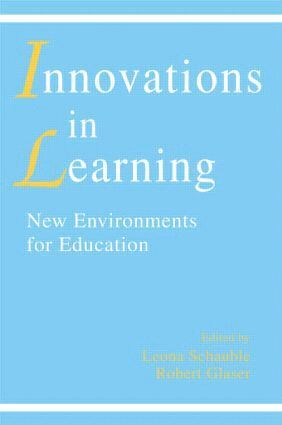
    innovations in Learning

    New Environments for Education

    AvLeona Schauble,Robert Glaser

    Häftad, Engelska, 1996

    892 kr

    Beställningsvara. Skickas inom 10-15 vardagar. Fri frakt över 249 kr.

    Beskrivning

    This volume documents the growth of a new kind of interdisciplinary teamwork that is evolving among practitioners, researchers, teacher educators, and community partners. Its premise: the design of learning environments and the development of theory must proceed in a mutually supportive fashion. Scientific researchers have learned that a prerequisite to studying the kinds of learning that matter is helping to shoulder the responsibility for ensuring that these forms of learning occur. To support and study learning, researchers are increasingly making major and long-term investments in the design and maintenance of contexts for learning. Practitioners are assuming new roles as well, reflecting an increasing awareness of the need to move beyond skillful doing. If developing learning contexts are to be protected within and expanded beyond the systems that surround them, it is necessary to foster professional communities that will support reflection about practice, including the generation and evaluation of rich and flexible environments for student thinking. One consequence of recent reforms is that teachers are increasingly regarding such tasks as central to their professional development.Innovations in Learning: New Environments for Education describes coordinated interaction between educational design on the one hand, and the development of learning theory on the other, through a series of examples. These examples have been chosen because they are continuing, proven programs with evidence of success. Contributors to the volume are researchers and practitioners who have played a role in inventing these programs and have guided their development over a period of years. Rather than choosing illustrations of a pipeline or "application model of research" from research and then to practice, the editors of this volume have selected interventions in which researchers and practitioners work together persistently to forge common understanding. Such activity is necessarily interdisciplinary, often encompassing long spans of time, and is more akin to engineering in the field than to laboratory science. The common themes that emerge from this activity -- for example, the role of tools, talk, and community -- belong exclusively neither to theory nor to practice, but to their intersection in commitment to specific contexts of learning and continuing contributions to practice and underlying theory.This volume is organized into three sections that reflect different levels and kinds of learning contexts. Each of these levels has been the focus of recent cognitive and reform applications to learning and schooling. The first offers examples of effective learning in informal settings; the second discusses innovative approaches to schooling at the classroom level; and the third reviews reforms that regard the entire school as the appropriate unit of change.

    Produktinformation

    • Utgivningsdatum:1996-09-01
    • Mått:152 x 229 x 23 mm
    • Vikt:730 g
    • Format:Häftad
    • Språk:Engelska
    • Antal sidor:390
    • Förlag:Taylor & Francis Inc
    • ISBN:9780805820706

    Utforska kategorier

    • Pedagogisk teori och filosofi inom Psykologi och pedagogik
    • Pedagogisk metodik inom Psykologi och pedagogik

    Recensioner i media

    "Collectively, the chapters give the reader an overview of collaborative project development using interdisciplinary teams, design and educational principles on which new learning environments are based, and interesting ideas for future research arising from these projects. Successful applications, such as those reported, extend our knowledge of theory and practice and provide a basis for creating school environments that make understanding a central goal."—Educational Technology Review"Anyone interested in the effort to design effective learning environments will find these articles concrete, relevant, and very clearly written."—Contemporary Psychology

    Innehållsförteckning

    • Contents: Foreword. Preface. Part I: Education Outside the Classroom.L. Schauble, D.B. Beane, G.D. Coates, L.M.W. Martin, P.V. Sterling, Outside the Classroom Walls: Learning in Informal Environments. L. Flower, Collaborative Planning and Community Literacy: A Window on the Logic of Learners. C. Juel, Learning to Learn from Effective Tutors. P. Pedraza, J. Ayala, Motivation as an Emergent Issue in an After-School Program in El Barrio. Part II: Learning Inside the Classroom.B. Warren, A.S. Rosebery, "This Question is Just Too, Too Easy!" Students' Perspectives on Accountability in Science. E.A. Silver, Moving Beyond Learning Alone and in Silence: Observations from the QUASAR Project Concerning Communication in Mathematics Classrooms. M. Resnick, Toward a Practice of "Constructional Design." J. Minstrell, V. Stimpson, A Classroom Environment for Learning: Guiding Students' Reconstruction of Understanding and Reasoning. G.W. McDiarmid, Challenging Prospective Teachers' Understandings of History: An Examination of a Historiography Seminar. M. Lamon, T. Secules, A.J. Petrosino, R. Hackett, J.D. Bransford, S.R. Goldman, Schools for Thought: Overview of the Project and Lessons Learned from One of the Sites. A.L. Brown, J.C. Campione, Psychological Theory and the Design of Innovative Learning Environments: On Procedures, Principles, and Systems. Part III: Changing Environments for Education.H.M. Levin, Accelerated Schools After Eight Years. J.P. McDonald, Below the Surface of School Reform: Vision and Its Foes.