• Fri frakt över 249 kr
  • •
  • Snabba leveranser
  • •
  • Billiga böcker
Kundservice

Du är på sajten för privatpersoner.

Företag, bibliotek eller offentlig verksamhet?

Du handlar på classic.bokus.com, där alla dina funktioner finns intakta.
Till classic.bokus.com
Bokus logotyp. Gå till startsidan.
  • Erbjudanden
  • Student
  • Topplistor
  • Barn & ungdom
  • Bokus Play
  • E-böcker
  • Ljudböcker
  • Pocketböcker
  • Spel och pussel

5% studentrabatt – använd koden KURSBOK27 →

Sidfot

Mina sidor

    Hjälp

    • Kundservice
    • Vanliga frågor och svar
    • Frakt och leverans
    • Retur vid ångerrätt
    • Reklamera vara
    • Betalning
    • Köpvillkor
    • Allmänna villkor
    • Information om webbplatsens tillgänglighet

    Om Bokus

    • Om oss
    • Pressrum
    • För studenter
    • För företag
    • För bibliotek och offentlig verksamhet
    • För leverantörer
    • Hållbarhet

    Populärt

    • Aktuella erbjudanden
    • Presentkort
    • Studentlitteratur
    • Nya böcker
    • Topplistor
    • Signerade böcker
    • Engelska böcker

    Inspiration

    • Boktips
    • BookTok
    • Barnbokskaraktärer
    • Populära författare
    Logotyp för Bokus
    Följ oss på Facebook (extern länk)Följ oss på Instagram (extern länk)Följ oss på YouTube (extern länk)Följ oss på TikTok (extern länk)
    bokus @ CookiesAnpassa cookiesIntegritetspolicyKöpvillkor
    Till Citymail hemsida (extern länk)Till Budbee hemsida (extern länk)Till Postnord hemsida (extern länk)Till Schenker hemsida (extern länk)Till Early Bird hemsida (extern länk)Till Walleys hemsida (extern länk)
    1. Historia och arkeologi
    2. Historia
    3. Europas historia
    4. Medeltiden

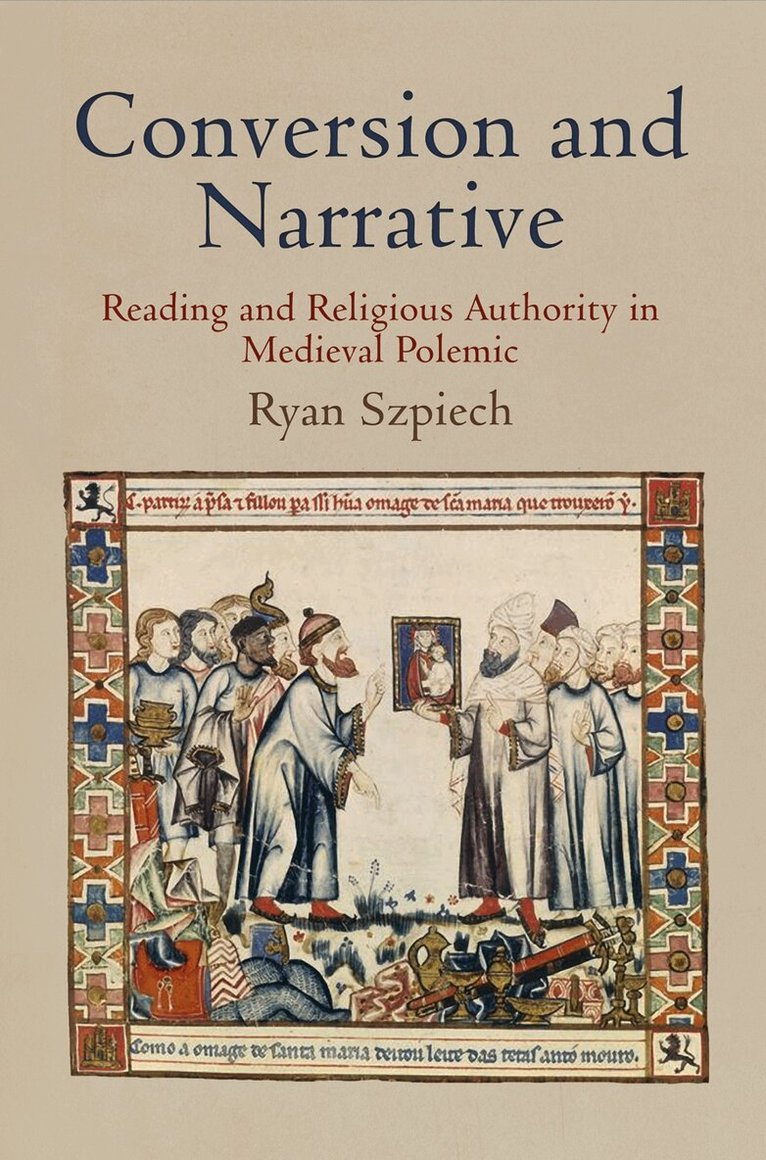
    Conversion and Narrative

    Reading and Religious Authority in Medieval Polemic

    AvRyan Szpiech

    E-bok
    Engelska, 2012

    Del i serien Middle Ages Series

    1 183 kr

    Läs direkt i Bokus Reader – eller ladda ned till din enhet

    Fler format och utgåvor

    Inbunden

    602 kr

    Beskrivning

    In 1322, a Jewish doctor named Abner entered a synagogue in the Castilian city of Burgos and began to weep in prayer. Falling asleep, he dreamed of a "great man" who urged him to awaken from his slumber. Shortly thereafter, he converted to Christianity and wrote a number of works attacking his old faith. Abner tells the story in fantastic detail in the opening to his Hebrew-language but anti-Jewish polemical treatise, Teacher of Righteousness.In the religiously plural context of the medieval Western Mediterranean, religious conversion played an important role as a marker of social boundaries and individual identity. The writers of medieval religious polemics such as Teacher of Righteousness often began by giving a brief, first-person account of the rejection of their old faith and their embrace of the new. In such accounts, Ryan Szpiech argues, the narrative form plays an important role in dramatizing the transition from infidelity to faith.Szpiech draws on a wide body of sources from Christian, Jewish, and Muslim polemics to investigate the place of narrative in the representation of conversion. Making a firm distinction between stories told about conversion and the experience of religious change, his book is not a history of conversion itself but a comparative study of how and why it was presented in narrative form within the context of religious disputation. He argues that between the twelfth and fifteenth centuries, conversion narratives were needed to represent communal notions of history and authority in allegorical, dramatic terms. After considering the late antique paradigms on which medieval Christian conversion narratives were based, Szpiech juxtaposes Christian stories with contemporary accounts of conversion to Islam and Judaism. He emphasizes that polemical conflict between Abrahamic religions in the medieval Mediterranean centered on competing visions of history and salvation. By seeing conversion not as an individual experience but as a public narrative, Conversion and Narrative provides a new, interdisciplinary perspective on medieval writing about religious disputes.

    Produktinformation

    • Utgivningsdatum:2012-10-29
    • Språk:Engelska
    • Antal sidor:328
    • Filformat:EPUB
    • Kopieringsskydd:LCP
    • ISBN:9780812207613
    • Förlag:University of Pennsylvania Press
    • Serie:Middle Ages Series

    Utforska kategorier

    • Medeltiden inom Historia och arkeologi
    • Religion: allmänt inom Filosofi och religion
    • Kristendom inom Filosofi och religion

    Mer om författaren

    Ryan Szpiech teaches Spanish literature and Jewish studies at the University of Michigan.

    Recensioner i media

    "A remarkably learned, ambitious, and important study. Conversion and Narrative will make a signal contribution to medieval studies in general, but more particularly to literary studies, intellectual history, and religious studies."-Thomas E. Burman, University of Tennessee "This impressive book bridges the fields of religious studies and comparative literature in order to produce close and sophisticated readings of conversion narratives from the later Middle Ages across a broad array of languages (Latin, Castilian/Catalan, Arabic, and Hebrew). Very few scholars can move so gracefully among these languages and areas of scholarship while offering insights from the minutiae of philological analysis to high literary theory, reflections on the nature of religion, and notions of the self."-Jonathan Decter, Brandeis University

    Innehållsförteckning

    • Note on Names, Titles, Citations, and TransliterationIntroduction: Conversion and History1. From Peripety to Prose: Tracing the Pauline and Augustinian Paradigms2. Alterity and Auctoritas: Reason and the Twelfth-Century Expansion of Authority3. In the Shadow of the Khazars: Narrating the Conversion to Judaism4. A War of Words: Translating Authority in Thirteenth-Century Polemic5. The Jargon of Authenticity: Abner of Burgos/Alfonso of Valladolid and the Paradox of Testimony6. The Supersessionist Imperative: Islam and the Historical Drama of RevelationConclusion: Polemic as NarrativeAbbreviationsNotesBibliographyIndexAcknowledgments