• Fri frakt över 249 kr
  • •
  • Snabba leveranser
  • •
  • Billiga böcker
Kundservice

Du är på sajten för privatpersoner.

Företag, bibliotek eller offentlig verksamhet?

Du handlar på classic.bokus.com, där alla dina funktioner finns intakta.
Till classic.bokus.com
Bokus logotyp. Gå till startsidan.
  • Erbjudanden
  • Nyheter
  • Student
  • Topplistor
  • Barn & ungdom
  • Bokus Play
  • E-böcker
  • Pocketböcker
  • Spel & pussel

10% rabatt på allt med kod NYSTART10 →

Sidfot

Mina sidor

    Hjälp

    • Kundservice
    • Vanliga frågor och svar
    • Frakt och leverans
    • Retur vid ångerrätt
    • Reklamera vara
    • Betalning
    • Köpvillkor
    • Allmänna villkor
    • Information om webbplatsens tillgänglighet

    Om Bokus

    • Om oss
    • Pressrum
    • För studenter
    • För företag
    • För bibliotek och offentlig verksamhet
    • För leverantörer
    • Hållbarhet

    Populärt

    • Aktuella erbjudanden
    • Presentkort
    • Studentlitteratur
    • Nya böcker
    • Topplistor
    • Signerade böcker
    • Engelska böcker

    Inspiration

    • Boktips
    • BookTok
    • Populära bokserier
    • Barnbokskaraktärer
    • Populära författare
    Logotyp för Bokus
    Följ oss på Facebook (extern länk)Följ oss på Instagram (extern länk)Följ oss på YouTube (extern länk)Följ oss på TikTok (extern länk)
    bokus @ CookiesAnpassa cookiesIntegritetspolicyKöpvillkor
    Till Citymail hemsida (extern länk)Till Budbee hemsida (extern länk)Till Postnord hemsida (extern länk)Till Schenker hemsida (extern länk)Till Early Bird hemsida (extern länk)Till Walleys hemsida (extern länk)
    1. Samhälle och politik
    2. Samhälle och kultur
    3. Kultur och medier
    4. Kulturvetenskap

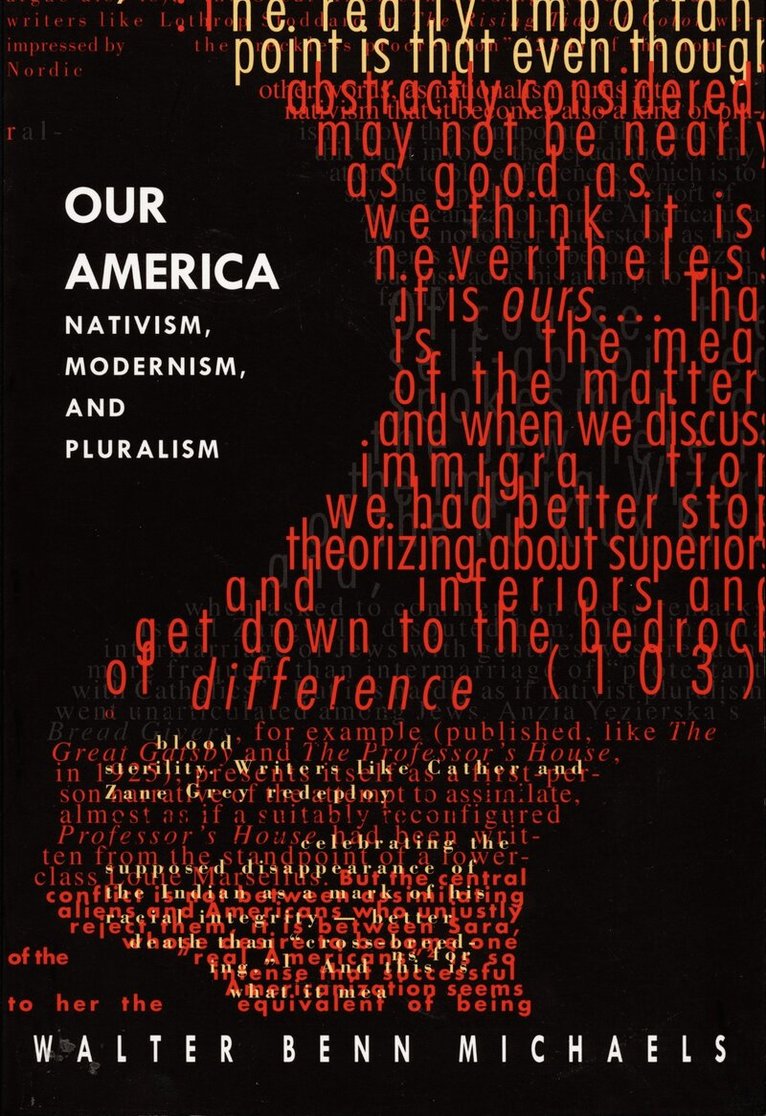
    Our America

    Nativism, Modernism, and Pluralism

    AvWalter Benn Michaels

    Häftad, Engelska, 1997

    Del i serien Post-Contemporary Interventions

    335 kr

    Beställningsvara. Skickas inom 5-8 vardagar. Fri frakt över 249 kr.

    Fler format och utgåvor

    E-bok

    503 kr

    Beskrivning

    Arguing that the contemporary commitment to the importance of cultural identity has renovated rather than replaced an earlier commitment to racial identity, Walter Benn Michaels asserts that the idea of culture, far from constituting a challenge to racism, is actually a form of racism. Our America offers both a provocative reinterpretation of the role of identity in modernism and a sustained critique of the role of identity in postmodernism.“We have a great desire to be supremely American,” Calvin Coolidge wrote in 1924. That desire, Michaels tells us, is at the very heart of American modernism, giving form and substance to a cultural movement that would in turn redefine America’s cultural and collective identity-ultimately along racial lines. A provocative reinterpretation of American modernism, Our America also offers a new way of understanding current debates over the meaning of race, identity, multiculturalism, and pluralism.Michaels contends that the aesthetic movement of modernism and the social movement of nativism came together in the 1920s in their commitment to resolve the meaning of identity-linguistic, national, cultural, and racial. Just as the Johnson Immigration Act of 1924, which excluded aliens, and the Indian Citizenship Act of the same year, which honored the truly native, reconceptualized national identity, so the major texts of American writers such as Cather, Faulkner, Hurston, and Williams reinvented identity as an object of pathos-something that can be lost or found, defended or betrayed. Our America is both a history and a critique of this invention, tracing its development from the white supremacism of the Progressive period through the cultural pluralism of the Twenties. Michaels’s sustained rereading of the texts of the period-the canonical, the popular, and the less familiar-exposes recurring concerns such as the reconception of the image of the Indian as a symbol of racial purity and national origins, the relation between World War I and race, contradictory appeals to the family as a model for the nation, and anxieties about reproduction that subliminally tie whiteness and national identity to incest, sterility, and impotence.

    Produktinformation

    • Utgivningsdatum:1997-07-14
    • Mått:157 x 235 x 17 mm
    • Vikt:363 g
    • Format:Häftad
    • Språk:Engelska
    • Serie:Post-Contemporary Interventions
    • Antal sidor:200
    • Förlag:Duke University Press
    • ISBN:9780822320647

    Utforska kategorier

    • Kulturvetenskap inom Samhälle och politik
    • Antropologi inom Samhälle och politik
    • Sociala och etiska frågor inom Samhälle och politik

    Mer om författaren

    Walter Benn Michaels is Professor of English and the Humanities at the Johns Hopkins University.

    Recensioner i media

    "Unlike so many of his academic colleagues, Michaels has little interest in the effort to design more intricate notions of group identity... Rather, he wishes to jettison those notions altogether... Race, for Michaels, isn't a fact of nature or a social experience; it's an intellectual fallacy. Culture isn't a living tradition or a font of wisdom; it's more like a phantom limb or a false memory." - Alexander Star, The New Yorker "Michaels's name tends to provoke irritation and even outrage from many academics, as if his work constituted a personal insult... The fact that he provokes such anger and resentment seems to me to signify that his work exposes ethical dilemmas which most academics are more comfortable repressing, that he somehow exposes the 'bad faith' of the University." - Loren Glass, Modern Language Studies "Cunning, brilliant, acutely suggestive, often exhilarating to read, Micheals has nonetheless become the Alan Bakke of American literary criticism... His neopragmatist version of negation simply forbids any account of American culture which would make reference to raced and ethnic identities... Michaels is way too cynical to allow himself to be for anything." - Eric Lott, Transition "Our America is not only a genealogy and a critical reassessment of the legacy of modernism. It is also a provocation, to both our sense of history and our sense of ourselves." - Carla Kaplan, Modernism/Modernity