• Fri frakt över 249 kr
  • •
  • Snabba leveranser
  • •
  • Billiga böcker
Kundservice

Du är på sajten för privatpersoner.

Företag, bibliotek eller offentlig verksamhet?

Du handlar på classic.bokus.com, där alla dina funktioner finns intakta.
Till classic.bokus.com
Bokus logotyp. Gå till startsidan.
  • Erbjudanden
  • Nyheter
  • Student
  • Topplistor
  • Barn & ungdom
  • Bokus Play
  • E-böcker
  • Pocketböcker
  • Spel & pussel

10% rabatt på allt med kod: NYSTART10 →

Sidfot

Mina sidor

    Hjälp

    • Kundservice
    • Vanliga frågor och svar
    • Frakt och leverans
    • Retur vid ångerrätt
    • Reklamera vara
    • Betalning
    • Köpvillkor
    • Allmänna villkor
    • Information om webbplatsens tillgänglighet

    Om Bokus

    • Om oss
    • Pressrum
    • För studenter
    • För företag
    • För bibliotek och offentlig verksamhet
    • För leverantörer
    • Hållbarhet

    Populärt

    • Aktuella erbjudanden
    • Presentkort
    • Studentlitteratur
    • Nya böcker
    • Topplistor
    • Signerade böcker
    • Engelska böcker

    Inspiration

    • Boktips
    • BookTok
    • Populära bokserier
    • Barnbokskaraktärer
    • Populära författare
    Logotyp för Bokus
    Följ oss på Facebook (extern länk)Följ oss på Instagram (extern länk)Följ oss på YouTube (extern länk)Följ oss på TikTok (extern länk)
    bokus @ CookiesAnpassa cookiesIntegritetspolicyKöpvillkor
    Till Citymail hemsida (extern länk)Till Budbee hemsida (extern länk)Till Postnord hemsida (extern länk)Till Schenker hemsida (extern länk)Till Early Bird hemsida (extern länk)Till Walleys hemsida (extern länk)
    1. Samhälle och politik
    2. Samhälle och kultur
    3. Kultur och medier
    4. Kulturvetenskap

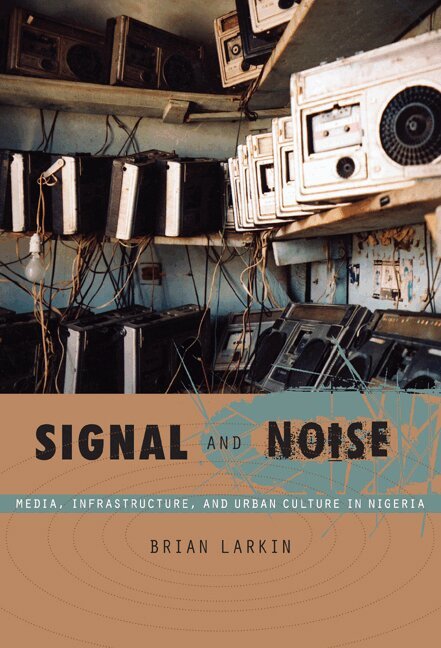
    Signal and Noise

    Media, Infrastructure, and Urban Culture in Nigeria

    AvBrian Larkin

    Häftad, Engelska, 2008

    Del i serien John Hope Franklin Center Book

    377 kr

    Beställningsvara. Skickas inom 5-8 vardagar. Fri frakt över 249 kr.

    Fler format och utgåvor

    E-bok

    568 kr

    Beskrivning

    Mainstream media and film theory are based on the ways that media technologies operate in Europe and the United States. In this groundbreaking work, Brian Larkin provides a history and ethnography of media in Nigeria, asking what media theory looks like when Nigeria rather than a European nation or the United States is taken as the starting point. Concentrating on the Muslim city of Kano in the north of Nigeria, Larkin charts how the material qualities of technologies and the cultural ambitions they represent feed into the everyday experiences of urban Nigeria. Media technologies were introduced to Nigeria by colonial regimes as part of an attempt to shape political subjects and create modern, urban Africans. Larkin considers the introduction of media along with electric plants and railroads as part of the wider infrastructural project of colonial and postcolonial urbanism. Focusing on radio networks, mobile cinema units, and the building of cinema theaters, he argues that what media come to be in Kano is the outcome of technology’s encounter with the social formations of northern Nigeria and with norms shaped by colonialism, postcolonial nationalism, and Islam. Larkin examines how media technologies produce the modes of leisure and cultural forms of urban Africa by analyzing the circulation of Hindi films to Muslim Nigeria, the leisure practices of Hausa cinemagoers in Kano, and the dynamic emergence of Nigerian video films. His analysis highlights the diverse, unexpected media forms and practices that thrive in urban Africa. Signal and Noise brings anthropology and media together in an original analysis of media’s place in urban life.

    Produktinformation

    • Utgivningsdatum:2008-03-31
    • Mått:156 x 230 x 20 mm
    • Vikt:450 g
    • Format:Häftad
    • Språk:Engelska
    • Serie:John Hope Franklin Center Book
    • Antal sidor:328
    • Förlag:Duke University Press
    • ISBN:9780822341086

    Utforska kategorier

    • Kulturvetenskap inom Samhälle och politik
    • Antropologi inom Samhälle och politik
    • Media och underhållning inom Ekonomi och Ledarskap

    Mer om författaren

    Brian Larkin is Associate Professor of Anthropology at Barnard College, Columbia University. He is a coeditor of Media Worlds: Anthropology on New Terrain.

    Recensioner i media

    “[A]n impressive study. . . . The study represents a door-opener into a wider analysis of the ways in which various parts of the urban society, from colonial times until most recently, negotiate technical and economic changes, create meaning, develop modes of coping and resistance and local cultural styles beyond a simple adaptation to new technological projects.” - Tilo GrÄtz, Social Anthropology “This insightful, highly stimulating, and well-written book examines how media technologies entered into 20th century northern Nigeria society, and how their initial association with colonial rule, and also their material qualities and the cultural possibilities they enabled, transformed public and social life in sometimes unexpected ways. . . . [A] highly innovative study of colonial and postcolonial urban culture in Africa. It also makes it a highly welcome contribution to scholarship on modernity and postcoloniality, on media and public culture, and to analyses of global media forms and consumption. It will fascinate a wide range of readers, granting stimulating analytical insights into the place of media in urban life.” - Dorothea E. Schulz, American Ethnologist “With considerable analytical power, Larkin explains how to locate cultural texts in an urban space, understand the leisure of social bonding, connect the household into powerful structures of capital and state, and relate technologies of radio and electricity to the political order and the critique of the state and political holders. Recommended. General collections, graduate students, faculty.” - T. Falola, Choice “Larkin’s work is impressive in its theoretical and analytical depth, rich empirical details, and astute observations and summaries about cinema and modernity in urban Nigeria. This work is as much a development communication project as it is an anthropological study or a cinema studies project. . . . [T]he book makes excellent reading for students and scholars in a series of disciplines and sub-disciplines, including international and development communication.” - Sujatha Sosale, Global Media Journal “Larkin has developed a richly researched study of media cultures in Nigeria. Equipped with language skills and a nuanced understanding of local Muslim religious practices and traditions, Larkin offers a vivid account of the emergence of modern Nigerian media infrastructures. . . . Signal and Noise inspires new ways of thinking about what media technologies are, how they have emerged in different ways in different parts of the world, and how local and national Nigerian actors have contended with the forces of the global media economy.” - Lisa Parks, Cinema Journal “A true intellectual tour de force, Signal and Noise should have a major impact on the way we understand Africa in the contemporary period.”- Kenneth W. Harrow, African Studies Review “This eagerly anticipated book is a wonderful contribution to several fields: media studies, cultural studies, African studies, anthropology, and analyses of globalization. Brian Larkin writes with eloquence and passion, and he compels us to rethink our assumptions about the work of transnational media and the formation of identity.”-Purnima Mankekar, author of Screening Culture, Viewing Politics: An Ethnography of Television, Womanhood, and Nation in Postcolonial India “This thoughtful, scholarly, and original book links the transnational traffic of media forms to the logics of the colonial state and to the vulnerabilities of large cities in Africa. It will provoke new thinking among Africanists, urbanists, anthropologists, and all students of globalizing media processes. Brian Larkin is a major new voice in the study of media as lived infrastructure in a world of uneven connectivity.”-Arjun Appadurai, author of Fear of Small Numbers: An Essay on the Geography of Anger“[A]n impressive study. . . . The study represents a door-opener into a wider analysis of the ways in which various parts of the urban society, from colonial times until most recently, negotiate technical and economic changes, create meaning, develop modes of coping and resistance and local cultural styles beyond a simple adaptation to new technological projects.” - Tilo Grätz (Social Anthropology) “A true intellectual tour de force, Signal and Noise should have a major impact on the way we understand Africa in the contemporary period.”- Kenneth W. Harrow (African Studies Review) “Larkin has developed a richly researched study of media cultures in Nigeria. Equipped with language skills and a nuanced understanding of local Muslim religious practices and traditions, Larkin offers a vivid account of the emergence of modern Nigerian media infrastructures. . . . Signal and Noise inspires new ways of thinking about what media technologies are, how they have emerged in different ways in different parts of the world, and how local and national Nigerian actors have contended with the forces of the global media economy.” - Lisa Parks (Cinema Journal) “Larkin’s work is impressive in its theoretical and analytical depth, rich empirical details, and astute observations and summaries about cinema and modernity in urban Nigeria. This work is as much a development communication project as it is an anthropological study or a cinema studies project. . . . [T]he book makes excellent reading for students and scholars in a series of disciplines and sub-disciplines, including international and development communication.” - Sujatha Sosale (Global Media Journal) “With considerable analytical power, Larkin explains how to locate cultural texts in an urban space, understand the leisure of social bonding, connect the household into powerful structures of capital and state, and relate technologies of radio and electricity to the political order and the critique of the state and political holders. Recommended. General collections, graduate students, faculty.” - T. Falola (Choice)

    Innehållsförteckning

    • Acknowledgments ixIntroduction 11. Infrastructure, the Colonial Sublime, and Indirect Rule 162. Unstable Objects: The Making of Radio in Nigeria 483. Majigi, Colonial Film, State Publicity, and the Political Form of Cinema 734. Colonialism and the Built Space of Cinema 1235. Immaterial Urbanism and the Cinematic Event 1466. Extravagant Aesthetics: Instability and the Excessive World of Nigerian Film 1687. Degraded Images, Distorted Sounds: Nigerian Video and the Infrastructure of Piracy 217Conclusion 242Notes 257Bibliography 277Index 301