• Fri frakt över 249 kr
  • •
  • Snabba leveranser
  • •
  • Billiga böcker
Kundservice

Du är på sajten för privatpersoner.

Företag, bibliotek eller offentlig verksamhet?

Du handlar på classic.bokus.com, där alla dina funktioner finns intakta.
Till classic.bokus.com
Bokus logotyp. Gå till startsidan.
  • Erbjudanden
  • Nyheter
  • Student
  • Topplistor
  • Barn & ungdom
  • Bokus Play
  • E-böcker
  • Pocketböcker
  • Spel & pussel

10% rabatt på allt med kod: NYSTART10 →

Sidfot

Mina sidor

    Hjälp

    • Kundservice
    • Vanliga frågor och svar
    • Frakt och leverans
    • Retur vid ångerrätt
    • Reklamera vara
    • Betalning
    • Köpvillkor
    • Allmänna villkor
    • Information om webbplatsens tillgänglighet

    Om Bokus

    • Om oss
    • Pressrum
    • För studenter
    • För företag
    • För bibliotek och offentlig verksamhet
    • För leverantörer
    • Hållbarhet

    Populärt

    • Aktuella erbjudanden
    • Presentkort
    • Studentlitteratur
    • Nya böcker
    • Topplistor
    • Signerade böcker
    • Engelska böcker

    Inspiration

    • Boktips
    • BookTok
    • Populära bokserier
    • Barnbokskaraktärer
    • Populära författare
    Logotyp för Bokus
    Följ oss på Facebook (extern länk)Följ oss på Instagram (extern länk)Följ oss på YouTube (extern länk)Följ oss på TikTok (extern länk)
    bokus @ CookiesAnpassa cookiesIntegritetspolicyKöpvillkor
    Till Citymail hemsida (extern länk)Till Budbee hemsida (extern länk)Till Postnord hemsida (extern länk)Till Schenker hemsida (extern länk)Till Early Bird hemsida (extern länk)Till Walleys hemsida (extern länk)
    1. Samhälle och politik
    2. Samhälle och kultur
    3. Kultur och medier
    4. Kulturvetenskap

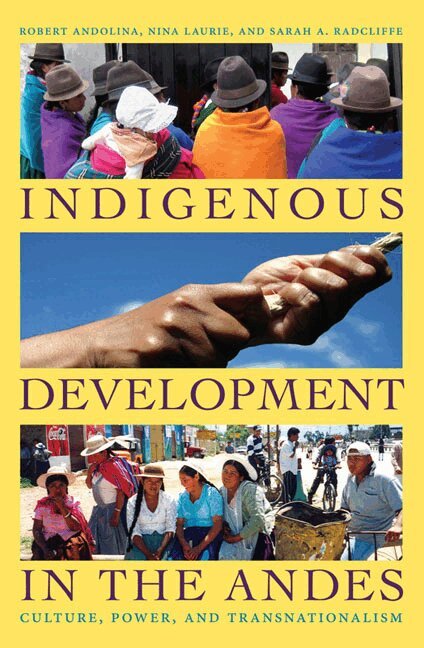
    Indigenous Development in the Andes

    Culture, Power, and Transnationalism

    AvRobert Andolina,Nina Laurie

    Häftad, Engelska, 2009

    431 kr

    Beställningsvara. Skickas inom 5-8 vardagar. Fri frakt över 249 kr.

    Beskrivning

    As indigenous peoples in Latin America have achieved greater prominence and power, international agencies have attempted to incorporate the agendas of indigenous movements into development policymaking and project implementation. Transnational networks and policies centered on ethnically aware development paradigms have emerged with the goal of supporting indigenous cultures while enabling indigenous peoples to access the ostensible benefits of economic globalization and institutionalized participation. Focused on Bolivia and Ecuador, Indigenous Development in the Andes is a nuanced examination of the complexities involved in designing and executing “culturally appropriate” development agendas. Robert Andolina, Nina Laurie, and Sarah A. Radcliffe illuminate a web of relations among indigenous villagers, social movement leaders, government officials, NGO workers, and staff of multilateral agencies such as the World Bank.The authors argue that this reconfiguration of development policy and practice permits Ecuadorian and Bolivian indigenous groups to renegotiate their relationship to development as subjects who contribute and participate. Yet it also recasts indigenous peoples and their cultures as objects of intervention and largely fails to address fundamental concerns of indigenous movements, including racism, national inequalities, and international dependencies. Andean indigenous peoples are less marginalized, but they face ongoing dilemmas of identity and agency as their fields of action cross national boundaries and overlap with powerful institutions. Focusing on the encounters of indigenous peoples with international development as they negotiate issues related to land, water, professionalization, and gender, Indigenous Development in the Andes offers a comprehensive analysis of the diverse consequences of neoliberal development, and it underscores crucial questions about globalization, governance, cultural identity, and social movements.

    Produktinformation

    • Utgivningsdatum:2009-12-23
    • Mått:156 x 235 x 25 mm
    • Vikt:522 g
    • Format:Häftad
    • Språk:Engelska
    • Antal sidor:360
    • Förlag:Duke University Press
    • ISBN:9780822345404

    Utforska kategorier

    • Kulturvetenskap inom Samhälle och politik
    • Etnicitet inom Samhälle och politik

    Mer om författaren

    Robert Andolina is Assistant Professor of International Studies at Seattle University.Nina Laurie is Professor of Development and Environment in the School of Geography, Politics, and Sociology at Newcastle University. She is an author of Geographies of New Femininities.Sarah A. Radcliffe is Reader in Latin American Geography at the University of Cambridge. She is the editor of the journal Progress in Human Geography and an editor of several collections, including Culture and Development in a Globalizing World.

    Recensioner i media

    “This is an important book that all social scientists working in the Andes and Amazonia will want to own, read, and re-read for the complex and nuanced arguments that the authors make. Robert Andolina, Nina Laurie and Sarah A. Radcliffe do a wonderful job of tacking between the everyday of indigenous political practice and the arguments about culture, identity, and development that go on inside development agencies. They explore both the spaces opened, and those closed down, by ethnically-aware approaches to development, and in doing so give a reading of neoliberalism in practice that is among the most careful and ethnographically insightful yet published. This is a book that is at once conceptually brave and empirically grounded and has manifold implications for how to think about development-not just in the Andes, but way beyond.”-Anthony Bebbington, University of Manchester “Indigenous Development in the Andes is a hopeful and timely book. It provides important insights about the power and potential of transnationalism for indigenous development; of the tremendous agency of indigenous peoples; and the openings for governments and the international development community to learn new ways of effectively engaging indigenous populations. Readers will find these insights applicable for thinking through the challenges of how to continue to improve indigenous development outcomes in Latin America, as well in other developing nations, continents and regions.”- Michelle Carnegie (Progress in Development Studies) “Indigenous Development in the Andes is of undeniable importance to scholars who focus on the Andean region or Indigenous Studies in general. . . . [An] engaging, well-designed, and groundbreaking study that will influence how academics and policy makers think about these issues for years to come.” - Paul Worley (The Latin Americanist) “Most predominant in the book as a whole is its emphasis on scale and place. Thus, geographers will be its most natural audience, though other disciplines also may benefit from thinking through transnational relationships through a geographer’s lens. . . . The authors’ method of multisited ethnography allows them to map a huge array of discursive debates that cross local and national boundaries. . . . [T]his book certainly advances our understanding of the complexities behind the transnational production of ‘ethno-development’ policies today.” - Christina Ewig (Comparative Political Studies) “Moving seamlessly back and forth between examples from Bolivia and Ecuador, the authors ask how ethnic practices change development policies, and how multiethnic transnationalism emerges and sustains itself. . . . Recommended.” - M. Becker (Choice) "A kaleidoscope of rural development projects in highland regions in Ecuador and Bolivia that became vital sites of local/global interactionbetween indigenous groups and the sponsors and funders of those projects."  - Brooke Larson (Latin American Research Review)

    Innehållsförteckning

    • List of Maps and Tables viiAcknowledgments ixIntroduction: Indigenous Development in the Andes 11. Development, Transnational Networks, and Indigenous Politics 232. Development-with-Identity: Social Capital and Andean Culture 533. Development in Place: Ethnic Culture in the Transnational Local 804. Neoliberalisms, Transnational Water Politics, and Indigenous People 1255. Transnational Professionalization of Indigenous Actors and Knowledge 1576. Gender, Transnationalism, and Cultures of Development 195Conclusion: Transnationalism, Development, and Culture in Theory and Practice 223Appendix 1: Methodology and Research Design 247Appendix 2: Development-Agency Initiatives for Andean IndigenousPeoples, 1990–2002 249Appendix 3: Professional Biographies of Teachers in Interculturalism 253Acronyms and Abbreviations 257Notes 263Bibliography 297Index 335