• Fri frakt över 249 kr
  • •
  • Snabba leveranser
  • •
  • Billiga böcker
Kundservice

Du är på sajten för privatpersoner.

Företag, bibliotek eller offentlig verksamhet?

Du handlar på classic.bokus.com, där alla dina funktioner finns intakta.
Till classic.bokus.com
Bokus logotyp. Gå till startsidan.
  • Erbjudanden
  • Student
  • Topplistor
  • Barn & ungdom
  • Bokus Play
  • E-böcker
  • Ljudböcker
  • Pocketböcker
  • Spel & pussel

Upp till 25% på utvalda nyheter →

Sidfot

Mina sidor

    Hjälp

    • Kundservice
    • Vanliga frågor och svar
    • Frakt och leverans
    • Retur vid ångerrätt
    • Reklamera vara
    • Betalning
    • Köpvillkor
    • Allmänna villkor
    • Information om webbplatsens tillgänglighet

    Om Bokus

    • Om oss
    • Pressrum
    • För studenter
    • För företag
    • För bibliotek och offentlig verksamhet
    • För leverantörer
    • Hållbarhet

    Populärt

    • Aktuella erbjudanden
    • Presentkort
    • Studentlitteratur
    • Nya böcker
    • Topplistor
    • Signerade böcker
    • Engelska böcker

    Inspiration

    • Boktips
    • BookTok
    • Populära bokserier
    • Barnbokskaraktärer
    • Populära författare
    Logotyp för Bokus
    Följ oss på Facebook (extern länk)Följ oss på Instagram (extern länk)Följ oss på YouTube (extern länk)Följ oss på TikTok (extern länk)
    bokus @ CookiesAnpassa cookiesIntegritetspolicyKöpvillkor
    Till Citymail hemsida (extern länk)Till Budbee hemsida (extern länk)Till Postnord hemsida (extern länk)Till Schenker hemsida (extern länk)Till Early Bird hemsida (extern länk)Till Walleys hemsida (extern länk)
    1. Samhälle och politik
    2. Samhälle och kultur
    3. Sociala grupper och identitet
    4. Etnicitet

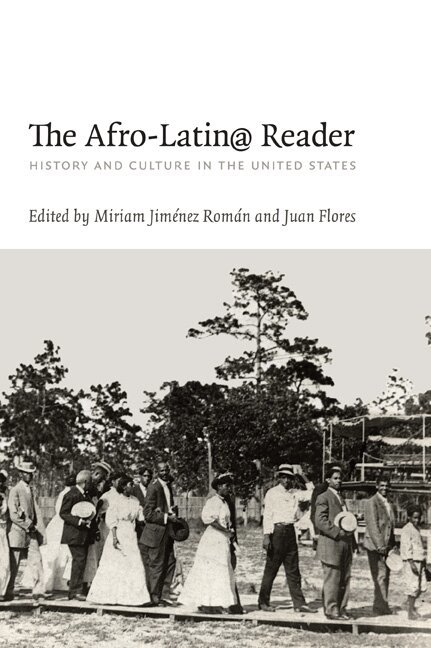
    Afro-Latin@ Reader

    History and Culture in the United States

    AvMiriam Jiménez Román,Juan Flores

    Häftad, Engelska, 2010

    Del i serien John Hope Franklin Center Book

    376 kr

    Beställningsvara. Skickas inom 5-8 vardagar. Fri frakt över 249 kr.

    Beskrivning

    The Afro-Latin@ Reader focuses attention on a large, vibrant, yet oddly invisible community in the United States: people of African descent from Latin America and the Caribbean. The presence of Afro-Latin@s in the United States (and throughout the Americas) belies the notion that Blacks and Latin@s are two distinct categories or cultures. Afro-Latin@s are uniquely situated to bridge the widening social divide between Latin@s and African Americans; at the same time, their experiences reveal pervasive racism among Latin@s and ethnocentrism among African Americans. Offering insight into Afro-Latin@ life and new ways to understand culture, ethnicity, nation, identity, and antiracist politics, The Afro-Latin@ Reader presents a kaleidoscopic view of Black Latin@s in the United States. It addresses history, music, gender, class, and media representations in more than sixty selections, including scholarly essays, memoirs, newspaper and magazine articles, poetry, short stories, and interviews.While the selections cover centuries of Afro-Latin@ history, since the arrival of Spanish-speaking Africans in North America in the mid-sixteenth-century, most of them focus on the past fifty years. The central question of how Afro-Latin@s relate to and experience U.S. and Latin American racial ideologies is engaged throughout, in first-person accounts of growing up Afro-Latin@, a classic essay by a leader of the Young Lords, and analyses of U.S. census data on race and ethnicity, as well as in pieces on gender and sexuality, major-league baseball, and religion. The contributions that Afro-Latin@s have made to U.S. culture are highlighted in essays on the illustrious Afro-Puerto Rican bibliophile Arturo Alfonso Schomburg and music and dance genres from salsa to mambo, and from boogaloo to hip hop. Taken together, these and many more selections help to bring Afro-Latin@s in the United States into critical view.Contributors: Afro–Puerto Rican Testimonies Project, Josefina BaÉz, Ejima Baker, Luis Barrios, Eduardo Bonilla-Silva, Adrian Burgos Jr., Ginetta E. B. Candelario, AdriÁn Castro, JesÚs ColÓn, Marta I. Cruz-Janzen, William A. Darity Jr., Milca Esdaille, Sandra MarÍa Esteves, MarÍa Teresa FernÁndez (Mariposa), Carlos Flores, Juan Flores, Jack D. Forbes, David F. Garcia, Ruth Glasser, Virginia Meecham Gould, Susan D. Greenbaum, Evelio Grillo, Pablo “Yoruba” GuzmÁn, Gabriel Haslip-Viera, Tanya K. HernÁndez, Victor HernÁndez Cruz, Jesse Hoffnung-Garskof, Lisa Hoppenjans, Vielka Cecilia Hoy, Alan J. Hughes, MarÍa Rosario Jackson, James Jennings, Miriam JimÉnez RomÁn, Angela Jorge, David Lamb, Aida Lambert, Ana M. Lara, Evelyne Laurent-Perrault, Tato Laviera, John Logan, Antonio LÓpez, Felipe Luciano, Louis Pancho McFarland, Ryan Mann-Hamilton, Wayne Marshall, Marianela Medrano, Nancy Raquel Mirabal, Yvette Modestin, Ed Morales, Jairo Moreno, Marta Moreno Vega, Willie Perdomo, Graciela PÉrez GutiÉrrez, Sofia Quintero, Ted Richardson, Louis Reyes Rivera, Pedro R. Rivera , Raquel Z. Rivera, Yeidy Rivero, Mark Q. Sawyer, Piri Thomas, Silvio Torres-Saillant, Nilaja Sun, Sherezada “Chiqui” Vicioso, Peter H. Wood

    Produktinformation

    • Utgivningsdatum:2010-07-07
    • Mått:156 x 235 x 37 mm
    • Vikt:839 g
    • Format:Häftad
    • Språk:Engelska
    • Serie:John Hope Franklin Center Book
    • Antal sidor:584
    • Förlag:Duke University Press
    • ISBN:9780822345725

    Utforska kategorier

    • Etnicitet inom Samhälle och politik

    Mer om författaren

    Miriam JimÉnez RomÁn is a visiting scholar in the Africana Studies Program at New York University and Executive Director of afrolatin@ forum, a research and resource center focusing on Black Latin@s in the United States.Juan Flores is Professor in the Department of Social and Cultural Analysis at New York University. His most recent works include The Diaspora Strikes Back: CaribeÑo Tales of Learning and Turning, From Bomba To Hip-Hop: Puerto Rican Culture and Latino Identity, and the English translation of Edgardo RodrÍguez JuliÁ’s book Cortijo’s Wake, also published by Duke University Press.

    Recensioner i media

    “[R]equired reading for all Latinos. . . . This important reader provides critical information from a wide variety of approaches on the evolution and current realities of Black Latinos and Latinas. From poetic to musical to social scientific sources, this is a powerful 360-degree treatment of the subject.” - Angelo FalcÓn, National Institute for Latino Policy Book Notes “This exciting collection is a great resource for anyone interested in Ethnic Studies, Cultural Studies, or American Studies.” - Jenell Navarro, Women’s Studies “As a collection of pieces, many of which have been published previously, The Afro-Latin@ Reader ultimately serves as a compact archive of materials from various academic disciplines and creative genres that details the Afro-Latina/o experience in the United States. . . . The Afro-Latin@ Reader makes accessible to students, scholars, and the general public a virtually ignored set of important contributions, not only to the study of Afro-Latina/os, but to the discourse about race in the United States more generally.” - Petra R. Rivera, Transition “The collected works in The Afro-Latin@ Reader broaden definitions of blackness and latinidad and reveal the multiple ways in which Afro-Latino/as navigate national and cultural histories that have consistently denigrated or dismissed their African heritage and challenge US racial classifications that dismiss their cultural background and linguistic difference. The Afro-Latin@ Reader invites us to move beyond a binary understanding of racial identity and to embrace the allegiances that may be forged and, in many instances, have been forged among Afro-Latino/as, Latinos/as, African Americans, and other underrepresented groups in the US.” - Sobeira Latorre, Anthurium: A Caribbean StudiesJournal “The Afro-Latin@ Reader assembles in one place an extraordinary range of articles, chapters, and first-person accounts of Afro-Latin@ identity. These pieces show that explorations of Afro-Latin@ identities quickly reveal significant hidden histories of racialization, colonization, exploitation, and social mobilization. They complicate our understanding of the U.S. racial order and its complex systems of inclusion and exclusion. This collection is a much-needed addition to scholarship in ethnic studies.”-George Lipsitz, author of American Studies in a Moment of Danger “The Afro-Latin@ Reader is a superb collection, one that I cannot wait to use in my own courses. For some time now, scholars have engaged the history and anthropology of Black populations in Latin America, but the scholarship on the Afro-Latin@ presence (as configured on this side of the Rio Grande) has been more episodic and, to some extent, under-theorized. The breadth of The Afro-Latin@ Reader, as well as its effort to actually define the entire field, makes it a unique scholarly contribution.”-Ben Vinson III, co-author of African Slavery in Latin America and the Caribbean “[R]equired reading for all Latinos. . . . This important reader provides critical information from a wide variety of approaches on the evolution and current realities of Black Latinos and Latinas. From poetic to musical to social scientific sources, this is a powerful 360-degree treatment of the subject.” - Angelo Falcón (National Institute for Latino Policy Book Notes) “As a collection of pieces, many of which have been published previously, The Afro-Latin@ Reader ultimately serves as a compact archive of materials from various academic disciplines and creative genres that details the Afro-Latina/o experience in the United States. . . . The Afro-Latin@ Reader makes accessible to students, scholars, and the general public a virtually ignored set of important contributions, not only to the study of Afro-Latina/os, but to the discourse about race in the United States more generally.” - Petra R. Rivera (Transition) “The collected works in The Afro-Latin@ Reader broaden definitions of blackness and latinidad and reveal the multiple ways in which Afro-Latino/as navigate national and cultural histories that have consistently denigrated or dismissed their African heritage and challenge US racial classifications that dismiss their cultural background and linguistic difference. The Afro-Latin@ Reader invites us to move beyond a binary understanding of racial identity and to embrace the allegiances that may be forged and, in many instances, have been forged among Afro-Latino/as, Latinos/as, African Americans, and other underrepresented groups in the US.” - Sobeira Latorre (Anthurium)

    Innehållsförteckning

    • Acknowledgments xiiiEditorial Note xvIntroduction 1I. Historical Background before 1900 The Earliest Africans in North America / Peter H. Wood 19Black Pioneers: The Spanish-Speaking Afroamericans of the Southwest / Jack D. Forbes 27Slave and Free Women of Color in the Spanish Ports of New Orleans, Mobile, and Pensacola / Virginia Meacham Gould 38Afro-Cubans in Tampa / Susan D. Greenbaum 51Excerpt from Pulling the Muse from the Drum / Adrian Castro 62II. Arturo Alfonso Schomburg Excerpt from Racial Integrity: A Plea for the Establishment of a Chair of Negro History in Our Schools and Colleges / Arturo Alfonso Schomburg 67The World of Arturo Alfonso Schomburg / Jesse Hoffnung-Garskof 70Invoking Arturo Schomburg's Legacy in Philadelphia / Evelyne Laurent-Perrault 92III. Afro-Latin@s on the Color Line Black Cuban, Black American / Evelio Grillo 99A Puerto Rican in New York and Other Sketches / Jesus Colon 113Melba Alvarado, El Club Cubano Inter-Americano, and the Creation of Afro-Cubanidades in New York City / Nancy Raquel Mirabel 120An Uneven Playing Field: Afro-Latinos in Major League Baseball / Adrian Burgos Jr. 127Changing Identities: An Afro-Latino Family Portrait / Gabriel Haslip-Viera 142Eso era tremendo!: An Afro-Cuban Musician Remembers / Graciela Perez Gutierrez 150IV. Roots of Salsa: Afro-Latin@ Popular Music From "Indianola" to "No ColÁ": The Strange Career of the Afro-Puerto Rican Musician / Ruth Glasser 157Excerpt from cu/bop / Louis Reyes Rivera 176BauzÁ–Gillespie–Latin/JAzz: Difference, Modernity, and the Black Caribbean / Jairo Moreno 177Contesting that Damned Mambo: Arsenio Rodriguez and the People of El Barrio and the Bronx in the 1950s / David F. Garcia 187Boogaloo and Latin Soul / Juan Flores 199Excerpt from the salsa of bethesda fountain / Tato Laviera 207V. Black Latin@ Sixties Hair Conking: Buy Black / Carlos Cooks 211Carlos A. Cooks: Dominican Garveyite in Harlem / Pedro R. Rivera 215Down These Mean Streets / Piri Thomas 219African Things / Victor Hernandez Cruz 232Black Notes and "You Do Something to Me" / Sandra Maria Esteves 233Before People Called Me a Spic, They Called Me a Nigger / Pablo "Yoruba" Guzman 235Excerpt from JÍbaro, My Pretty Nigger / Felipe Luciano 244The Yoruba Orisha Tradition Comes to New York City / Marta Moreno Vega 245Reflections and Lived Experiences of Afro-Latin@ Religiosity / Luis Barrios 252Discovering Myself / Un Testimonio / Josefina Baez 266VI. Afro-Latinas The Black Puerto Rican Woman in Contemporary American Society / Angela Jorge 269Something Latino Was Up with Us / Spring Redd 276Excerpt from Poem for My Grifa-Rican Sistah, or Broken Ends Broken Promises / Mariposa (MarÍa Teresa Fernandez) 280Latinegras: Desired Women-Undesirable Mothers, Daughters, Sisters, and Wives / Marta I. Cruz-Janzen 282Letter to a Friend / Nilaja Sun 296Uncovering Mirrors: Afro-Latina Lesbian Subjects / Ana M. Lara 298The Black Bellybutton of a Bongo / Marianela Medrano 314VII. Public Images and (Mis)Representations Notes on Eusebia Cosme and Juano Hernandez / Miriam Jimenez Roman 319Desde el Mero Medio: Race Discrimination within the Latino Community / Carlos Flores 323Displaying Identity: Dominicans in the Black Mosaic of Washington, D.C. / Ginetta E. B. Candelario 326Bringing the Soul: Afros, Black Empowerment, and Lucecita BenÍtez / Yeidy M. Rivero 343Can BET Make You Black? Remixing and Reshaping Latin@s on Black Entertainment Television / Ejima Baker 358The Afro-Latino Connection: Can this group be the bridge to a broadbased Black-Hispanic alliance? / Alan Hughes and Milca Esdaille 364VIII. Afro-Latin@s in the Hip Hop Zone Ghettocentricity, Blackness, and Pan-Latinidad / Raquel Z. Rivera 373Chicano Rap Roots: Afro-Mexico and Black-Brown Cultural Exchange / Pancho McFarland 387The Rise and Fall of Reggaeton: From Daddy Yankee to Tego Calderon and Beyond / Wayne Marshall 396Do Platanos Go wit' Collard Greens? / David Lamb 404Divas Don't Yield / Sofia Quintero 411IX. Living Afro-Latinidads An Afro-Latina's Quest for Inclusion / Yvette Modestin 417Retracing Migration: From Samana to New York and Back Again / Ryan Mann-Hamilton 422Negotiating among Invisibilities: Tales of Afro-Latinidades in the United States / Vielka Cecilia Hoy 426We Are Black Too: Experiences of a Honduran Garifuna / Aida Lambert 431Profile of an Afro-Latina: Black, Mexican, Both / Maria Rosario Jackson 434Enrique Patterson: Black Cuban Intellectual in Cuban Miami / Antonio Lopez 439Reflections about Race by a Negrito Acomplejao / Eduardo Bonilla-Silva 445Divisible Blackness: Reflections on Heterogeneity and Racial Identity / Silvio Torres-Saillant 453Nigger-Reecan Blues / Willie Perdomo 467X. Afro-Latin@s: Present and Future Tenses How Race Counts for Hispanic Americans / John R. Logan 471Bleach in the Rainbow: Latino Ethnicity and Preferences for Whiteness / William A. Darity Jr., Jason Dietrich, and Darrick Hamilton 485Brown Like Me? / Ed Morales 499Against the Myth of Racial Harmony in Puerto Rico / Afro-Puerto Rican Testimonies Project 508Mexican Ways, African Roots / Lisa Hoppenjans and Ted Richardson 512Afro-Latin@s and the Latino Workplace / Tanya Kateri Hernandez 520Racial Politics in Multiethnic America: Black and Latina/o Identities and Coalitions 527Afro-Latinism in United States Society: A Commentary / James Jennings 540Sources and Permissions 547Contributors 551Index 559