• Fri frakt över 249 kr
  • •
  • Snabba leveranser
  • •
  • Billiga böcker
Kundservice

Du är på sajten för privatpersoner.

Företag, bibliotek eller offentlig verksamhet?

Du handlar på classic.bokus.com, där alla dina funktioner finns intakta.
Till classic.bokus.com
Bokus logotyp. Gå till startsidan.
  • Erbjudanden
  • Nyheter
  • Student
  • Topplistor
  • Barn & ungdom
  • Bokus Play
  • E-böcker
  • Pocketböcker
  • Spel & pussel

10% rabatt på allt med kod NYSTART10 →

Sidfot

Mina sidor

    Hjälp

    • Kundservice
    • Vanliga frågor och svar
    • Frakt och leverans
    • Retur vid ångerrätt
    • Reklamera vara
    • Betalning
    • Köpvillkor
    • Allmänna villkor
    • Information om webbplatsens tillgänglighet

    Om Bokus

    • Om oss
    • Pressrum
    • För studenter
    • För företag
    • För bibliotek och offentlig verksamhet
    • För leverantörer
    • Hållbarhet

    Populärt

    • Aktuella erbjudanden
    • Presentkort
    • Studentlitteratur
    • Nya böcker
    • Topplistor
    • Signerade böcker
    • Engelska böcker

    Inspiration

    • Boktips
    • BookTok
    • Populära bokserier
    • Barnbokskaraktärer
    • Populära författare
    Logotyp för Bokus
    Följ oss på Facebook (extern länk)Följ oss på Instagram (extern länk)Följ oss på YouTube (extern länk)Följ oss på TikTok (extern länk)
    bokus @ CookiesAnpassa cookiesIntegritetspolicyKöpvillkor
    Till Citymail hemsida (extern länk)Till Budbee hemsida (extern länk)Till Postnord hemsida (extern länk)Till Schenker hemsida (extern länk)Till Early Bird hemsida (extern länk)Till Walleys hemsida (extern länk)
    1. Samhälle och politik
    2. Politik och statsskick
    3. Politiska ideologier och rörelser
    4. Nationalism

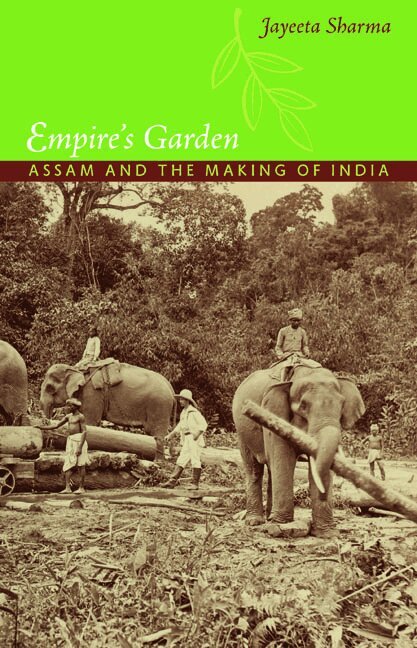
    Empire's Garden

    Assam and the Making of India

    AvJayeeta Sharma

    Häftad, Engelska, 2011

    Del i serien Radical Perspectives

    559 kr

    Beställningsvara. Skickas inom 3-6 vardagar. Fri frakt över 249 kr.

    Beskrivning

    In the mid-nineteenth century the British created a landscape of tea plantations in the northeastern Indian region of Assam. The tea industry filled imperial coffers and gave the colonial state a chance to transform a jungle-laden frontier into a cultivated system of plantations. Claiming that local peasants were indolent, the British soon began importing indentured labor from central India. In the twentieth century these migrants were joined by others who came voluntarily to seek their livelihoods. In Empire’s Garden, Jayeeta Sharma explains how the settlement of more than one million migrants in Assam irrevocably changed the region’s social landscape. She argues that the racialized construction of the tea laborer catalyzed a process by which Assam’s gentry sought to insert their homeland into an imagined Indo-Aryan community and a modern Indian political space. Various linguistic and racial claims allowed these elites to defend their own modernity while pushing the burden of primitiveness onto “non-Aryan” indigenous tribals and migrant laborers. As vernacular print arenas emerged in Assam, so did competing claims to history, nationalism, and progress that continue to reverberate in the present.

    Produktinformation

    • Utgivningsdatum:2011-08-01
    • Mått:149 x 232 x 22 mm
    • Vikt:467 g
    • Format:Häftad
    • Språk:Engelska
    • Serie:Radical Perspectives
    • Antal sidor:344
    • Förlag:Duke University Press
    • ISBN:9780822350491

    Utforska kategorier

    • Nationalism inom Samhälle och politik
    • Migration inom Samhälle och politik
    • Asiens historia inom Historia och arkeologi

    Mer om författaren

    Jayeeta Sharma is Assistant Professor of History at the University of Toronto.

    Recensioner i media

    “The author’s prodigious work illuminates and deals with the vast consequences of creating the Empire’s Tea Garden and the settlement of over a million migrants into the tea plantations…. Read this deeply researched and wide-ranging book.” - Richard Ellis, Royal Society for Asian Affairs “[P]athbreaking…. [T]his careful and thoughtful study is especially welcome…. Empire’s Garden provides a rich set of reflections on regions, regionalism, and the growth of nationalism in the modern world.” - Thomas R. Metcalf, The Journal of Interdisciplinary History “Empire’s Garden creates a rich, rewarding, and multi-stranded appreciation of Assam’s modern history. It greatly enriches understanding of the history and politics of Assam while at the same time giving fresh insights into the processes involved in the making of modern India and the incorporation of its diverse regions.” - David Arnold, The Economic History Review “This book is an important work exploring the history of Assam through the colonial era.” - Gareth Price, Pacific Affairs “Jayeeta Sharma’s recent monograph brilliantly explores how the contradiction inherent in the integration of Assam with global capitalist modernity through the quasi-feudal agency of colonial capitalism transformed social and economic life in Bramhaputra Valley, one of the core regions of colonial Assam’s territories.” - Subho Basu, Labour/Le Travail “Empire’s Garden is a new departure for the historical study of Assam, extraordinarily wide-ranging, with important things to say not only about Assam but about India, South Asia, and themes ranging from colonialism, nationalism, and regionalism to ethnicity, elite formation, migration, and economic development. It will anchor histories of Assam for years to come.”-David Ludden, editor of Reading Subaltern Studies: Critical History, Contested Meaning and the Globalization of South Asia “This rich history of Assam fills a void in scholarship. Assam is an area of South Asia that has received little attention from serious historians of the subcontinent, except those working on the tea industry. Jayeeta Sharma provides us with fascinating details of Assam’s history. More importantly, she relates local themes to larger issues of South Asian history: colonial ideologies of race and the importance of these ideologies to the political economy, the structure of colonial rule, the development of the public sphere, and the reformulation of identities under colonial circumstances. Empire’s Garden also helps us to understand the historical dimensions of contemporary conflicts in the region, without making the conflicts seem predetermined by what happened in the colonial period.”-Douglas E. Haynes, author of Rhetoric and Ritual in Colonial India: The Shaping of a Public Culture in Surat City, 1852–1928 “Empire’s Garden creates a rich, rewarding, and multi-stranded appreciation of Assam’s modern history. It greatly enriches understanding of the history and politics of Assam while at the same time giving fresh insights into the processes involved in the making of modern India and the incorporation of its diverse regions.” - David Arnold (Economic History Review) “[P]athbreaking…. [T]his careful and thoughtful study is especially welcome…. Empire’s Garden provides a rich set of reflections on regions, regionalism, and the growth of nationalism in the modern world.” - Thomas R. Metcalf (Journal of Interdisciplinary History) “Jayeeta Sharma’s recent monograph brilliantly explores how the contradiction inherent in the integration of Assam with global capitalist modernity through the quasi-feudal agency of colonial capitalism transformed social and economic life in Bramhaputra Valley, one of the core regions of colonial Assam’s territories.” - Subho Basu (Labour/Le Travail) “The author’s prodigious work illuminates and deals with the vast consequences of creating the Empire’s Tea Garden and the settlement of over a million migrants into the tea plantations…. Read this deeply researched and wide-ranging book.” - Richard Ellis (Royal Society for Asian Affairs) “This book is an important work exploring the history of Assam through the colonial era.” - Gareth Price (Pacific Affairs)

    Innehållsförteckning

    • Preface xiNote on Orthography and Usage xivIntroduction 1Part I. Making a Garden 231. Nature's Jungle, Empire's Garden 252. Borderlands, Rice Eaters, and Tea Growers 493. Migrants in the Garden: Expanding the Frontier 79Part II. Improving Assam, Making India 1174. Old Lords and "Improving" Regimes 1195. Bringing Progress, Restoring Culture 1476. Language and Literature: Framing Identity 1777. Contesting Publics: Raced Communities and Gendered History 205Conclusion 234Notes 243Glossary 273Bibliography 277Index 311