• Fri frakt över 249 kr
  • •
  • Snabba leveranser
  • •
  • Billiga böcker
Kundservice

Du är på sajten för privatpersoner.

Företag, bibliotek eller offentlig verksamhet?

Du handlar på classic.bokus.com, där alla dina funktioner finns intakta.
Till classic.bokus.com
Bokus logotyp. Gå till startsidan.
  • Erbjudanden
  • Nyheter
  • Student
  • Topplistor
  • Barn & ungdom
  • Bokus Play
  • E-böcker
  • Pocketböcker
  • Spel & pussel

10% rabatt på allt med kod NYSTART10 →

Sidfot

Mina sidor

    Hjälp

    • Kundservice
    • Vanliga frågor och svar
    • Frakt och leverans
    • Retur vid ångerrätt
    • Reklamera vara
    • Betalning
    • Köpvillkor
    • Allmänna villkor
    • Information om webbplatsens tillgänglighet

    Om Bokus

    • Om oss
    • Pressrum
    • För studenter
    • För företag
    • För bibliotek och offentlig verksamhet
    • För leverantörer
    • Hållbarhet

    Populärt

    • Aktuella erbjudanden
    • Presentkort
    • Studentlitteratur
    • Nya böcker
    • Topplistor
    • Signerade böcker
    • Engelska böcker

    Inspiration

    • Boktips
    • BookTok
    • Populära bokserier
    • Barnbokskaraktärer
    • Populära författare
    Logotyp för Bokus
    Följ oss på Facebook (extern länk)Följ oss på Instagram (extern länk)Följ oss på YouTube (extern länk)Följ oss på TikTok (extern länk)
    bokus @ CookiesAnpassa cookiesIntegritetspolicyKöpvillkor
    Till Citymail hemsida (extern länk)Till Budbee hemsida (extern länk)Till Postnord hemsida (extern länk)Till Schenker hemsida (extern länk)Till Early Bird hemsida (extern länk)Till Walleys hemsida (extern länk)
    1. Samhälle och politik
    2. Sociologi och antropologi
    3. Antropologi

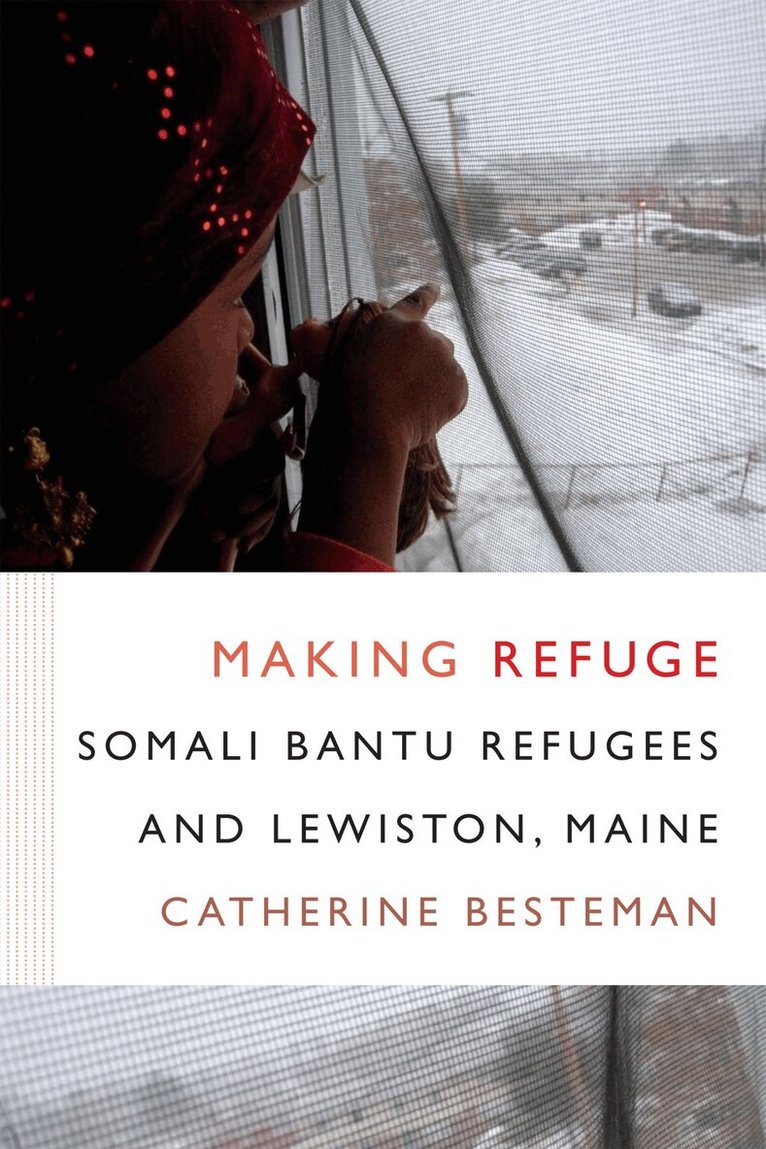
    Making Refuge

    Somali Bantu Refugees and Lewiston, Maine

    AvCatherine Besteman

    Inbunden, Engelska, 2016

    Del i serien Global Insecurities

    1 220 kr

    Beställningsvara. Skickas inom 5-8 vardagar. Fri frakt över 249 kr.

    Fler format och utgåvor

    Häftad

    331 kr

    Beskrivning

    How do people whose entire way of life has been destroyed and who witnessed horrible abuses against loved ones construct a new future? How do people who have survived the ravages of war and displacement rebuild their lives in a new country when their world has totally changed? In Making Refuge Catherine Besteman follows the trajectory of Somali Bantus from their homes in Somalia before the onset in 1991 of Somalia’s civil war, to their displacement to Kenyan refugee camps, to their relocation in cities across the United States, to their settlement in the struggling former mill town of Lewiston, Maine. Tracking their experiences as "secondary migrants" who grapple with the struggles of xenophobia, neoliberalism, and grief, Besteman asks what humanitarianism feels like to those who are its objects and what happens when refugees move in next door. As Lewiston's refugees and locals negotiate coresidence and find that assimilation goes both ways, their story demonstrates the efforts of diverse people to find ways to live together and create community. Besteman’s account illuminates the contemporary debates about economic and moral responsibility, security, and community that immigration provokes.

    Produktinformation

    • Utgivningsdatum:2016-02-05
    • Mått:152 x 229 x 23 mm
    • Vikt:612 g
    • Format:Inbunden
    • Språk:Engelska
    • Serie:Global Insecurities
    • Antal sidor:352
    • Förlag:Duke University Press
    • ISBN:9780822360278

    Utforska kategorier

    • Antropologi inom Samhälle och politik
    • Sociala och etiska frågor inom Samhälle och politik
    • Afrikas historia inom Historia och arkeologi

    Mer om författaren

    Catherine Besteman is Francis F. and Ruth K. Bartlett Professor of Anthropology at Colby College and the author of Transforming Cape Town and Unraveling Somalia: Race, Class, and the Legacy of Slavery.

    Recensioner i media

    "Besteman eschews social science jargon to tell her story with great insight and empathy. Her book should be required reading for policymakers currently debating what to do with refugees from Syria." - Nichola van de Walle (Foreign Affairs) "Given Besteman’s unique perspective on the Somali Bantu community in Lewiston and her impressive scholarship on refugees, Africa and racism, it would be difficult to imagine any scholar having as rich and multi-faceted a frame of reference on the issue of refugees in Maine. ... Besteman’s writing offers an in-depth and timely analysis of the Somali Bantu experience in Lewiston, now in its second decade."   - Dave Canarie (Portland Press Herald) "Tensions between newcomers and established communities are as old as the US itself, and Making Refuge is a rich account of what is gained and what is lost in becoming American. Think of this book as your ringside seat to the birth of a new shared meaning of 'life the way it should be.'" - Faith Nibbs (Times Higher Education) "[S]cholarly yet accessible. . . . The book neither loses itself in despair nor politicizes what she treats as the wholly human drama that it is." - Jim Breithaupt (Bookslut) "It is a devastating read, full of complex geopolitical realities, crushing social revelations regarding race and poverty in America, the seemingly insurmountable problems the Somali Bantu in particular face, and a general public prone to nasty blog comments and xenophobia." - D. L. Mayfield (Books & Culture) "The book is highly accessible, engaging, ethnographically rich, and written with real sensitivity, qualities that will resonate well with students. The book will also be useful to policy makers, NGOs, and refugee service providers." - Stephanie R. Bjork (American Anthropologist) "In a time marked by continuous talk about refugee crisis and a rise in anti-immigrant sentiments, Making Refuge forms an important contribution to a more nuanced understanding of displacement. Given the little ethnographically driven research there has been into the plight of Somali minority groups, the book also forms a significant historical document about a community in the making." - Annika Lems (Society & Space) "Making Refuge is a superbly written, well-organized book with beautiful stories and photographs and sound but subtle theories that will make it a great book for undergraduates and graduate students and a must-read for anyone interested in refugees, human rights, the aftermaths of war and migration, race and ethnicity, and engaged anthropology." - Jennifer Erickson (American Ethnologist) "Making Refuge is particularly relevant in a time when refugee resettlement is widely discussed, as it points to the flaws and contradictions of a system that expects refugees to be docile and thankful recipients of charity to gain resettlement but at the same time requires for them to become self-sufficient shortly after arriving in the country. Besteman offers many useful lessons to policy makers and those who provide services to refugees as well as students of immigrant incorporation." - Cristina Ramos (African Studies Quarterly) "Besteman goes beyond simply portraying the lives of Somali Bantus in Lewiston, Maine and instead shows how the ethnic group ‘Bantu’ was created, along with the construction and dispute of the Bantu identity, both by those described as Bantus and those doing the labeling. . . . The richness of the data makes the community really come alive in the pages of the book." - Bernadette Ludwig (Migration Studies) "Making Refuge deserves wide readership, both for its distinctive ethnographic foundations and salient conclusions. This timely work speaks to current controversies over refugees and resettlement with rich, data-driven analysis that shatters dominant narratives of integration and belonging." - Emily Frazier (African Conflict and Peacebuilding Review) "Besteman’s book is the fruit of years of engagement with the people about whom she is writing, across two continents, allowing for a rich and intimate account which is a pleasure to read, seamlessly mixing the stories of particular individuals and families, more general analysis, and conceptual insight. A great strength of the account is its multidimensionality: close attention is paid to policy-making and bureaucratic processes, but also to the lived experiences and agency of refugees, and how they navigate these systems."- Anna Lindley (Journal of Anthropological Research) “Powerful, persuasive, and illuminating, at once deeply intimate and broadly relevant. Making Refuge will interest students of all levels, professional anthropologists, members of the media, and an educated non-academic readership.” - Daniel M. Goldstein (PoLAR)

    Innehållsförteckning

    • List of Terms and Abbreviations  ixTimeline of Events  xiAcknowledgments  xvIntroduction  1Part I. Refugees1. Becoming Refugees  352. The Humanitarian Condition  573. Becoming Somali Bantus  77Part II. LewistonIntroduction  1034. We Have Responded Valiantly  1155. Strangers in Our Midst  1396. Helpers in the Neoliberal Borderlands  169Part III. RefugeIntroduction  2057. Making Refuge  2158. These Are Our Kids  243Conclusion: The Way Life Should Be  277Notes  291References  313Index  327