• Fri frakt över 249 kr
  • •
  • Snabba leveranser
  • •
  • Billiga böcker
Kundservice

Du är på sajten för privatpersoner.

Företag, bibliotek eller offentlig verksamhet?

Du handlar på classic.bokus.com, där alla dina funktioner finns intakta.
Till classic.bokus.com
Bokus logotyp. Gå till startsidan.
  • Erbjudanden
  • Nyheter
  • Student
  • Topplistor
  • Barn & ungdom
  • Bokus Play
  • E-böcker
  • Pocketböcker
  • Spel & pussel

10% rabatt på allt med kod: NYSTART10 →

Sidfot

Mina sidor

    Hjälp

    • Kundservice
    • Vanliga frågor och svar
    • Frakt och leverans
    • Retur vid ångerrätt
    • Reklamera vara
    • Betalning
    • Köpvillkor
    • Allmänna villkor
    • Information om webbplatsens tillgänglighet

    Om Bokus

    • Om oss
    • Pressrum
    • För studenter
    • För företag
    • För bibliotek och offentlig verksamhet
    • För leverantörer
    • Hållbarhet

    Populärt

    • Aktuella erbjudanden
    • Presentkort
    • Studentlitteratur
    • Nya böcker
    • Topplistor
    • Signerade böcker
    • Engelska böcker

    Inspiration

    • Boktips
    • BookTok
    • Populära bokserier
    • Barnbokskaraktärer
    • Populära författare
    Logotyp för Bokus
    Följ oss på Facebook (extern länk)Följ oss på Instagram (extern länk)Följ oss på YouTube (extern länk)Följ oss på TikTok (extern länk)
    bokus @ CookiesAnpassa cookiesIntegritetspolicyKöpvillkor
    Till Citymail hemsida (extern länk)Till Budbee hemsida (extern länk)Till Postnord hemsida (extern länk)Till Schenker hemsida (extern länk)Till Early Bird hemsida (extern länk)Till Walleys hemsida (extern länk)
    1. Samhälle och politik
    2. Sociologi och antropologi
    3. Antropologi

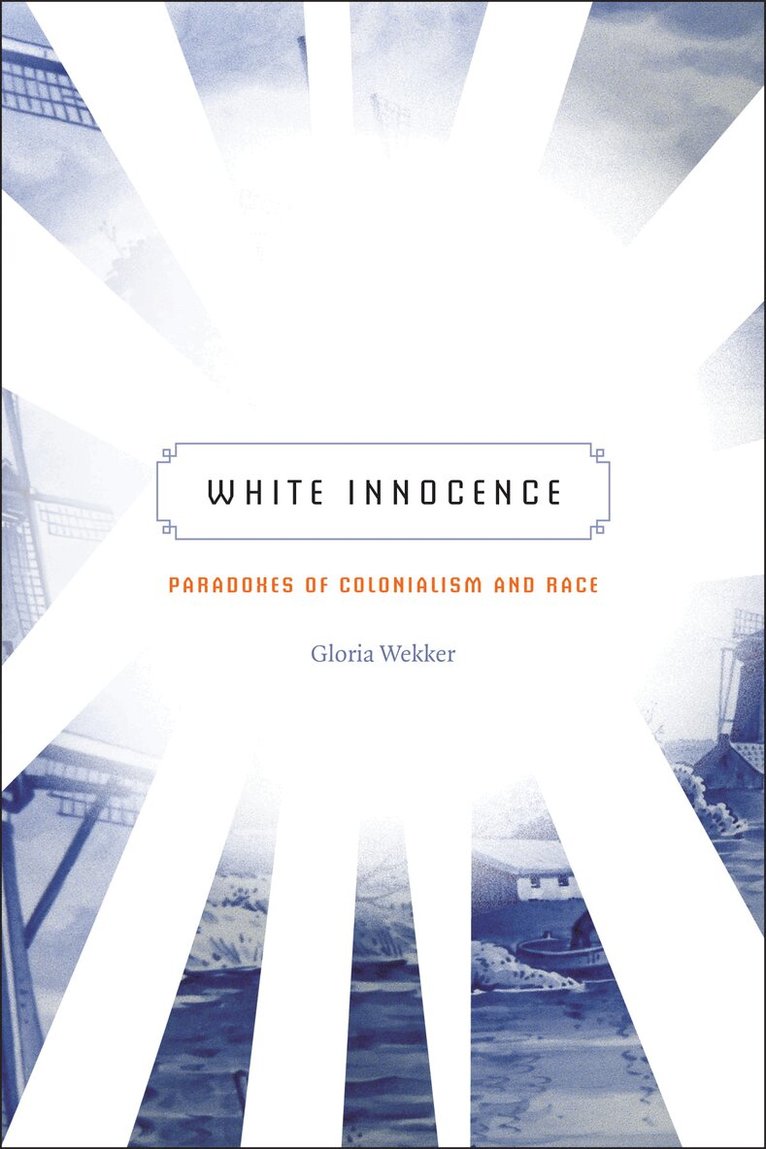
    White Innocence

    Paradoxes of Colonialism and Race

    AvGloria Wekker

    Häftad, Engelska, 2016

    285 kr

    Skickas . Fri frakt över 249 kr.

    Fler format och utgåvor

    Inbunden

    1 162 kr

    E-bok

    438 kr

    Beskrivning

    In White Innocence Gloria Wekker explores a central paradox of Dutch culture: the passionate denial of racial discrimination and colonial violence coexisting alongside aggressive racism and xenophobia. Accessing a cultural archive built over 400 years of Dutch colonial rule, Wekker fundamentally challenges Dutch racial exceptionalism by undermining the dominant narrative of the Netherlands as a "gentle" and "ethical" nation. Wekker analyzes the Dutch media's portrayal of black women and men, the failure to grasp race in the Dutch academy, contemporary conservative politics (including gay politicians espousing anti-immigrant rhetoric), and the controversy surrounding the folkloric character Black Pete, showing how the denial of racism and the expression of innocence safeguards white privilege. Wekker uncovers the postcolonial legacy of race and its role in shaping the white Dutch self, presenting the contested, persistent legacy of racism in the country.

    Produktinformation

    • Utgivningsdatum:2016-04-29
    • Mått:160 x 235 x 15 mm
    • Vikt:360 g
    • Format:Häftad
    • Språk:Engelska
    • Antal sidor:240
    • Förlag:Duke University Press
    • ISBN:9780822360759

    Utforska kategorier

    • Antropologi inom Samhälle och politik
    • Europas historia inom Historia och arkeologi
    • Etnicitet inom Samhälle och politik

    Mer om författaren

    Gloria Wekker is Professor Emeritus of Gender Studies at Utrecht University and the author of several books, including The Politics of Passion: Women's Sexual Culture in the Afro-Surinamese Diaspora.

    Recensioner i media

    "White Innocence explains why white Dutch people seem unable to grasp the racism of Zwarte Piet: Assured of their own social progressivism, they can a priori think and therefore do no wrong. . . .  Wekker concludes her work with a plea for 'another "embarrassment of riches,"' for acknowledging the racism staring us in the face. In the United States, we might start by recognizing that there is, and always has been, no more audacious identity politics than white identity politics, as Trump and his white-supremacist ilk gleefully demonstrate. At least the illusion of innocence has been stripped away. Or perhaps not?"- Nick Barr Clingan (The Nation) "White Innocence exposes how Dutch racism is infused with classism, sexism, and homophobia in discussions of everyday racism that includes [Wekker's] own personal exoticization as a child and criminalization as an adult, TV talk shows and films, experiences of mixed-race families, white gay liberation that constitutes Dutch homonationalism . . . and the 'siloing' of gender and race/ethnicity in politics and academics that makes intersectional policy and scholarship impossible. In doing so, Wekker reveals the very real personal consequences for people of color when their very existence is in service of white people." - Melissa F. Weiner (Journal of Anthropological Research) "White Innocence provides a welcome and thought-provoking impetus to think more acutely about the long-term impacts of imperialism, as well as about the interrelations between colonies and metropole." - Bart Luttikhuis (History: Reviews of New Books) "White Innocence makes a significant contribution to the field of critical whiteness studies by examining the role of race, especially whiteness, and the legacy of colonialism in the present-day Netherlands." - Shannon Sullivan (philoSOPHIA) "White Innocence is an enticing invitation to confront the contradictions of Dutch discourse on race, colonialism and violence. . . . Wekker’s work is of vital relevance for those willing to unlearn the legacy ofcolonialism." - Lucía Berro Pizzarossa (European Journal of Women's Studies) "This book has been a long time coming. . . . An exemplary work of critical scholarship." - Paul Mepschen (Journal of the Royal Anthropological Institute)

    Innehållsförteckning

    • Acknowledgments  ixIntroduction  11. "Suppose She Brings a Big Negro Home": Case Studies of Everyday Racism  302. The House That Race Built  503. The Coded Language of Hottentot Nymphae and the Discursive Presence of Race, 1917  814. Of Homo Nostalgia and (Post)Coloniality: Or, Where Did All the Critical White Gay Men Go?  1085. "For Even Though I Am Black as Soot, My Intentions Are Good": The Case of Black Pete  139Coda. "But What about the Captain?"  168Notes  175References  193Index  215