• Fri frakt över 249 kr
  • •
  • Snabba leveranser
  • •
  • Billiga böcker
Kundservice

Du är på sajten för privatpersoner.

Företag, bibliotek eller offentlig verksamhet?

Du handlar på classic.bokus.com, där alla dina funktioner finns intakta.
Till classic.bokus.com
Bokus logotyp. Gå till startsidan.
  • Erbjudanden
  • Nyheter
  • Student
  • Topplistor
  • Barn & ungdom
  • Bokus Play
  • E-böcker
  • Pocketböcker
  • Spel & pussel

10% rabatt på allt med kod NYSTART10 →

Sidfot

Mina sidor

    Hjälp

    • Kundservice
    • Vanliga frågor och svar
    • Frakt och leverans
    • Retur vid ångerrätt
    • Reklamera vara
    • Betalning
    • Köpvillkor
    • Allmänna villkor
    • Information om webbplatsens tillgänglighet

    Om Bokus

    • Om oss
    • Pressrum
    • För studenter
    • För företag
    • För bibliotek och offentlig verksamhet
    • För leverantörer
    • Hållbarhet

    Populärt

    • Aktuella erbjudanden
    • Presentkort
    • Studentlitteratur
    • Nya böcker
    • Topplistor
    • Signerade böcker
    • Engelska böcker

    Inspiration

    • Boktips
    • BookTok
    • Populära bokserier
    • Barnbokskaraktärer
    • Populära författare
    Logotyp för Bokus
    Följ oss på Facebook (extern länk)Följ oss på Instagram (extern länk)Följ oss på YouTube (extern länk)Följ oss på TikTok (extern länk)
    bokus @ CookiesAnpassa cookiesIntegritetspolicyKöpvillkor
    Till Citymail hemsida (extern länk)Till Budbee hemsida (extern länk)Till Postnord hemsida (extern länk)Till Schenker hemsida (extern länk)Till Early Bird hemsida (extern länk)Till Walleys hemsida (extern länk)
    1. Naturvetenskap och teknik
    2. Matematik och naturvetenskap
    3. Biologi
    4. Biokemi

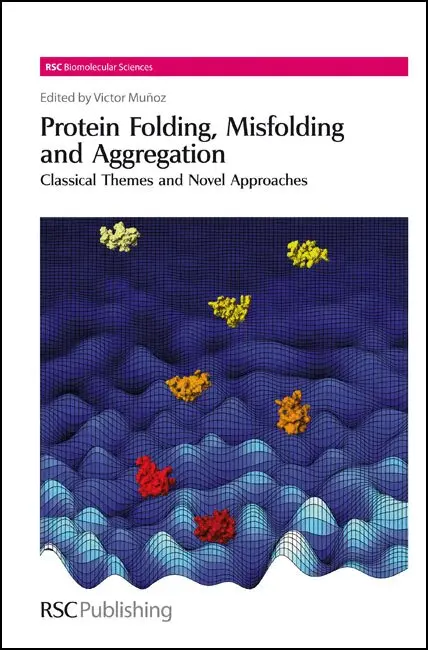
    Protein Folding, Misfolding and Aggregation

    Classical Themes and Novel Approaches

    AvVictor Muñoz

    Inbunden, Engelska, 2008

    Del i serien RSC Biomolecular Sciences

    2 375 kr

    Beställningsvara. Skickas inom 5-8 vardagar. Fri frakt över 249 kr.

    Beskrivning

    Protein folding and aggregation is the process by which newly synthesized proteins fold into the specific three-dimensional structures defining their biologically active states. It has always been a major focus of research in biochemistry and has often been seen as the unsolved second part of the genetic code. In the last 10 years we have witnessed a quantum leap in the research in this exciting area. Computational methods have improved to the extent of making possible to simulate the complete folding process of small proteins and the early stages of protein aggregation. Experimental methods have evolved to permit resolving fast processes of folding reactions and visualizing single molecules during folding. The findings from these novel experiments and detailed computer simulations have confirmed the main predictions of analytical theory of protein folding. In summary, protein folding research has finally acquired the status of a truly quantitative science, paving the way for more exciting developments in the near future. This unique book covers all the modern approaches and the many advances experienced in the field during the last 10 years. There is also much emphasis on computational methods and studies of protein aggregation which have really flourished in the last decade. It includes chapters in the areas that have witnessed major developments and are written by top experts including:computer simulations of folding, fast folding, single molecule spectroscopy, protein design, aggregation studies (both computational and experimental). Readers will obtain a unique perspective of the problems faced in the biophysical study of protein conformational behaviour in aqueous solution and how these problems are being solved with a multidisciplinary approach that combines theory, experiment and computer simulations. Protein Folding, Misfolding and Aggregation Classical Themes and Novel Approaches is essential reading for graduate students actively involved in protein folding research, other scientists interested in the recent progress of the field and instructors revamping the protein folding section of their biochemistry and biophysics courses.

    Produktinformation

    • Utgivningsdatum:2008-06-24
    • Mått:156 x 234 x 22 mm
    • Vikt:743 g
    • Format:Inbunden
    • Språk:Engelska
    • Serie:RSC Biomolecular Sciences
    • Antal sidor:288
    • Förlag:Royal Society of Chemistry
    • ISBN:9780854042579

    Utforska kategorier

    • Biokemi inom Naturvetenskap och teknik
    • Analytisk kemi inom Naturvetenskap och teknik
    • Fysikalisk kemi inom Naturvetenskap och teknik

    Mer om författaren

    Victor Mu±oz is Associate Professor in Chemistry and Biochemistry at the University of Maryland, USA and Research Professor in Biophysics at the Spanish Research Council (CSIC), Madrid, Spain. He has worked in the area of protein folding and aggregation for the last 16 years and for the last 7 years he has been involved in promoting a change from the classical biochemical to a physical paradigm in experimental protein folding.

    Recensioner i media

    "As a whole, the book is strongly focused on current conceptual and theoretical thinking of protein folding.""...it will appeal more to academic scientists involved in fundamental studies."

    Innehållsförteckning

    • Preface: Classical Themes and Novel Approaches in Protein Folding and Aggregation;Chapter 1: The Helix as the Simplest Protein Folding Model;Helix-Coil Theory, Stability and Design;Chapter 2: Kinetics and Mechanisms of -Helix Formation;Chapter 3: Protein Folding Theory;The Folding Energy Landscape: A Primer;Chapter 4: Hydrogen Exchange Experiments;Detection and Characterization of Folding Intermediates;Chapter 5: Statistical Differential Scanning Calorimetry;Probing Protein Folding-Unfolding Ensembles;Chapter 6: Fast Protein Folding;Chapter 7: Single Molecule Spectroscopy in Protein Folding;From Ensembles to Single Molecules;Chapter 8: Computer Simulations of Protein Folding;Chapter 9: Protein Design;Tailoring Sequence, Structure and Folding Properties;Chapter 10: Protein Misfolding and -Amyloid Formation;Chapter 11: Computational Studies of Protein Aggregation;Molecular Dynamics Simulations and Bioinformatic Analysis of Scenarios for Protein Aggregation