• Fri frakt över 249 kr
  • •
  • Snabba leveranser
  • •
  • Billiga böcker
Kundservice

Du är på sajten för privatpersoner.

Företag, bibliotek eller offentlig verksamhet?

Du handlar på classic.bokus.com, där alla dina funktioner finns intakta.
Till classic.bokus.com
Bokus logotyp. Gå till startsidan.
  • Erbjudanden
  • Nyheter
  • Student
  • Topplistor
  • Barn & ungdom
  • Bokus Play
  • E-böcker
  • Pocketböcker
  • Spel & pussel

10% rabatt på allt med kod: NYSTART10 →

Sidfot

Mina sidor

    Hjälp

    • Kundservice
    • Vanliga frågor och svar
    • Frakt och leverans
    • Retur vid ångerrätt
    • Reklamera vara
    • Betalning
    • Köpvillkor
    • Allmänna villkor
    • Information om webbplatsens tillgänglighet

    Om Bokus

    • Om oss
    • Pressrum
    • För studenter
    • För företag
    • För bibliotek och offentlig verksamhet
    • För leverantörer
    • Hållbarhet

    Populärt

    • Aktuella erbjudanden
    • Presentkort
    • Studentlitteratur
    • Nya böcker
    • Topplistor
    • Signerade böcker
    • Engelska böcker

    Inspiration

    • Boktips
    • BookTok
    • Populära bokserier
    • Barnbokskaraktärer
    • Populära författare
    Logotyp för Bokus
    Följ oss på Facebook (extern länk)Följ oss på Instagram (extern länk)Följ oss på YouTube (extern länk)Följ oss på TikTok (extern länk)
    bokus @ CookiesAnpassa cookiesIntegritetspolicyKöpvillkor
    Till Citymail hemsida (extern länk)Till Budbee hemsida (extern länk)Till Postnord hemsida (extern länk)Till Schenker hemsida (extern länk)Till Early Bird hemsida (extern länk)Till Walleys hemsida (extern länk)
    1. Historia och arkeologi
    2. Historia
    3. Historia: särskilda händelser och ämnen
    4. Socialhistoria och kulturhistoria

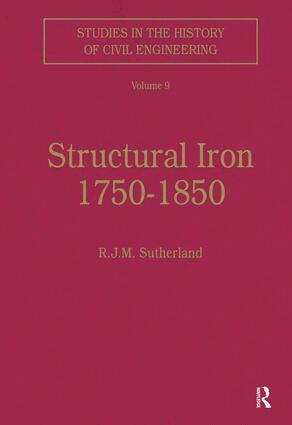
    Structural Iron 1750–1850

    AvR.J.M. Sutherland

    Inbunden, Engelska, 1998

    Del i serien Studies in the History of Civil Engineering

    3 765 kr

    Beställningsvara. Skickas inom 10-15 vardagar. Fri frakt över 249 kr.

    Beskrivning

    This book deals with the period when iron became the dominant ’high-technology’ material, increasingly taking over from timber and masonry. It was necessary for the engines and machines of the new industries, but equally vital for the vast civil engineering works which supported this industrialisation. It was these works - mills, warehouses, dockyards, and above all bridges - which so impressed the public in the early 19th century. The papers selected here trace the evolving structural uses of cast and wrought iron in frames and roofs for buildings, and look in particular at the development of bridge design and construction, in America, France, and Russia, as well as in Britain. They cover the processes of design and testing, and at the same time throw much light on the attitudes and careers of the engineers themselves.

    Produktinformation

    • Utgivningsdatum:1998-01-28
    • Mått:169 x 244 x 31 mm
    • Vikt:907 g
    • Format:Inbunden
    • Språk:Engelska
    • Serie:Studies in the History of Civil Engineering
    • Antal sidor:424
    • Förlag:Taylor & Francis Ltd
    • ISBN:9780860787587

    Utforska kategorier

    • Socialhistoria och kulturhistoria inom Historia och arkeologi
    • Teknik: allmänt inom Naturvetenskap och teknik
    • Byggnadsteknik inom Naturvetenskap och teknik

    Mer om författaren

    R.J.M. Sutherland, Fellow of the Royal Academy of Engineering and Past President of the Newcomen Society S.B. Hamilton, A. W. Skempton, H.R. Johnson, R.S. Fitzgerald, R.J.M. Sutherland, E.J. Diestelkamp, S.J Fedorov, E.L. Kemp, T. Day, A. Picon, B. Trinder, D.A. Gasparini, C. Provost, D. Smith, J.G. James.

    Recensioner i media

    '[Sutherland’s]...pedigree as editor of such a volume is therefore beyond dispute...he brings magisterial authority to the volume’s Introduction....this volume [is]...to be very much welcomed by industrial archaeologists for focusing attention on the wealth of published material on subjects crucial to our understanding of the engineering infrastructure of modern society and for making the material so easily accessible....' Industrial Archaeology Review, Vol. XXI, No. 1 'The aim of Ashgate's twelve volume series is to bring together collections of important papers on particular topics from scholarly journals, conference proceedings and other hard-to-access sources. This is a wholly laudable objective. Some of the papers in the volume under review [The Civil Engineering of Canals and Railways before 1850] cannot be found even in abundantly-resourced academic libraries. The series opens up, directly or indirectly, debates over the nature of historical evidence which arise from the profoundly different approaches to the past of historians of technology, whose works are principally represented in these volumes, industrial archaeologists and social and economic historians.' Industrial Archaeology Review, Vol. XXI, No. 1

    Innehållsförteckning

    • Contents: The use of cast iron in building, S.B. Hamilton; The first iron frames, A. W. Skempton and H.R. Johnson; The development of the cast iron frame in textile mills to 1850, R.S. Fitzgerald; The age of cast iron 1780-1850: who sized the beams?, R.J.M. Sutherland; Richard Turner and the Palm House at Kew Gardens, E.J. Diestelkamp; Matthew Clark and the origins of Russian structural engineering 1810-40s: an introductory biography, S.J Fedorov; Shipbuilding and the long span roof, R.J. M. Sutherland; James Finley and the modern suspension bridge, E.L. Kemp; Samuel Brown: his influence on the design of suspension bridges, T. Day; Navier and the introduction of suspension bridges in France, A. Picon; Ellet’s contribution to the development of suspension bridges, E.L. Kemp; The first iron bridges, B. Trinder; Early 19th-century developments in truss design in Britain, France and the United States, D.A. Gasparini and C. Provost; The introduction of structural wrought iron, R.J.M. Sutherland; Structural model testing and the design of British railway bridges in the 19th century, D. Smith; The evolution of iron bridge trusses to 1850; J.G. James; Russian iron bridges to 1850, J.G. James; Index.