• Fri frakt över 249 kr
  • •
  • Snabba leveranser
  • •
  • Billiga böcker
Kundservice

Du är på sajten för privatpersoner.

Företag, bibliotek eller offentlig verksamhet?

Du handlar på classic.bokus.com, där alla dina funktioner finns intakta.
Till classic.bokus.com
Bokus logotyp. Gå till startsidan.
  • Erbjudanden
  • Student
  • Topplistor
  • Barn & ungdom
  • Bokus Play
  • E-böcker
  • Ljudböcker
  • Pocketböcker
  • Spel och pussel

Pocketfynda! Hundratals böcker för 49 kr/st →

Sidfot

Mina sidor

    Hjälp

    • Kundservice
    • Vanliga frågor och svar
    • Frakt och leverans
    • Retur vid ångerrätt
    • Reklamera vara
    • Betalning
    • Köpvillkor
    • Allmänna villkor
    • Information om webbplatsens tillgänglighet

    Om Bokus

    • Om oss
    • Pressrum
    • För studenter
    • För företag
    • För bibliotek och offentlig verksamhet
    • För leverantörer
    • Hållbarhet

    Populärt

    • Aktuella erbjudanden
    • Presentkort
    • Studentlitteratur
    • Nya böcker
    • Topplistor
    • Signerade böcker
    • Engelska böcker

    Inspiration

    • Boktips
    • BookTok
    • Barnbokskaraktärer
    • Populära författare
    Logotyp för Bokus
    Följ oss på Facebook (extern länk)Följ oss på Instagram (extern länk)Följ oss på YouTube (extern länk)Följ oss på TikTok (extern länk)
    bokus @ CookiesAnpassa cookiesIntegritetspolicyKöpvillkor
    Till Citymail hemsida (extern länk)Till Budbee hemsida (extern länk)Till Postnord hemsida (extern länk)Till Schenker hemsida (extern länk)Till Early Bird hemsida (extern länk)Till Walleys hemsida (extern länk)
    1. Filosofi och religion
    2. Filosofi
    3. Filosofiska discipliner

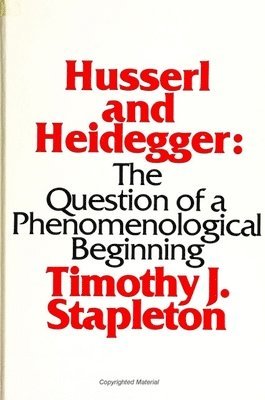
    Husserl and Heidegger

    The Question of a Phenomenological Beginning

    AvTimothy J. Stapleton

    Häftad, Engelska, 1984

    Del i serien SUNY series in Philosophy

    382 kr

    Tillfälligt slut

    Fler format och utgåvor

    Inbunden

    Tillf. slut

    Beskrivning

    The phenomenology of Edmund Husserl has decisively influenced much of contemporary philosophy. Yet Husserl's philosophy has come under such criticism that today it is viewed as little more than a historical relic. One of the most important and influential critiques of Husserl's transcendental phenomenology was launched by Martin Heidegger in Being and Time, which radically reinterpreted phenomenology.Timothy Stapleton returns to the origin of phenomenology to provide a clear, concise perspective on where it has been and on where it ought to be heading. This book is a careful reexamination of the internal development of Husserl's thought as well as of the ways in which Heidegger used and transformed the phenomenological method. It begins with an interpretation of the "transcendental" dimension of Husserl's philosophy, stressing the importance of the ontological rather than the epistemological problematic in determining the unfolding of Husserlian thought. The work progresses to an account of Heidegger's early works, viewed as a radicalization of Husserl's phenomenology both in name and substance. Stapleton concludes by contrasting a transcendental origin with a hermeneutic beginning point in terms of their respective ideals of intelligibility, meaning, and being; and then looks at some of the consequences of the idea of a hermeneutic philosophy.

    Produktinformation

    • Utgivningsdatum:1984-06-30
    • Mått:148 x 226 x 12 mm
    • Vikt:227 g
    • Format:Häftad
    • Språk:Engelska
    • Serie:SUNY series in Philosophy
    • Antal sidor:160
    • Förlag:State University of New York Press
    • ISBN:9780873957458

    Utforska kategorier

    • Filosofiska discipliner inom Filosofi och religion

    Mer om författaren

    Timothy J. Stapleton is Assistant Professor of Philosophy at Loyola College in Maryland.

    Innehållsförteckning

    • Acknowledgments Introduction: The Nature of the Problem Chapter 1. Absolute Consciousness in Ideas I The Prephilosophical and Philosophical AttitudesThe Problem of the ReductionThe Way to the Reduction in Ideas IThe Absolute of Consciousness2. Philosophical Science and the Idea of Evidence That Which Makes a Beginning PossibleThe Question of the BeginningThe Beginning of Philosophy3. Toward a Logic of the Transcendental Reduction The Concept of FoundationTranscendental Subjectivity as Absolute ConcretumThing, World, and Transcendental SubjectivityMotives for the Transcendental Turn4. Transcendental Subjectivity and Being-in-the-World IntentionalityThe "Subjective" Turn in Husserl and HeideggerPosing the Question of BeingTranscendence and World5. Phenomenological Beginnings A SummaryA Transcendental or Hermeneutic Beginning?Notes Selected Bibliography Index