• Fri frakt över 249 kr
  • •
  • Snabba leveranser
  • •
  • Billiga böcker
Kundservice

Du är på sajten för privatpersoner.

Företag, bibliotek eller offentlig verksamhet?

Du handlar på classic.bokus.com, där alla dina funktioner finns intakta.
Till classic.bokus.com
Bokus logotyp. Gå till startsidan.
  • Erbjudanden
  • Nyheter
  • Student
  • Topplistor
  • Barn & ungdom
  • Bokus Play
  • E-böcker
  • Pocketböcker
  • Spel & pussel

10% studentrabatt med kod TERM26

Sidfot

Mina sidor

    Hjälp

    • Kundservice
    • Vanliga frågor och svar
    • Frakt och leverans
    • Retur vid ångerrätt
    • Reklamera vara
    • Betalning
    • Köpvillkor
    • Allmänna villkor
    • Information om webbplatsens tillgänglighet

    Om Bokus

    • Om oss
    • Pressrum
    • För studenter
    • För företag
    • För bibliotek och offentlig verksamhet
    • För leverantörer
    • Hållbarhet

    Populärt

    • Aktuella erbjudanden
    • Presentkort
    • Studentlitteratur
    • Nya böcker
    • Topplistor
    • Signerade böcker
    • Engelska böcker

    Inspiration

    • Boktips
    • BookTok
    • Populära bokserier
    • Barnbokskaraktärer
    • Populära författare
    Logotyp för Bokus
    Följ oss på Facebook (extern länk)Följ oss på Instagram (extern länk)Följ oss på YouTube (extern länk)Följ oss på TikTok (extern länk)
    bokus @ CookiesAnpassa cookiesIntegritetspolicyKöpvillkor
    Till Citymail hemsida (extern länk)Till Budbee hemsida (extern länk)Till Postnord hemsida (extern länk)Till Schenker hemsida (extern länk)Till Early Bird hemsida (extern länk)Till Walleys hemsida (extern länk)
    1. Filosofi och religion
    2. Filosofi
    3. Filosofiska discipliner

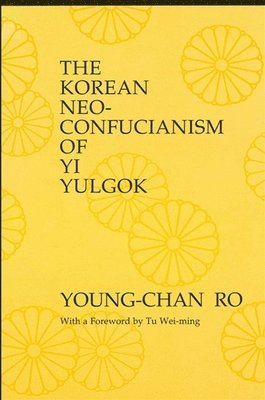
    Korean Neo-Confucianism of Yi Yulgok

    AvYoung-chan Ro

    Häftad, Engelska, 1988

    Del i serien SUNY series in Philosophy

    382 kr

    Tillfälligt slut

    Fler format och utgåvor

    Inbunden

    Tillf. slut

    Beskrivning

    This book explores the philosophical and religious dimensions of Korean Neo-Confuciansim as expounded by one of the foremost Korean Neo-Confucian thinkers, Yi Yulgok (1536-1584). Yulgok's creative interpretations reformulate some fundamental issues of Confucian philosophy. This book explores the significance of the fundamental assumption which underlies the entire system of Yulgok's Confucian thought. That philosophical assumption is characterized by the author as 'non-dualistic' and 'anthropocosmic'.It is a unique aspect of Korean Neo-Confucianism which leads to a new way of understanding the Confucian world view and spirituality. This 'non-dualistic' vision sheds a new and critical light on the dialectical framework of thinking at work in Western formulations of understanding the ultimate reality, nature, the universe, and human being. The 'anthropocosmic' vision in this respect will challenge fundamental assumptions of Western theological formulation and suggest a new understanding of human nature and the universe.A 'non-dualistic' and 'anthropocosmic' interpretation of Yulgok's thought is a fruitful way of approaching the Korean way of thinking and of coming to grips with one Neo-Confucian mode of attaining human self-understanding.

    Produktinformation

    • Utgivningsdatum:1988-07-01
    • Mått:153 x 229 x 8 mm
    • Vikt:245 g
    • Format:Häftad
    • Språk:Engelska
    • Serie:SUNY series in Philosophy
    • Antal sidor:154
    • Förlag:State University of New York Press
    • ISBN:9780887066566

    Utforska kategorier

    • Filosofiska discipliner inom Filosofi och religion

    Mer om författaren

    Young-chan Ro is Assistant Professor of Religious Studies at George Mason University.

    Recensioner i media

    "The book is clearly, concisely written and discusses complex ideas in an approachable manner. It gives a comprehensive introduction to all major points of Yulgok's thought, placing him within the context of the Neo-Confucian tradition as a whole, as well as his contemporary Korean philosophical environment, while adding an interesting critique from the Western philosophical perspective, based on the work of Heidegger and Gadamer. It also includes much cogent background information on the basics of Neo-Confucianism to assist the general reader." — Sung Bae Park

    Innehållsförteckning

    • ForewordPrefaceIntroduction1. The Tradition2. The Person3. The Scope and ApproachOne. Yulgok and the Neo-Confucian Cosmology and Ontology1. The Neo-Confucian Understanding of T'ai-chi (the Great Ultimate)2. The Cosmological Implication of T'ai-chi3. The Ontological Implication of T'ai-chi4. Chu Hsi's 'Cosmo-Ontological' Development of T'ai-chi5. The Non-dualistic nature of the Cosmo-Ontological T'ai-chi6. Yulgok's Anthropocosmic VisionTwo. Yulgok's Understanding of 'Human Nature' (hsing) and 'Mind' (hsin): Yulgok's Anthropology1. The Underlying Unity of "Cosmo-Ontology" and Anthropology2. The Problem of the Study of the Mind3. Yulgok and the Neo-Confucian Anthropologya. The Basic Cosmo-Ontological Unity of Man and the Universe in Chu Hsib. Chu Hsi's Understanding of the Mind4. The Discussion of the Mind and Yulgok's Anthropology5. Yulgok's Phenomenology of the Mind6. Yulgok's Analysis of the Feelings (ch'ing) and the Minda. Non-Duality of "Four Beginnings" and "Seven Feelings"b. The Relationship of Tao-hsin and Jen-hsinc. The Ontological Unity of the Feelings: the 'Four Beginnings' and the 'Seven Feelings'7. The Ontology of the Mind8. Yulgok's Synthesis of Ontology and Phenomenology in His Theory of MindThree. Ch'eng, (Song, Sincerity)1. Ch'eng in The Doctrine of the Mean (the Chung-yung)2. Ch'eng in The Great Learning (The Ta-Hsueh)3. Yulgok's Understanding of 'Sincerity' (Ch'eng)a. Ch'eng as the Foundation of Epistemologyb. The Function of Ch'eng4. Ch'eng as the Medium of Cosmic and Moral Forcea. Ch'eng and 'Reality' in a Comparative Context5. Sagehood and Ch'eng6. Ch'eng and Establishing the Will7. The Language of Ch'eng8. Ch'eng (Song, Sincere Reality) and Yulgok's PragmatismConclusionAppendix: Yulgok's Pragmatism: Political and Economic ThoughtGlossary of Chinese and Korean WordsSelected BibliographyNotesIndex