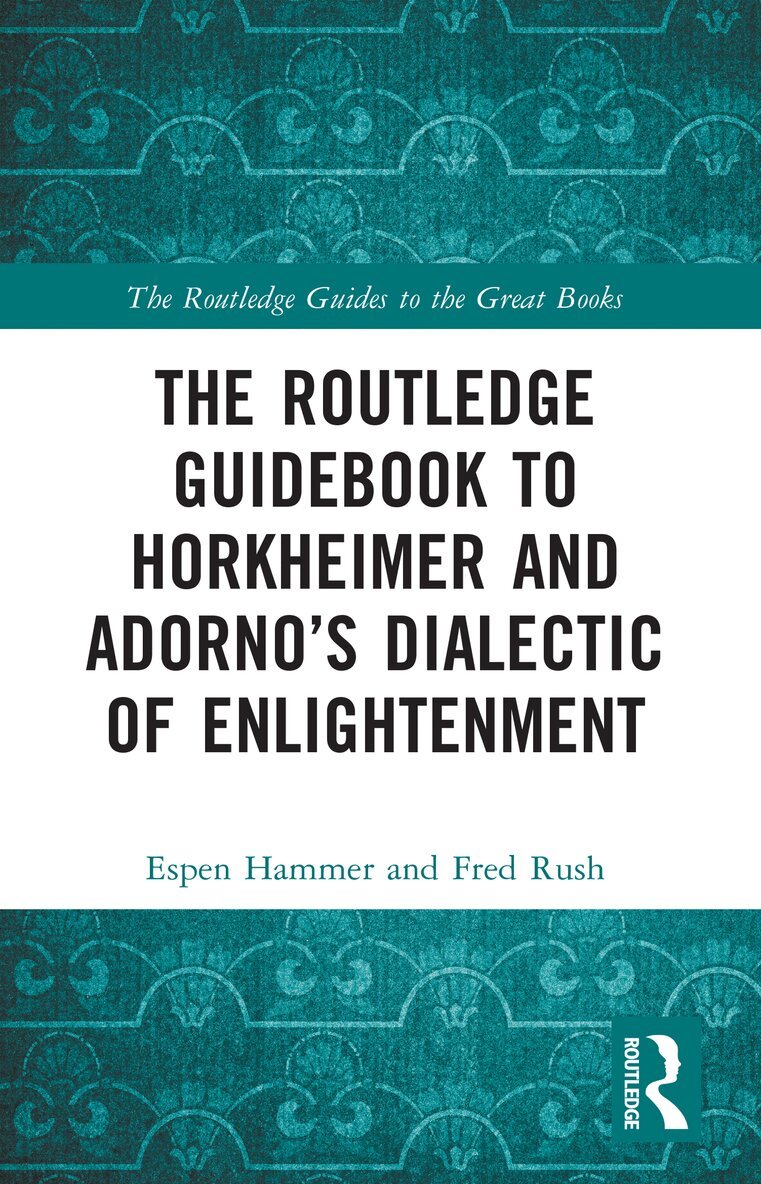
Häftad, Engelska, 2025
Routledge Guidebook to Horkheimer and Adorno’s Dialectic of Enlightenment
Del i serien Routledge Guides to the Great Books
428 kr
Beställningsvara. Skickas inom 10-15 vardagar. Fri frakt över 249 kr.
Beskrivning
Produktinformation
- Utgivningsdatum: 2025-10-27
- Mått: 129 x 198 x 18 mm
- Vikt: 480 g
- Format: Häftad
- Språk: Engelska
- Serie: Routledge Guides to the Great Books
- Antal sidor: 252
- Förlag: Taylor & Francis Ltd
- ISBN: 9781032048901
Utforska kategorier
Mer om författaren
Espen Hammer is Professor of Philosophy at Temple University, USA. He is the author of Stanley Cavell: Skepticism, Subjectivity, and the Ordinary (2002), Adorno and the Political (Routledge, 2006), Philosophy and Temporality from Kant to Critical Theory (2011), Adorno’s Modernism: Art, Experience, and Catastrophe (2015), and After the Death of God: Secularization as a Philosophical Challenge from Kant to Nietzsche (2025). He edited German Idealism (Routledge, 2007), Theodor W. Adorno II (Routledge, 2015), and Kafka’s The Trial (2019), and co-edited The Routledge Companion to the Frankfurt School (2019) and A Companion to Adorno (2020).Fred Rush is Professor of Philosophy at the University of Notre Dame, USA. He is the author of On Architecture (Routledge, 2009) and Irony and Idealism (2016). He edited The Cambridge Companion to Critical Theory (2004) and co-edited Philosophy of Sculpture: Historical Problems, Contemporary Approaches (Routledge, 2020).
Recensioner i media
'In their commentary on Dialectic of Enlightenment, Hammer and Rush achieve the almost impossible: they explain its intellectual context and the individual sources from which it draws in such an unmistakably clear manner that the line of argument and the historical-philosophical substance of the individual chapters become almost completely comprehensible for the first time. For anyone who wants to grasp the dark timelessness of this book today, this commentary is essential reading.' - Axel Honneth, Columbia University, USA'Presents the background and main steps of Horkheimer’s and Adorno’s seminal work masterfully, succinctly exposing and evaluating its controversial features. Precisely because these highly controversial considerations of the Dialectic account for its undiminished topicality, this Guidebook is the ideal aid for anyone who exposes themselves to its claims and attempts to think with it.' - Christoph Menke, Goethe Universität Frankfurt am Main, Germany'In this impressive work of patient reconstruction Hammer and Rush – two of the field’s leading scholars – have made a remarkable contribution to elucidating Dialectic of Enlightenment’s key ideas whilst, at the same time, insightfully drawing attention to a range of philosophical, political, and contextual ideas previously neglected in the literature.' - Brian O’Connor, University College Dublin, Ireland'Hammer and Rush have produced an exceptionally clear and accessible guide to the most important text of the Frankfurt School critical theory tradition. It not only situates the Dialectic of Enlightenment in its intellectual and historical context, guiding readers through each of its chapters and core concepts, but also equips them to grasp the enduring significance of its central thesis: that what we take to be progress, guided by reason, contains regressive, barbaric, and even self-destructive tendencies.' - Kyla Bruff, Carleton University, Canada'Students are often keen to study Dialectic of Enlightenment, but find it tough-going. This book is an excellent aid in unriddling the context, structure, and goals of the Dialectic. Scholars will find it is equally well suited for the purpose of getting acquainted with the deeper features of the Dialectic, and as a teaching aid in discussing it with others.' - Owen Hulatt, University of York, UK
Betyg & recensioner
0 recensioner
Inga recensioner tillgängliga.