• Fri frakt över 249 kr
  • •
  • Snabba leveranser
  • •
  • Billiga böcker
Kundservice

Du är på sajten för privatpersoner.

Företag, bibliotek eller offentlig verksamhet?

Du handlar på classic.bokus.com, där alla dina funktioner finns intakta.
Till classic.bokus.com
Bokus logotyp. Gå till startsidan.
  • Erbjudanden
  • Nyheter
  • Student
  • Topplistor
  • Barn & ungdom
  • Bokus Play
  • E-böcker
  • Pocketböcker
  • Spel & pussel

10% rabatt på allt med kod NYSTART10 →

Sidfot

Mina sidor

    Hjälp

    • Kundservice
    • Vanliga frågor och svar
    • Frakt och leverans
    • Retur vid ångerrätt
    • Reklamera vara
    • Betalning
    • Köpvillkor
    • Allmänna villkor
    • Information om webbplatsens tillgänglighet

    Om Bokus

    • Om oss
    • Pressrum
    • För studenter
    • För företag
    • För bibliotek och offentlig verksamhet
    • För leverantörer
    • Hållbarhet

    Populärt

    • Aktuella erbjudanden
    • Presentkort
    • Studentlitteratur
    • Nya böcker
    • Topplistor
    • Signerade böcker
    • Engelska böcker

    Inspiration

    • Boktips
    • BookTok
    • Populära bokserier
    • Barnbokskaraktärer
    • Populära författare
    Logotyp för Bokus
    Följ oss på Facebook (extern länk)Följ oss på Instagram (extern länk)Följ oss på YouTube (extern länk)Följ oss på TikTok (extern länk)
    bokus @ CookiesAnpassa cookiesIntegritetspolicyKöpvillkor
    Till Citymail hemsida (extern länk)Till Budbee hemsida (extern länk)Till Postnord hemsida (extern länk)Till Schenker hemsida (extern länk)Till Early Bird hemsida (extern länk)Till Walleys hemsida (extern länk)
    1. Naturvetenskap och teknik
    2. Matematik och naturvetenskap
    3. Matematik
    4. Matematisk statistik

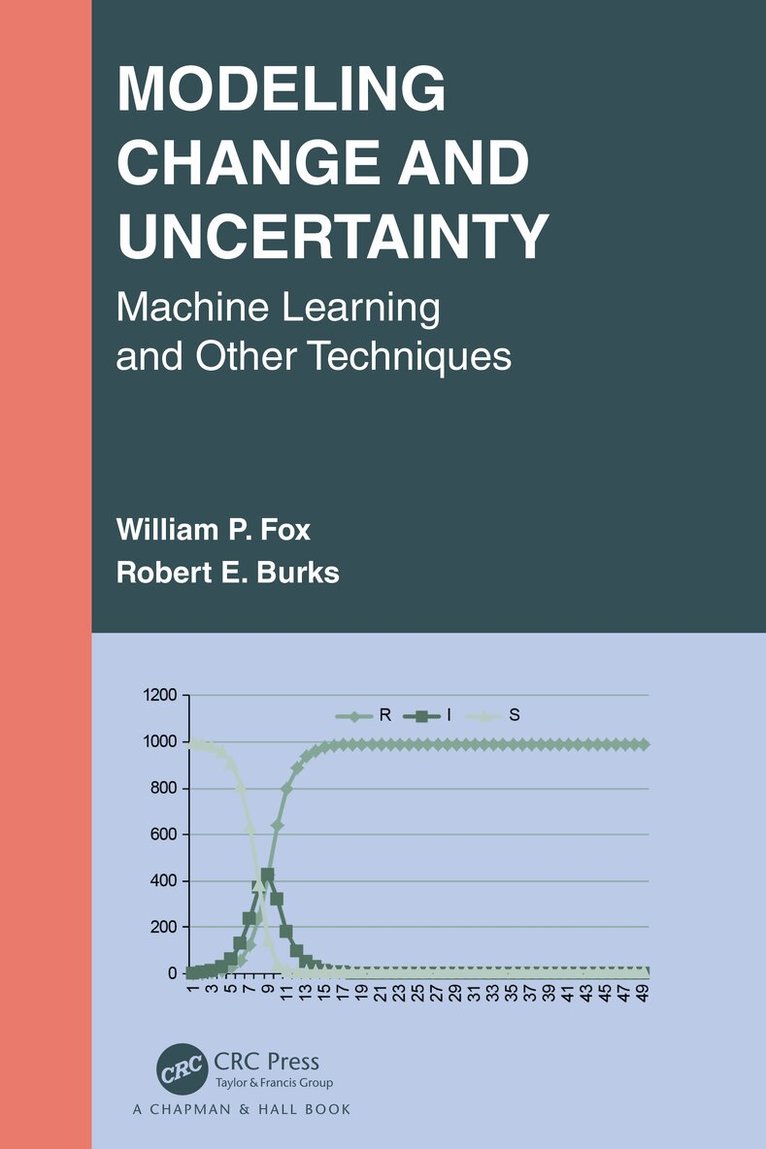
    Modeling Change and Uncertainty

    Machine Learning and Other Techniques

    AvWilliam P. Fox,Robert E. Burks

    Inbunden, Engelska, 2022

    Del i serien Textbooks in Mathematics

    1 467 kr

    Beställningsvara. Skickas inom 10-15 vardagar. Fri frakt över 249 kr.

    Fler format och utgåvor

    Häftad

    892 kr

    Beskrivning

    Mathematical modeling is a powerful craft that requires practice. The more practice the better one will become in executing the art. The authors wrote this book to develop the craft of mathematical modeling and to foster a desire for lifelong learning, habits of mind and develop competent and confident problem solvers and decision makers for the 21st century. This book offers a problem-solving approach. The authors introduce a problem to help motivate the learning of a particular mathematical modeling topic. The problem provides the issue or what is needed to solve using an appropriate modeling technique. Then principles are applied to the problem and present the steps in obtaining an appropriate model to solve the problem. Modeling Change and Uncertainty: Covers both linear and nonlinear models of discrete dynamical systems. Introduces statistics and probability modeling. Introduces critical statistical concepts to handle univariate and multivariate data. Establishes a foundation in probability modeling. Uses ordinary differential equations (ODEs) to develop a more robust solution to problems. Uses linear programming and machine learning to support decision making. Introduces the reality of uncertainty and randomness that is all around us. Discusses the use of linear programing to solve common problems in modern industry. Discusses he power and limitations of simulations.Introduces the methods and formulas used in businesses and financial organizations. Introduces valuable techniques using Excel, MAPLE, and R. Mathematical modeling offers a framework for decision makers in all fields. This framework consists of four key components: the formulation process, the solution process, interpretation of the solution in the context of the actual problem, and sensitivity analysis.Modeling Change and Uncertainty will be of interest to mathematics departments offering advanced mathematical modeling courses focused on decision making or discrete mathematical modeling and by undergraduate, graduate students and practitioners looking for an opportunity to develop, practice, and apply the craft of mathematical modeling.

    Produktinformation

    • Utgivningsdatum:2022-07-20
    • Mått:156 x 234 x 29 mm
    • Vikt:1 020 g
    • Format:Inbunden
    • Språk:Engelska
    • Serie:Textbooks in Mathematics
    • Antal sidor:446
    • Förlag:Taylor & Francis Ltd
    • ISBN:9781032062372

    Utforska kategorier

    • Matematisk statistik inom Naturvetenskap och teknik
    • Tillämpad matematik inom Naturvetenskap och teknik
    • Systemvetenskap och AI inom Data och IT

    Mer om författaren

    Dr. William P. Fox is currently a visiting professor of Computational Operations Research at the College of William and Mary. He is an emeritus professor in the Department of Defense Analysis at the Naval Postgraduate School and teaches a three-course sequence in mathematical modeling for decision making. He received his Ph.D. in Industrial Engineering from Clemson University. He has taught at the United States Military Academy for twelve years until retiring and at Francis Marion University where he was the chair of mathematics for eight years. He has many publications and scholarly activities including twenty plus books and one hundred and fifty journal articles.Colonel (R) Robert E. Burks, Jr., Ph.D. is an Associate Professor in the Defense Analysis Department of the Naval Postgraduate School (NPS) and the Director of the NPS’ Wargaming Center. He holds a Ph.D. in Operations Research from the Air Force Institute of Technology. He is a retired logistics Army Colonel with more than thirty years of military experience in leadership, advanced analytics, decision modeling, and logistics operations who served as an Army Operations Research analyst at the Naval Postgraduate School, TRADOC Analysis Center, United States Military Academy, and the United States Army Recruiting Command.Other book by William P. Fox and Robert E. Burks: Advanced Mathematical Modeling with Technology, 2021, CRC Press.Other books by William P. Fox from CRC Press: Mathematical Modeling in the Age of the Pandemic, 2021, CRC Press.Advanced Problem Solving Using Maple: Applied Mathematics, Operations Research, Business Analytics, and Decision Analysis (w/William Bauldry), 2020, CRC Press.Mathematical Modeling with Excel (w/Brian Albright), 2020, CRC Press.Nonlinear Optimization: Models and Applications, 2020, CRC Press.Advanced Problem Solving with Maple: A First Course (w/William Bauldry), 2019. CRC Press.Mathematical Modeling for Business Analytics, 2018, CRC Press.

    Innehållsförteckning

    • 1. Perfect Partners: Combining Models of Change and Uncertainty with Technology. 1.1. Overview of the Process of Mathematical Modeling. 1.2. The Modeling Process. 1.3. Illustrative Examples. 1.4. Technology. 1.5. Exercises. 1.6. Projects. 1.7. References and Suggested Further Reading. 2. Modeling Change: Discrete Dynamical Systems (DDS) and Modeling Systems of DDS. 2.1. Introduction and Review of Modeling with Discrete Dynamical Systems. 2.2. Equilibrium and Stability Values and Long-Term Behavior. 2.3. Introduction to Systems of Discrete Dynamical Systems. 2.4. Iteration and Graphical Solution. 2.5. Modeling of Predator–prey Model, SIR Model, and Military Models. 2.6. Technology Examples for Discrete Dynamical Systems. 2.7. Exercises. 2.8. Projects. 2.9. References. 3. Statistical and Probabilistic Models. 3.1. Introduction. 3.2. Understanding Univariate & Multivariate Data. 3.3. Displays of Data and Statistics. 3.4. Statistical Measures. 3.5. Exercises. 3.6. References. 4. Modeling with Probability. 4.1. Classical Probability. 4.2. Bayes’ Theorem. 4.3. Discrete Distributions in Modeling. 4.4. Continuous Probability Models. 4.5. Confidence Intervals and Hypothesis Testing. 4.6. Exercises. 4.7. References. 5. Differential Equations. 5.1. Introduction. 5.1. Qualitative Assessment of Autonomous Systems of First Order Differential Equations. 5.2. Solving Homogeneous and Non-Homogeneous Systems. 5.3. Technology Examples for Systems of Ordinary Differential Equations. 5.4. Exercises. 5.5. Projects. 5.6. References and Suggested Future Readings. 6. Forecasting with Linear Programming and Machine Learning. 6.1. Introduction to Forecasting. 6.2. Machine Learning. 6.3. Model Fitting. 6.4. Time Series Models. 6.5. Case Studies of Time Series Data. 6.6. Summary and Conclusions. 6.7. References and Suggested Readings. 7. Stochastic Models and Markov Chains. 7.1. Introduction. 7.2. Transition Matrices. 7.3. Markov Chains and Bayes’ Theorem. 7.4. Markov Processes. 7.5. Exercises. 7.6. References. 8. Linear Programming. 8.1. Introduction. 8.2. Formulating Linear Programming Problems. 8.3. Technology Examples for Linear Programming. 8.4. Transportation and Assignment Problems. 8.5. Case Studies in Linear Programming. 8.6. Sensitivity Analysis in MAPLE. 8.7. Stochastic Optimization. 8.8. References. 9. Simulation of Queueing Models. 9.1. Introduction. 9.2. Queueing Model Practice Problems: Solutions. 9.3. Exercises. 9.4. References. 10. Modeling of Financial Analysis. 10.1. Introduction. 10.2. Simple and Compound Interest. 10.3. Rates of Interest, Discounting, and Depreciation. 10.4. Present Value. 10.5. Bond, Annuities, and Shrinking Funds. 10.6. Mortgages and Amortization. 10.7. Advanced Financial Models. 10.8. Exercises. 10.9. Projects. 10.10. References. 11. Reliability Models. 11.1. Introduction to Total Conflict (Zero-Sum) Games. 11.2. Modeling Component Reliability. 11.3. Modeling Series and Parallel Components. 11.4. Modeling Active Redundant Systems. 11.5. Modeling Standby Redundant Systems. 11.6. Models of Large-scale Systems. 11.7. Exercises. 11.8. References. 12. Machine Learning and Unconstrained Optimal Process. 12.1. Introduction. 12.2. The Gradient Method. 12.3. Machine Learning Regression: A Note on Complexity. 12.4. Genetic Algorithm as Machine Learning in R. 12.5. Initial Population. 12.6. Simulated Annealing. 12.7. Exercises. 12.8. References.