• Fri frakt över 249 kr
  • •
  • Snabba leveranser
  • •
  • Billiga böcker
Kundservice

Du är på sajten för privatpersoner.

Företag, bibliotek eller offentlig verksamhet?

Du handlar på classic.bokus.com, där alla dina funktioner finns intakta.
Till classic.bokus.com
Bokus logotyp. Gå till startsidan.
  • Erbjudanden
  • Nyheter
  • Student
  • Topplistor
  • Barn & ungdom
  • Bokus Play
  • E-böcker
  • Pocketböcker
  • Spel & pussel

10% rabatt på allt med kod: NYSTART10 →

Sidfot

Mina sidor

    Hjälp

    • Kundservice
    • Vanliga frågor och svar
    • Frakt och leverans
    • Retur vid ångerrätt
    • Reklamera vara
    • Betalning
    • Köpvillkor
    • Allmänna villkor
    • Information om webbplatsens tillgänglighet

    Om Bokus

    • Om oss
    • Pressrum
    • För studenter
    • För företag
    • För bibliotek och offentlig verksamhet
    • För leverantörer
    • Hållbarhet

    Populärt

    • Aktuella erbjudanden
    • Presentkort
    • Studentlitteratur
    • Nya böcker
    • Topplistor
    • Signerade böcker
    • Engelska böcker

    Inspiration

    • Boktips
    • BookTok
    • Populära bokserier
    • Barnbokskaraktärer
    • Populära författare
    Logotyp för Bokus
    Följ oss på Facebook (extern länk)Följ oss på Instagram (extern länk)Följ oss på YouTube (extern länk)Följ oss på TikTok (extern länk)
    bokus @ CookiesAnpassa cookiesIntegritetspolicyKöpvillkor
    Till Citymail hemsida (extern länk)Till Budbee hemsida (extern länk)Till Postnord hemsida (extern länk)Till Schenker hemsida (extern länk)Till Early Bird hemsida (extern länk)Till Walleys hemsida (extern länk)
    1. Data och IT
    2. Systemvetenskap och AI
    3. Artificiell intelligens
    • Nyhet

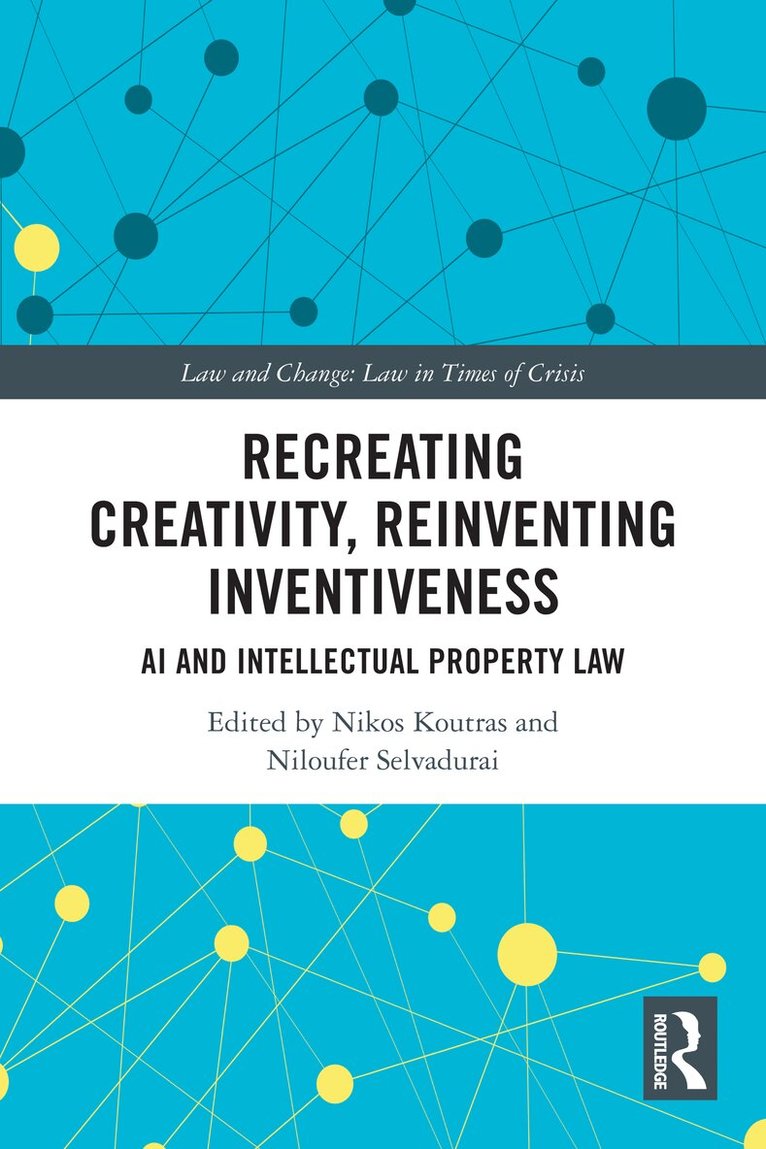
    Recreating Creativity, Reinventing Inventiveness

    AI and Intellectual Property Law

    AvNikos Koutras,Niloufer Selvadurai

    Häftad, Engelska, 2026

    Del i serien Law and Change

    626 kr

    Beställningsvara. Skickas inom 10-15 vardagar. Fri frakt över 249 kr.

    Beskrivning

    As artificial intelligence (AI) is increasingly used to generate inventions and creative works, a critical question to be addressed is whether intellectual property (IP) laws should protect such works. This book examines the critical question of whether intellectual property laws should protect works generated by artificial intelligence.If we do not wish to use IP laws to protect such works, how can we still support research, development, and innovation in society? If we do wish to use IP laws to protect such works, should the copyright, patents, and other IP rights attach to the human creator of the AI technology or the AI system? The book explores these compelling societal, economic, and legal issues. The authors evaluate the continuing relevance of existing laws, explore the divergent approaches being debated by nations around the world, and present visions for change.The book will enable both lawyers and non-lawyers to reimagine governance frameworks to create laws that equitably balance the interests of creators, investors, and end users of AI-generated works.

    Produktinformation

    • Utgivningsdatum:2026-07-20
    • Mått:156 x 234 x 12 mm
    • Vikt:380 g
    • Format:Häftad
    • Språk:Engelska
    • Serie:Law and Change
    • Antal sidor:188
    • Upplaga:26001
    • Förlag:Taylor & Francis Ltd
    • ISBN:9781032196282

    Utforska kategorier

    • Artificiell intelligens inom Data och IT
    • Immaterialrätt inom Juridik

    Mer om författaren

    Dr Nikos Koutras is a lecturer in law at Curtin University, Australia. Nikos obtained a PhD in Law from Macquarie University, Australia, in April 2018 and a PhD in Political Sciences from Ionian University, Greece, in March 2015. While undertaking his first PhD at Ionian University, he was a part-time research fellow in the School of Information and Informatics where he worked on a research project related to the open access repository of the Ionian University library and its operation framework. While undertaking his second PhD at Macquarie University, Nikos worked as a research fellow with the Macquarie School of Business and Monash University Law on a research project on the Consumers Right Directive 2011/83/EU. Since completion of his PhD in Law, Nikos has held postdoctoral positions at the Faculty of Law of University of Trento, Italy, and the Faculty of Law of the University of Antwerp, Belgium, conducting research on open science, governance, and the implications to copyright regulations in the European Union. Nikos has over ten years of experience in conducting research in the fields of policy and law. He worked as a postdoctoral researcher on copyright law and open access governance in Belgium and was a visiting professor on European Union Law for the master’s program (i.e., LLM) offered by the Faculty of Law of the University of Antwerp from 2017 to 2019.Professor Niloufer Selvadurai is a technology law scholar at Macquarie University. Niloufer researches and teaches on the effective governance of emerging and evolving technologies. She explores how technological change undermines the efficacy of laws, especially in the fields of AI and IP, and how legal frameworks can be reimagined to strengthen longevity and trust. A feature of her work is interdisciplinary collaborations with computing, engineering, and finance. Niloufer is the Director of Research and Innovation at the Macquarie Law School and a member of the cross-faculty leadership team of DataX Research Centre. Formerly, she was Deputy Dean of the Macquarie Law School. In 2022, Niloufer was the recipient of the Australian Legal Education Award for Excellence in Graduate Supervision from the Australian Law Academic Association (ALAA), and in 2021 the Executive Dean’s Award for Research Engagement. Qualifications include a BA LLB (First Class Hons) from the University of Sydney, a PhD from Macquarie University and admission as a solicitor in the Supreme Court of New South Wales.

    Innehållsförteckning

    • Part 1: Setting the Scene 1. Generative AI in Court Part 2: Context, Theory and Overarching Concepts 2. AI and Copyright: New Concepts vs. Traditional Law 3. Thaler and Contextually Sound AI Regulation 4. Digitalised Invention: An Anticipated Game Changer for the Legal Framework Part 3: Challenges of Application 5. Algorithmic Enforcement in Copyright: A Necessary Evil? 6. AI-produced Outputs in EU and International Patent Law 7. Threats to Cultural Heritage: Normative Developments on AI and Cultural Heritage Part 4: What the Future Brings 8. AI and New Technologies: What the Future Brings 9. The Protection of AI-generated Work by Patent and Copyright Laws: Present Laws and Potential Reforms